
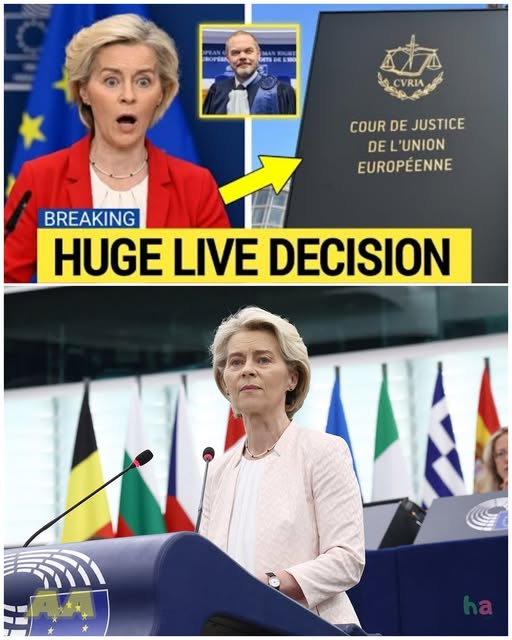
A Shockwave Through Brussels: The Court Ruling That Shook Europe’s Political Core
The political atmosphere in Brussels rarely lacks tension, but few moments have carried the intensity described in a recent viral transcript that has been circulating widely online.
According to the transcript, an extraordinary ruling by the European Court of Justice allegedly ordered the immediate resignation of European Commission President Ursula von der Leyen, citing sweeping accusations of corruption and abuse of power.
The claims, dramatic and far-reaching, depict a courtroom scene where judges delivered a verdict so severe that it reportedly sent shockwaves through European institutions within minutes.

Yet, as the narrative unfolds, it becomes clear that the story is not merely about a single political figure, but about the broader anxieties surrounding governance, accountability, and the credibility of public institutions in Europe.
The transcript outlines three major allegations, each more explosive than the last, beginning with the supposed misuse of funds from the European Union’s LIFE environmental program.
This program, designed to support climate initiatives and conservation efforts across member states, is described as having been redirected toward media campaigns aimed at discrediting critics of EU climate policy.

If true, such actions would represent not just administrative misconduct, but a fundamental breach of public trust, raising serious questions about how taxpayer money is managed at the highest levels.
The narrative then shifts to the height of the COVID-19 pandemic, a period marked by urgency, fear, and unprecedented government spending.
It claims that von der Leyen personally negotiated a massive vaccine procurement deal involving billions of doses, allegedly bypassing established procedures and relying on private communications rather than official channels.
The alleged deletion of these communications, as described in the transcript, is framed as an intentional effort to avoid scrutiny, further intensifying suspicions around transparency and accountability.
Such accusations, if substantiated, would strike at the heart of democratic governance, where transparency is not merely a principle but a necessity for legitimacy.
The third allegation reaches back to von der Leyen’s tenure as Germany’s defense minister, describing a pattern of awarding lucrative consulting contracts without proper oversight or competitive bidding.
The transcript characterizes this as a systematic approach rather than isolated incidents, suggesting a deliberate circumvention of established rules designed to prevent conflicts of interest.
Together, these claims form a narrative of institutional misconduct that, if accurate, would justify the severe consequences described.
However, it is crucial to approach such accounts with caution, especially when they originate from unverified or highly sensationalized sources.
The language used in the transcript is notably dramatic, employing phrases that emphasize shock, outrage, and inevitability, which are often hallmarks of content designed to provoke strong emotional reactions rather than provide balanced reporting.
Moreover, there is currently no confirmed evidence from credible international news organizations that such a ruling has taken place or that an immediate resignation order has been issued by the European Court of Justice.
This discrepancy highlights a growing challenge in the digital age, where information can spread rapidly across platforms without undergoing rigorous verification.
In such an environment, narratives that blend factual elements with speculation or exaggeration can gain traction quickly, shaping public perception even in the absence of confirmed facts.
The implications of this phenomenon extend beyond any single individual or institution.
They touch on the resilience of democratic systems in the face of misinformation and the responsibility of both media producers and consumers to prioritize accuracy over sensationalism.
For European leaders, the situation underscores the importance of maintaining transparency and clear communication, particularly during times of crisis or controversy.
For the public, it serves as a reminder to critically evaluate sources and seek out verified information before drawing conclusions.
The story described in the transcript may or may not reflect reality, but its impact lies in how it resonates with existing concerns about political accountability and institutional integrity.
It taps into a broader narrative of distrust that has been building in many parts of the world, where citizens increasingly question whether those in power are acting in the public interest.
In this sense, the transcript is not just a claim about a single event, but a reflection of a larger moment in global politics.
A moment where trust is fragile, scrutiny is intense, and the line between fact and speculation can become dangerously blurred.
As the situation continues to evolve, one thing remains certain: the need for careful, responsible journalism has never been greater.
Because in an era defined by information overload, the truth is not just valuable, it is essential.