
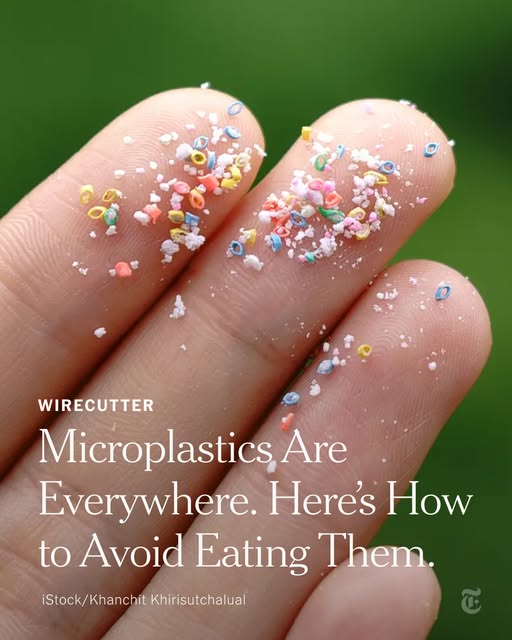
Microplastics Are Everywhere. Here’s How to Avoid Eating Them.


Katie Okamoto is an editor focusing on sustainability. She’s covered the intersections of products, environment, and health for more than a decade.
The teeny tiny pieces of plastic have been found in everything from drinking water to chicken nuggets, apples, and broccoli.
Recent studies have linked these pollutants to heart disease, lung disorders, and more worrying health issues.
But unfortunately, microplastics are now so pervasive that they’re nearly impossible to avoid.
If you’re concerned about the health effects linked to microplastics, the experts I spoke with said that you can lower your risk by taking care of your general health: getting plenty of sleep and exercise, eating a balanced diet, lowering stress, and seeking preventative care.
Still, it’s probably a good idea to lower your exposure to microplastics even if you can’t avoid them completely. Although you can cut back your exposure in as many ways as there are sources of plastic, the experts I spoke with recommended focusing on exposures from water, food, and air.
I talked to three doctors and a research scientist for tips on how to reduce the amount of tiny plastics and their chemicals that you (or your kids) might ingest. Here’s what they recommend.
1. Cut back on bottled water
Some research indicates plastic bottled water may be a significant source of microplastics. While scientists are still studying just how significant, one study from 2019 of water and other commonly consumed food and drink found it to be the most concentrated source.
There is emerging evidence that on average, bottled water contains more microplastics than tap. (One study published in 2024 suggests that we have underestimated measured concentrations.)
Drinking bottled water in a pinch isn’t the end of the world, but if you have concerns about it, you could always consider carrying a reusable steel or glass bottle or tumbler when out and about.
2. Get an NSF-certified water filter
Switching to tap water from plastic bottled water will likely significantly reduce your routine exposure to plastics. But while the average plastic water bottle contains more microplastics and nanoplastics than tap, research shows that tap water may also be a source of microplastics.
Several of our water filter picks are specifically NSF/American National Standards Institute–certified to reduce microplastics, which means they’ve been rigorously tested in an accredited lab. They’re certified only to reduce since the filters cannot guarantee total elimination. Our picks include under-sink filters, such as the Aquasana AQ-5200, and the Brita Elite, a pitcher filter.
Yes, it’s ironic that most NSF/ANSI-certified water filters contain plastic. But any microplastic shedding from using the plastic filter is likely to be minimal, as long as you avoid running hot water through the filter and store your water in the fridge, since heat accelerates plastic degradation.
Research suggests that boiling tap water, cooling it, and then filtering it may be especially effective at reducing microplastics, although it’s less practical for most people than simply using a filter.
3. Avoid storing food in plastic
There are times when plastic’s light weight and resistance to shattering might win over other materials like glass. But your safest bet is to avoid storing food or liquid in plastic when possible and to minimize exposing any plastic (even those that say they’re BPA-free or microwave-safe) to high heat. Sunlight, acids, and physical erosion can also degrade plastic. Plastic food storage and packaging is so common that it’s difficult to avoid entirely. It may be helpful to think of plastic food container use like a budget, cutting back for at-home use and reheating if you rely on plastic when commuting, for example.
Our guide to the best food storage containers recommends three glass storage sets, including Pyrex Ultimate 10-piece Glass Storage Set, an entirely plastic-free option.
4. Avoid reuse single-use plastics for food and drinks
Research suggests that single-use plastics can introduce microplastics and chemicals to foods, so some experts suggest limiting its use. Reusing single-use plastics for food uses is also discouraged. It’s great to reuse single-use plastic, but save it for something that isn’t food storage or reheating, said Dr. Gillian Goddard, an endocrinologist and author at ParentData, a science-based online resource for parents. That means don’t reuse plastic takeout containers, breastmilk bags, or drink bottles.
5. Don’t heat plastic
Avoid microwaving or heating food or water in plastic (that includes brewing certain tea bags). This is prudent to reduce exposure even if a container says it’s microwave-safe, said Tracey Woodruff, director of the Program on Reproductive Health and the Environment at University of California San Francisco. Instead, consider glass or ceramic.
6. Wash plastic by hand
Dishwasher temperatures run very hot and can degrade plastic—even dishwasher-safe plastic—and lead to microplastic shedding. Try to wash your plastic food containers by hand.
7. Use wood or bamboo cutting boards
Some research suggests that plastic cutting boards can be a significant source of microplastics in your diet, since repeated cutting on their surface can dislodge particles that adhere to food. Wood cutting boards also have some other advantages: They’re better for your knife blades and last longer than plastic when properly maintained.
Our cutting board top pick, the Jones Cutting Board 20 x 14 x 1.5 Inch Maple End Grain, is made from domestically sourced (and likely responsibly sourced) end-grain maple, which is more forgiving on your knives.
We also recommend The Boardsmith’s Maple End Grain Butcher Cutting Board, our upgrade-pick cutting board, which is thicker than the Jones board and made of sustainably sourced wood. For those who want a wood board but want to spend less, we recommend the Ironwood Gourmet 28218 Square Charleston End Grain Chef’s Board.
If you still prefer plastic for certain uses, use it sparingly and replace it after heavy scarring.
8. Clean your air
The air we breathe is also a potential source of microplastics, in the form of dust. Reducing airborne dust in your home, then, may reduce your exposure to inhaled microplastics.
That means doing boring stuff, like vacuuming regularly with a bagged, sealed-system vacuum that has a HEPA or S-class filter and mopping and wiping down surfaces with a damp sponge or cloth (since dusting kicks those tiny particles back up into the air).
You should also take care of seasonal chores like cleaning fans and AC unit filters and changing HVAC filters, and consider getting an air purifier if you live near a busy road.
Take special steps for infants and young children
Infants may be exposed to microplastics and nanoplastics in much higher concentrations than adults. Research shows that this exposure may be cause for concern, particularly at critical stages of early development. But much like health risks to adults, it’s important to think of microplastics exposure as just one piece of a child’s overall health.
“I emphasize that before putting much energy and resources into minimizing unknown risks, it is worth attending to reducing the risks we know about,” said Dr. Carlos Lerner, a pediatrician and professor of clinical pediatrics at UCLA Health. He cited following safe sleep recommendations for infants, avoiding secondhand smoke, and practicing good nutrition as examples.
If you want to take a more precautionary approach, avoid using plastic to warm formula or breastmilk. This is the main point of advice from the experts I spoke with, as well as the Cleveland Clinic.
1. Avoid microwaving or heating formula in plastic
Recent evidence shows that polypropylene-bottle-fed babies may swallow very high levels of tiny plastics due to the high temperatures used to sterilize bottles and prepare formula, as well as shaking the bottles to mix. If you want to feed your baby warmed formula and use plastic bottles, consider premixing the formula in a glass container, then cooling it down before transferring it to the feeding bottle.
2. Rinse heat-sterilized plastic bottles before adding formula or breastmilk
If you use heat to sterilize plastic bottles, leave them to cool then rinse them several times before filling them with formula or breastmilk, Lerner suggested.
3. Consider glass or silicone over plastic bottles
If your baby prefers warmed milk or formula, consider heating it in a glass or silicone bottle. (If you don’t use a bottle warmer, we have advice about how to safely do this without one.) We tested and recommend Dr. Brown’s Natural Flow Anti-Colic Options + Narrow Glass Baby Bottle in our guide to baby bottles, where we also list a number of other glass or silicone options. A glass version of our top pick, the Lansinoh Feeding Bottle, is expected in 2025.
4. Wash hands before eating
For young kids who eat with their hands, try to establish a habit of handwashing before eating, said Woodruff. While handwashing is not always possible, it can help reduce exposure from touching microplastics in dust and soil (and maybe, just maybe, stem the tide of germs).
How worried should you be about microplastics?
Scientists are still studying the exact connections between these teeny tiny pieces of plastic and human health. But it’s clear that exposure to plastic—whether it’s those tiny particles, the chemicals they leach, or a combination—is being linked to a variety of worrying health issues.
Some of those connections still require more research, such as ties to colon cancer, respiratory disease, metabolic function, and disruption to endocrine systems, while others—like a recent study that found those with levels of plastics in their arteries were at a higher risk for heart attacks, strokes, and death—seem a little more clear.
It’s important to remember that these links point to concerns about the impact of microplastics on public health, but they are not specific, predictable outcomes. “What I’m thinking about is population risk, not a risk to a specific individual,” said Goddard.
The tricky thing is that microplastics and nanoplastics are impossible to avoid, no matter how diligent you are: They’re in the air we breathe, our drinking water, and our food. But scientists aren’t sure what levels of microplastics and nanoplastics we’re each taking in from those sources.
The oft-cited estimate that the average person eats a credit card’s worth of plastic every week has been called into question. But our bodies are certainly taking in plastic, and that’s more than nature intended.
Given the growing body of evidence, it’s possible that we’ll start to see more public health measures that address microplastic pollution. Until then, taking care of your overall health is the first line of defense, followed by taking reasonable steps to reduce microplastic exposure.