
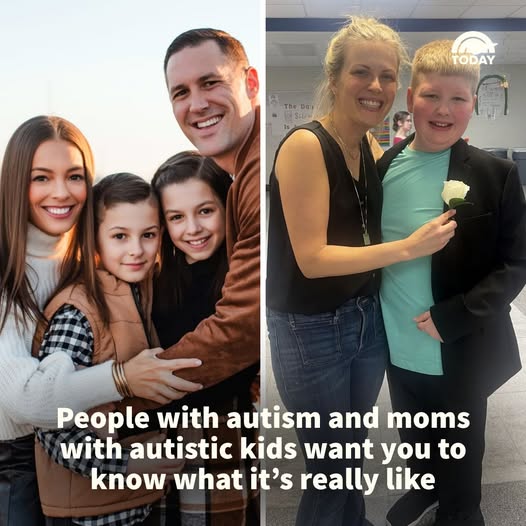
Here’s what moms, and people with autism, want you to know
April is Autism Awareness Month, and it’s living up to the name. The CDC just announced that the childhood autism rate has risen to 1 in 31, one of the top TV programs is a dating show featuring people with autism, and RFK Jr. made autism the star of his first press conference as President Trump’s Health Secretary.
“These are kids who will never pay taxes,” said Kennedy, discussing the rise in autism diagnoses. “They’ll never hold a job. They’ll never play baseball. They’ll never write a poem. They’ll never go out on a date. Many of them will never use a toilet unassisted. We have to recognize we are doing this to our children.”
Kennedy later clarified that he was speaking about those with “severe autism.”
Some parents of autistic children and people with autism — many of whom are out in the world working, paying taxes, dating and using toilets — were outraged by Kennedy’s statements, as well as his vow to uncover the cause of autism despite evidence suggesting there is not one single underlying reason that causes the disorder.
Others cautiously welcomed Kennedy’s attention, grateful for the spotlight it shines on autism.
“It is incredibly dangerous to say autism destroys lives,” Stephanie Hanrahan, a mom of two autistic children, wrote in an Instagram post that has received more than 10,000 likes.
“I would have rather heard about the infrastructure of support,” she told TODAY.com in an interview. “What is (Kennedy) going to do to support families who are already impacted and will continue to be impacted? Because autism is not going to go away.”

Another mom, Katie Swenson, whose teen son Cooper has what she calls “severe” autism, says she feels grateful that Kennedy’s comments have at least sparked conversation.
“I’m so thankful that autism has entered the chat,” Swenson tells TODAY.com, “I’m going to be a caregiver until the day that I die… people are talking and my family is being seen.”
Swenson, along with two other moms whose children have autism, co-wrote the book “Autism Out Loud,” which is about their different experiences and the parenting lessons they’ve learned.

“I’m not going to pretend that that was a gift or lovely,” she tells TODAY.com. “I should be able to say this is really hard, and not be chastised for it.”
One of Swenson’s co-authors, Adrian Wood, tells TODAY.com that while she welcomes the conversation about autism that Kennedy elevated, she worries about misinformation.
“Whenever autism is in the news, which it is very much recently, we are thankful because it means we have a seat at the table,” Wood says.
Wood notes that Kennedy’s claims that autism is a “preventable disease” caused by “environmental exposure” is contradicted by solid research showing that genetics is the leading cause.
Indeed, while scientists don’t know the exact cause of autism, research points to it being mostly genetic, with some possible environmental factors as well. A 2023 study published in the Journal of the American Medical Association found that 83% of the risk for autism comes from inherited genetic factors.
“We know that autism is not an epidemic, because it’s not a disease, it’s a neurodevelopmental disorder,” Wood tells TODAY.com.

Wood has four children including Amos, 11, who is in a traditional fourth-grade classroom at school. She says navigating her son’s autism through his childhood has given her a new perspective on what success means.
“My 9-year-old son cried when Amos used the spoon for the first time,” Woods recalls. “I was raised where you get an education and work hard; this is success. Now we have this whole new perspective on success, and it’s life-changing.”
Part of the problem, Hanrahan explains, is that autism is a spectrum, and you can’t generalize about what it’s like.
“I think he made a blanket statement which is not reflective of everyone’s experience on the spectrum, but it may be the experience of some,” Hanrahan tells TODAY.com.
When her children were first diagnosed, Hanrahan says she was afraid, because she only knew about autism stereotypes.
Now her son Eli plays baseball, among other sports, and enjoys reading and walking the family dog. Her daughter, Campbell, has become an advocate for herself and others with autism; she even did a presentation to her entire fourth grade class about autism awareness.
“We’ve been able to learn from the life we’ve been given, and it’s a beautiful life,” says Hanrahan.
Anyone who wants to know what a life with autism can look like can ask Kerry Magro, an autistic person who is a Ph.D, author and national speaker.
“I’ve been paying taxes for over a decade now,” Magro tells TODAY.com.

While it’s true that some people with autism may never go on dates, Magro does — and he’s had a girlfriend for the past two years.
He is also a consultant on one of the most popular shows on Netflix, “Love on the Spectrum,” which is all about people on the autism spectrum dating and having relationships.
“In the third season, we’ll see several people who find their love of their life and meaningful relationships,” he says.
Magro says he hopes the conversation about autism will shift to what should be done to help people with autism and their families right now.
“Look at the families of people who have children and adults who don’t have a voice and have high support needs,” says Magro. “That’s where we should be getting our knowledge around autism —by the people who live this every single day. Those are the people that we should be listening to now, and in the future of our autism community.”