
A Fall River man accused of using the Telegram app to sell drugs and ghost guns pleaded guilty this week to a number of federal charges, according to U.S. Attorney Leah Foley.
Benjamin Hunt, 27, was arrested in August 2024 after an investigation revealed he sold drugs and firearms on Telegram, which is a cloud-based app that’s been criticized for its lack of moderation.
Hunt advertised a variety of contraband through the Telegram app, according to Foley, including counterfeit pills containing fentanyl, ghost guns, firearm conversion switches, extended magazines, silencers and ammunition. He also regularly shipped orders to his customers through the mail in exchange for Bitcoin.

The months-long investigation into Hunt began back in February 2024, when he sold 100 counterfeit pills to an undercover officer. Foley said Hunt shipped the pills after the undercover officer paid him in Bitcoin.
The undercover officer bought 500 more counterfeit pills from Hunt in May 2024, followed by another 110 pills in June 2024. Foley said the undercover officer also purchased a Glock-type firearm, two switches, an extended magazine and 3D-printed brass knuckles from Hunt over the course of the investigation.
Investigators intercepted a number of other packages sent by Hunt, according to Foley, including one with a smoke grenade inside and another that contained 13 firearm conversion switches. Foley said the undercover officer also received a package containing 1,600 counterfeit pills from Hunt just days prior to his arrest.
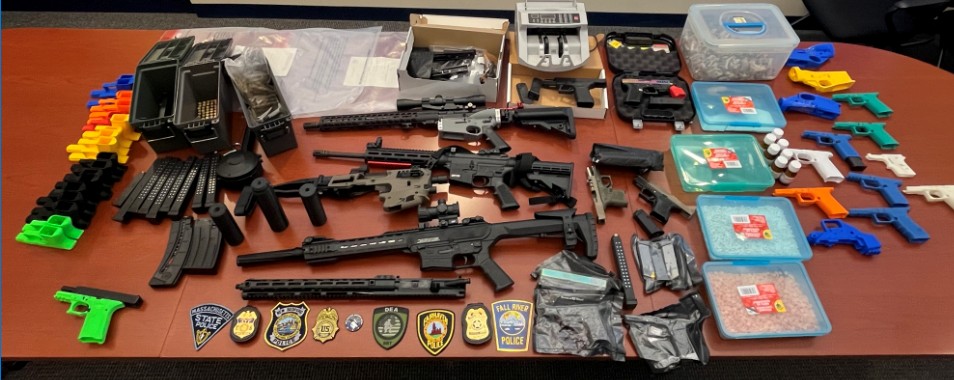
Detectives searched Hunt’s apartment, vehicle and storage unit the morning of his arrest and found suspected fentanyl, cocaine, methamphetamine, MDMA, morphine, codeine and mushrooms, according to court documents. The detectives also uncovered approximately 10 guns and a variety of firearm accessories, including silencers, conversion switches, extended magazines and ammunition.


Foley said Hunt owned a number of 3D printers, which he likely used to create the ghost guns, firearm accessories and weapons he sold via the Telegram app.
Detectives learned about the overdose death of a 17-year-old minor in May 2023 in Indiana after taking Hunt into custody, according to Foley.
Foley said an investigation into that minor’s death revealed that Hunt had been communication with the victim through the Telegram app and offered various drugs for sale.
The minor bought an assortment of drugs from Hunt and reportedly paid for them via Cashapp. Foley said Hunt then mailed the drugs to the minor in Indiana.
Hunt and the victim messaged back and forth in the hours leading up to the minor’s death, which Foley said was determined to be caused by acute mixed drug intoxication.


Foley said Hunt confessed to supplying the minor with fentanyl, MDMA, MDA, ketamine and LSD. Hunt also admitted that his distribution of those drugs resulted in the victim’s death.
Hunt was convicted Thursday of the following charges:
- Distribution of fentanyl, MDMA, MDA, ketamine and LSD resulting in death;
- Two counts of distribution of and possession with intent to distribute fentanyl;
- Distribution of and possession with intent to distribute 40 grams or more of fentanyl;
- Two counts of unlawful transfer and possession of a machine gun;
- Possession with intent to distribute 500 grams or more of a mixture and substance containing methamphetamine and cocaine.
Hunt is slated to be sentenced on March 19. Foley said he will receive between 20 and 25 years in federal prison as a result of his guilty plea.
“[Hunt] made a business out of selling poisonous drugs and flooding our communities with illegal guns – and a 17-year-old victim paid for it with his life,” Foley said. “By exploiting online platforms to sell lethal drugs and guns, the defendant showed a complete disregard for human life and public safety.”
“This guilty plea makes clear that those who deal in death and violence, whether on the street or through online encrypted apps, will be held fully accountable,” she continued.