
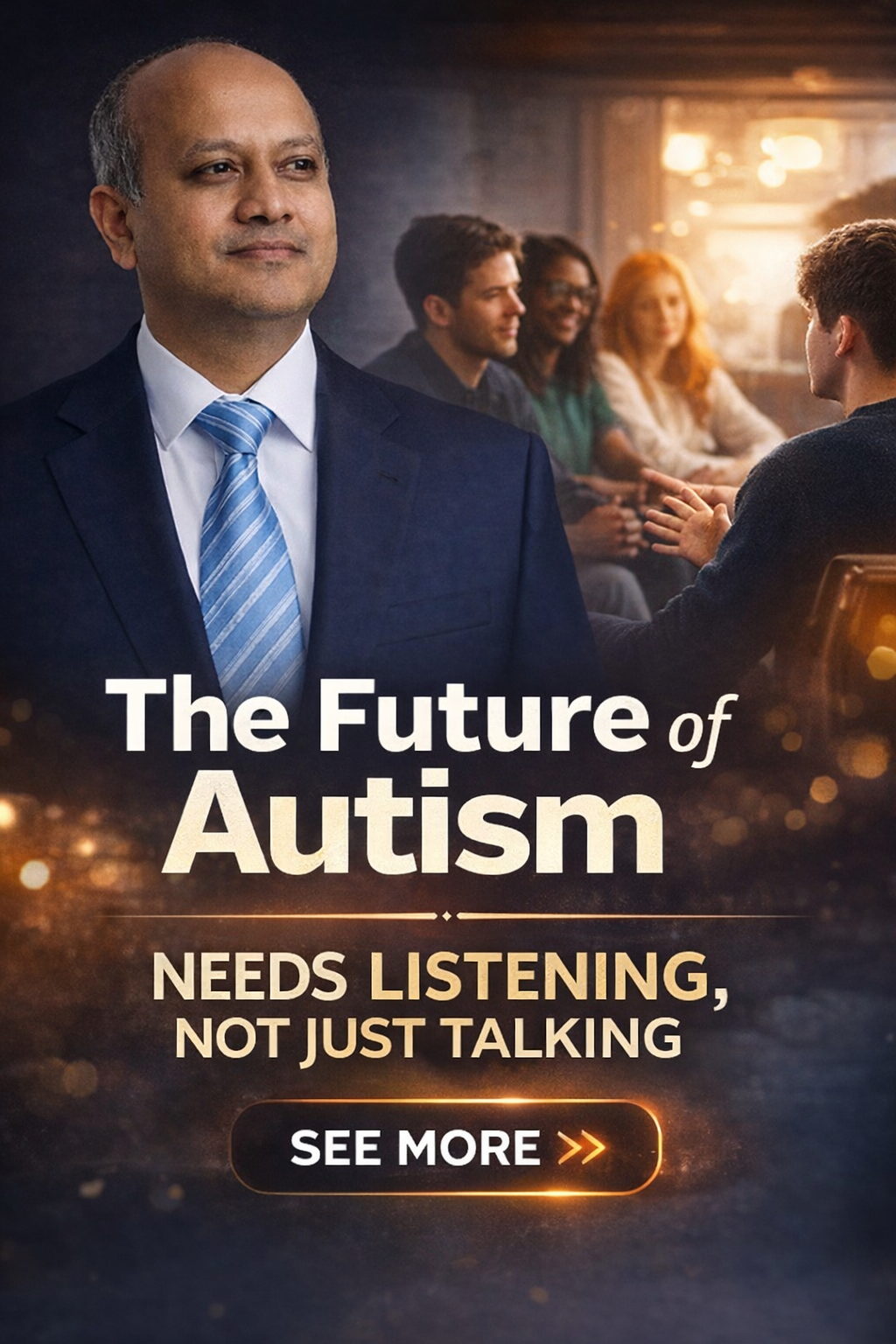
Across education, healthcare and employment, autism is often discussed in terms of systems, strategies and outcomes. What is discussed far less is the question that sits beneath all of this. Who is being listened to, and whose knowledge is shaping the future?
This question is at the centre ofEpisode 35 of The William Gomes Podcast, a reflective exploration of where autism research, inclusion and public understanding may be heading, and what needs to change if autistic people are to thrive rather than merely cope.
As conversations about autism grow louder in public life, there is a risk that progress becomes performative. Policies are written, initiatives are announced, yet autistic people continue to report exclusion, misunderstanding and harm. This episode argues quietly but firmly that the future of autism cannot be built without centring autistic voices as equal partners in research, decision making and everyday design.
Autism research must change direction
Much autism research continues to focus on measurement, categorisation and intervention, often driven by non-autistic priorities. While research has its place, the episode reflects on how frequently autistic lived experience is sidelined or treated as anecdotal rather than authoritative.
Listening to autistic adults and young people does not weaken science. It strengthens it. Research that is informed by lived experience is more ethical, more relevant and more likely to lead to outcomes that improve quality of life rather than reinforce stigma.
Inclusion is not achieved through language alone
In education, healthcare and the workplace, inclusion is often framed as compliance rather than care. Adjustments are made reluctantly, environments remain overwhelming, and autistic people are expected to adapt endlessly to systems that were never designed with them in mind.
The podcast explores the importance of sensory-aware and trauma-informed environments, not as specialist accommodations but as basic elements of humane design. Noise, lighting, time pressure and rigid social expectations can all create distress. Reducing these barriers benefits autistic people first, but ultimately improves environments for everyone.
Work, dignity and the right to belong
Employment remains one of the most persistent areas of exclusion for autistic adults. Despite well-meaning diversity statements, many workplaces still reward conformity over competence and mask difference rather than valuing it.
The episode challenges organisations to think beyond token inclusion. A future that works for autistic people is one where contribution is recognised without demanding the suppression of identity. This is not charity or special treatment. It is a matter of dignity and fairness.
A future shaped by compassion
Episode 35 does not offer a checklist or quick fixes. Instead, it invites listeners to imagine what becomes possible when systems are designed with empathy rather than efficiency as the primary goal.
The future of autism, as discussed in this episode, is not something that arrives automatically with time or awareness campaigns. It is something shaped deliberately through listening, restraint and a willingness to change how power is distributed.
For autistic people, families, professionals and policymakers, these questions are not abstract. They affect daily life, access to opportunity and mental health. As autism becomes more visible in public discourse, the responsibility to get this right grows heavier.
The William Gomes Podcast continues to create space for these conversations, not to sensationalise autism, but to treat it with the seriousness, complexity and humanity it deserves.
Episode 35, The Future of Autism: Research, Inclusion and a More Compassionate World, is available now on YouTube and Spotify.