
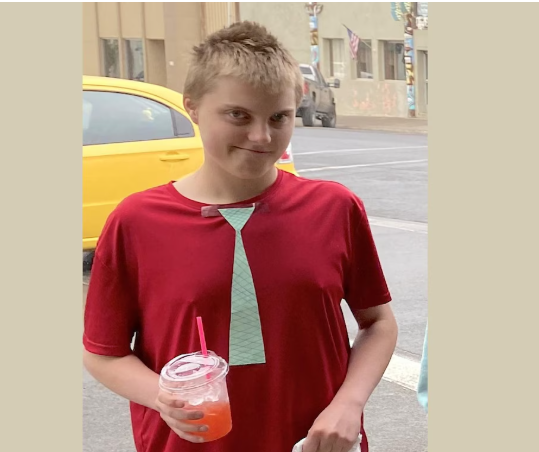
Advocacy group Disability Rights Oregon on Tuesday accused the state Department of Human Services of failing to prevent the death of a southern Oregon teenager allegedly killed by his mother and her boyfriend last year.
A new investigative report by the disability rights group accuses the department of failing to act on two child abuse reports that Thomas Strong, a teenager with autism, had been pulled out of school by his mother and lost a dangerous amount of weight before he died last February in Lake County. When the department did open an investigation into Strong’s well-being after a third complaint, Disability Rights Oregon alleges that investigators didn’t act quickly or aggressively enough to save his life.
The Disability Rights Oregon report does not name the child, but details about the teen make it clear that the report is about Strong, a Lakeview High School junior who was known for taping paper ties to the front of his shirt.
Strong was found dead in his Lakeview home nearly a year ago, on Feb. 18, a day after what would have been his 17th birthday. Court documents say that the Lake County Sheriff’s Office and Oregon State Police arrived at his mother’s home to take Strong into protective custody, but they were weeks too late. Authorities found Strong’s body in a cardboard box in the garage, prosecutors said, with signs of “egregious physical abuse, including widespread bruising, broken ribs and internal injuries.” Court documents say the teen likely died around Feb. 1.
A grand jury indicted the teen’s mother, Amanda Edwards, and her boyfriend, Nathan Cullins, on murder charges. Cullins is accused of killing Strong by subjecting the teen to “prolonged physical abuse.” Edwards faces charges of murder “by neglect and maltreatment.”
Both have pleaded not guilty.
The Department of Human Services issued a statement Tuesday in response to the disability rights report which did not address the advocacy group’s concerns about how its caseworkers handled reports that Strong was in danger.
“Our hearts go out to the family, friends and community who a year later remain impacted by this tragic loss,” Department of Human Services spokesperson Sara Campos wrote in the emailed statement. “Safety is the highest priority of the work we do in Child Welfare and we are continually making changes aimed at improving safety for all children.”
When a youth who was on the state’s radar for possible neglect or abuse dies, the Department of Human Services must evaluate its handling of the case and publish a “critical incident review” detailing any systemic failures or lessons learned.
The state has not published its review of Strong’s death a full year later. The Department of Human Services has delayed publication of the report several times and said Tuesday that it did so at the request of the local district attorney while the criminal investigation proceeds.
Because that state report is not public, The Oregonian/OregonLive has not been able to independently verify the timeline of Strong’s interaction with human services officials. Disability Rights Oregon was given early access to that critical incident report.
The advocacy group argues that patterns in Strong’s death echo issues it has seen with other children’s deaths before: That the state took a passive role in investigating his well-being, made little direct contact with the teen even after it opened an investigation and failed to refer him to get services for children with disabilities.
“Despite multiple complaints from his teachers that he was being neglected, the Department of Human Services failed to protect this child,” Jake Cornett, executive director for Disability Rights Oregon said in a news release. “If they had investigated and intervened as the law and policy required, (he) would be alive today.”
The Department of Human Services declined to respond to those allegations when asked by The Oregonian/OregonLive. In a Monday letter, Human Services Director Liesl Wendt told the advocacy group that a lack of response to any details in its report should “not be construed as agreement.”
Disability Rights Oregon claims that people including Strong’s teachers, principal and school resource officer filed at least three complaints to the child welfare hotline in December outlining concerns that Strong’s mother had pulled him out of school in November, that he’d lost up to 40 pounds and was living in dark and dirty conditions in a home “barricaded with a rifle pointed at the front door.”
The state did not open an investigation after the first two complaints, which detailed Strong’s weight loss, disappearance from school and the gun in his home, Disability Rights Oregon alleges.
However, a third complaint “raising many of the same allegations” did spur the state to open an investigation into the teen’s well-being on Dec. 17, Disability Rights Oregon said.
Still, the advocacy group accused the state of making “very limited” effort to help. Strong continued to miss school, the group says, while the state referred the teen for mental health services.
State caseworkers didn’t try to contact Strong in person between late December and mid-February, didn’t make a safety plan to check in on the teen or try to reach out to relatives other than his mother, Disability Rights Oregon alleges.
Strong’s well-being “was left dependent on the very parent whose care was under investigation,” the report claims.
Through the month of January, Edwards failed to schedule appointments with mental health providers or to take him back to school, the report says. While the state reached out to the mother through voicemails and texts, Disability Rights argued it did not “treat the mounting evidence as the emergency it was.”
Strong’s grandfather told state workers on Feb. 12 that he was concerned about the teen, who he had not seen since October, the Disability Rights Oregon report says. He told the state that Edwards had struggled with substance use, the report claims, and missed work for several weeks. Caseworkers went to Strong’s house, the report says, but nobody responded to their knock on the window.
By that point, investigators think Strong was likely already dead.
On Feb. 18, the state obtained a court order to take Strong into protective custody and found his body.
Disability Rights Oregon argues that the state should have investigated the complaints earlier, should have created a safety plan for Strong’s well-being and kept a closer eye on the teen.
In a series of recommendations, the disability rights group argued that the state should abandon “passive child welfare practices that rely on waiting for parent engagement,” and instead focus its efforts on making regular and direct contact with children who state workers suspect are in danger.
Disability Rights Oregon also took aim at what it considered flaws in the state’s critical incident review of Strong’s death and recommended that state lawmakers put an outside agency in charge of those.
In a response to Disability Rights Oregon, the state wrote that child welfare records are confidential and it would have to address how to share that information with an outside agency, if that’s what lawmakers want.