

When Caitlin Mullins started as a SOAR teacher at William Diggs Elementary School three years ago she taught three grades that would have up to nine special education students.
She was shocked at the expectation to modify three grade levels of content, provide intervention and provide behavior intervention for her students.
SOAR is a regionalized program for students with autism, who require specialized instruction to access curriculum and develop skills essential to achieving independence, according to the school system.
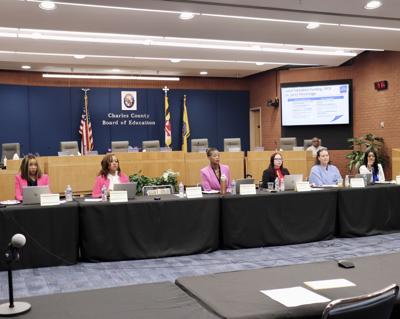
“We were short on staff and it was really hard to manage the amount of behaviors in the classroom,” Mullins said during the Charles board of education work session on Monday. “It never felt like I was doing enough.”
Charles public schools increased by 351 special education students from fiscal year 2024 to 2027, Larry Johnson, director of special education, said. Students ages 3 to 5 represented a 33% growth.
This growth required more support and addressing the “intensive levels of needs that require more intensive levels of support that’s in proportion to what [students] need,” he said.
As part of “leveling the program,” the school district changed how many grades a special education teacher was responsible for, Johnson said. Last school year, only 3% of the SOAR program, the special education program in the district, had less than three grade levels in one room. This year, nearly 98% of the program has less than three grades.
The SOAR program is typically staffed with one SOAR teacher and two instructional assistants with a maximum of eight students, Johnson said. The higher levels of needs for third through fifth grades have caused a higher class size.
“We really needed to reset how we were intentionally rostering our SOAR classrooms,” he said.
Since the change, i-Ready Assessment scores have improved in English language arts, with 60% of SOAR students showing a level of progress and 58% of SOAR students showing growth in math, this school year, Johnson said.
“The program is certainly moving in the right direction and students are making growth,” he said.
The change has also opened an opportunity for teachers to have more time to plan and collaborate with teacher peers, Johnson said. The change to the SOAR program also balanced the needs of behavioral concerns, which helped decrease suspensions.
Last year, there were five students who were suspended for a total of 25 days, Johnson said. So far this school year, one elementary school student was suspended for four days.
The change has caused the SOAR program to stabilize where teachers are asking for clear day-to-day expectations for protective planning, support structures and more instructional learning, Johnson said.
Since the change, Mullins only teaches fourth grade and has five students, she said. Her classroom now has a higher level of engagement because the classroom is better balanced.
“In the past, I felt like I was failing my students as far as … interventions,” Mullins said. “This year is the first time I’ve ever felt like I actually had the time and energy to prioritize them.”
Mullins has taken grade level skills and included them into intervention to narrow the gap, Mullins said. Students are engaging in lessons and are collaborating with each other.
“My students are more independent than ever,” she said. “They feel heard, they feel included. We’re not outnumbered.”