
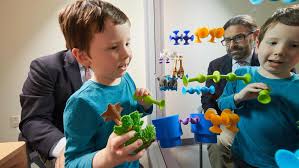
James McPartland, PhD, is the director of the Developmental Disabilities Clinic and Harris Professor at Yale Child Study Center (YCSC). He has written seven books and more than 200 scholarly works on autism and related topics. His research investigates the brain bases of neurodevelopmental conditions to develop tools that improve detection, treatment, and quality of life for autistic people and their families.
In a recent interview, McPartland shared some of his expertise about autism—also known as autism spectrum disorder (ASD)—which is a complex neurodevelopmental condition that affects how people communicate, interact, learn, and behave.
“Autistic people are born with brains that process information differently than neurotypical people,” he explains. As these neurodiverse brains grow and develop, differences shape attention and social interactions, which can influence how the brain continues to develop.
The interview has been edited for length and clarity and formatted into a three-part Q&A series.
In brief, what is the history of autism and autism diagnosis?
Autism has always been a part of human experience, though it was not recognized as such until 1943 when child psychiatrist Leo Kanner described children with distinct social interactions, language use, and a preference for routine. Around the same time, Hans Asperger’s work in Germany detailed similar traits, leading to the identification of Asperger’s Syndrome, a form of autism characterized by less language impairment and average or above-average IQ.
Finally, in 1980, clinicians formally added autism to the Diagnostic and Statistical Manual (DSM), the official guide for psychiatric and neurodevelopmental conditions, based on expert clinical consensus. In 1981, a paper by Asperger was translated into English, which led to the inclusion of Asperger’s Syndrome in the DSM-IV in 1994. This broadened the understanding of autism to include a wider range of individuals.
Initially, the DSM-4 distinguished between autistic disorder, Asperger’s syndrome, and pervasive developmental disorder not otherwise specified. Due to inconsistencies in how clinicians diagnosed these subtypes, the DSM-5 later removed the distinctions, consolidating them under the broader category of autism spectrum disorder.
What treatments or therapies are used with children and adolescents with autism?
Most therapies for autism rely on behavioral intervention. They haven’t changed dramatically since their initial development, though some have evolved to be more child-focused and play-based to incorporate more natural forms of reinforcement. Today, therapies aim to help autistic people thrive and to live functional, happy, and effective lives. They focus on generalizing skills in natural settings like playgrounds and classrooms.
The focus of these interventions has also shifted from changing behaviors associated with autism, like eye contact, to treating factors that hinder living a fulfilling life. This includes addressing co-occurring issues like attention problems and anxiety. The goal is to balance and support individuals in ways that meet their unique needs.
Scientists are studying future treatments beyond behavioral intervention. Ongoing research is exploring the development of medications for autism, as well as applying brain stimulation techniques that have been useful in other conditions such as depression. The emphasis remains on a person-first approach and tailoring services to individual needs.
Why have there been increases in the prevalence of autism in recent years?
While the biology of autism hasn’t changed, the criteria for diagnosis have evolved over time. Several decades ago, autism was considered rare, diagnosed in one out of thousands of children. Today, the CDC reports it as one in 31. This rise isn’t due to an autism epidemic or environmental changes alone, but largely reflects new criteria that recognizes some autistic patients who might have been previously overlooked. For instance, Asperger’s syndrome was added to the DSM in 1994, and subtypes of autism were revised in the DSM-5 in 2013.
Reduced stigma has also contributed to the increase in diagnoses. In the 1950s, autism was wrongly blamed on parenting styles, leading to reluctance in seeking or giving a diagnosis. As understanding shifted to recognizing autism as a biological, genetic condition, stigma decreased. Public figures discussing their autism experiences has also had an impact in reducing stigma.
Another factor is the availability of specific services for autistic children. This has motivated more parents to pursue diagnoses. Increased public awareness about autism has also played a role, though sometimes it leads to misunderstandings and misdiagnoses.
While some perceive the rise in diagnoses as alarming, it’s ultimately positive. We are better able to identify and support those who need it, though this has also placed strain on healthcare and education systems.
What are some important gaps or limitations in our understanding and diagnosis of autism?
We know less about autism and its causes than we would like. While we know that it is heritable and genetic, identifying the specific genetic mechanisms is challenging. Some genetic conditions, such as Fragile X syndrome, are linked to a higher likelihood of autism. But in most cases, it involves complex interactions between genes and the environment. We have some ideas about which brain systems are involved, but we do not know exactly how autism develops.
Currently, there are no medical treatments for autism itself. Only medications for associated symptoms like irritability are available, and our diagnostic tools are limited. These tools haven’t changed much since autism was first recognized in 1943. Diagnoses rely on observing behavior and talking to parents, but this approach has limitations. Some behaviors may not appear during assessments, and it’s hard to predict future behaviors. Also, these assessments may not be available in all areas or may be too expensive for some families.
I came to the field of autism first and foremost as a clinician, and these kinds of limitations are partly what made me interested in neuroscience research. I found the idea of studying biological indicators of autism very compelling. If we could develop a biological assay for autism, we would have a much more efficient and cost-effective means for diagnosis. Biomarker findings could help bridge the practical gap between what we can do as clinicians, both functionally and logistically, and what might be possible with new tools.
In the second Q&A of this three-part series, McPartland explores biomarker research in greater depth, sharing insights into promising work in this area and discussing future directions of autism research at Yale. In the third installment, he discusses ways to involve autistic people in related research and how the neurodiversity movement has impacted autism awareness. He also suggests ways to support the needs of people of all ages who are affected by autism.