
National Foundation for Autism Research helps job seekers gain employment

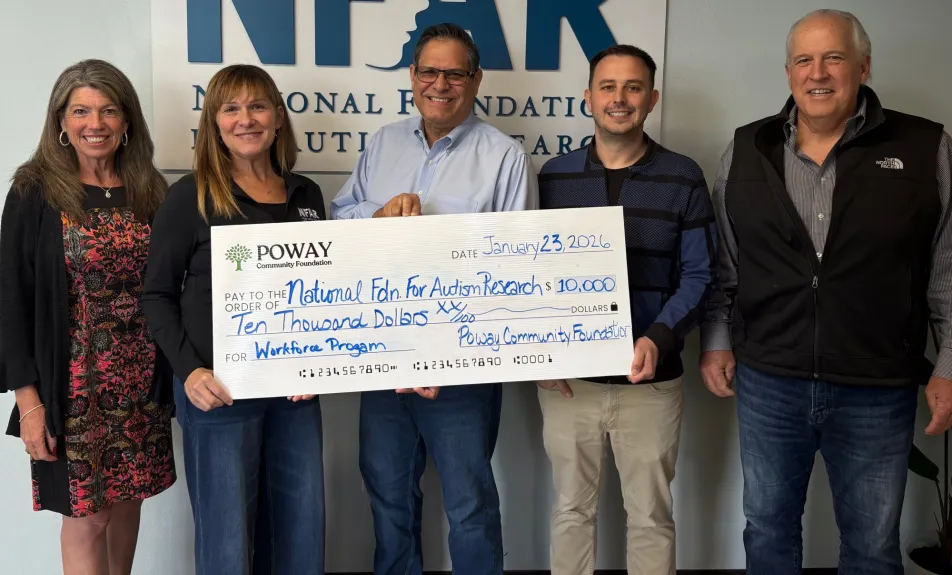
Poway Community Foundation Co-Chairs Ginger Couvrette, left, and John Couvrette, right, award representatives of the National Foundation for Autism Research (NFAR) a $10,000 grant. NFAR representatives are, from left, Community Outreach Specialist Robin Gibbons, President and Co-Founder Juan Leon, and COO Nick DeVico. (Courtesy Poway Community Foundation)

A $10,000 grant from the Poway Community Foundation will support the National Foundation for Autism Research’s goal of helping job seekers with autism gain meaningful employment.
The nonprofit foundation presented the award Jan. 23 at NFAR’s Scripps Ranch office.
Sharon Leon, executive director and co-founder of NFAR, said representatives of the nonprofit founded in 2003 were “truly thrilled and deeply honored” to receive this grant. They said the funds will enable the organization to expand its outreach services and training for companies throughout Poway and other local communities.
The award will also help NFAR reach its goals in expanding corporate neurodiversity training, consulting and hiring support for Poway-area businesses, she said.
“It’s exciting because it’s giving us an opportunity to reach out and offer these services to Poway businesses free of charge,” Leon said.
Leon said NFAR is dedicated to creating programs and supports that help individuals with autism thrive throughout their lifetimes.
Initiatives that serve families and children of all ages include parent groups, family activities, teacher grants and community projects. However, NFAR’s primary focus is on vocational training programs for adults ages 18 and older.
These include NFAR Tech, which offers participants eight months of training in software testing and certification, and preparation for careers in automation and coding.
Another program is NFAR Works, a year-long comprehensive training initiative that helps participants explore jobs across a variety of industries such as office jobs, copy centers, factory and distribution enterprises. It also helps strengthen work skills needed for many entry-level positions.
The NFAR Cyber program offers nine months of training to prepare participants for entry-level IT/cyber security roles through industry recognized curriculum.
Leon said NFAR’s initial focus was on young children since that was the age group of a majority of diagnoses of autism in NFAR’s early years.
“As we saw the population get older they were gaining skills, but they were not making it into the workplace,” Leon said. “Skilled individuals were staying at home. We felt like we could do better, not only at NFAR, but as a society, to help these talented individuals get into the workplace. We needed to create a pathway to employment so that’s why we started our vocational training programs.”
Leon said they start by having people on the autism spectrum identify their strengths and areas where they need support.
Robin Gibbons, an NFAR industry outreach specialist, said the goal is to identify compatible opportunities based on the participants’ skills that they’ve learned through NFAR.
“Depending on the program the candidates graduated from, we ascertain their hard skills and soft skills,” said Gibbons, who helps provide ongoing support to candidates and employers. “We feel these programs are a good match for small, medium and large companies if they have the right mentality, receive training and incorporate neurodivergent individuals. That includes leadership training and peer training. Autism awareness training is really important, and I incorporate interview training for hiring managers.”
Leon said one in 31 individuals are diagnosed with autism, which translates to more than 100,000 people in the San Diego region. Individuals with autism who gain employment have an opportunity for greater financial independence, professional growth, social networks with co-workers and a greater sense of purpose, she said. For families it means a sense of hope for the future and fulfillment, she added.
“That’s a significant number of people you want to include in the workforce,” she said.
All of NFAR’s training programs include technical and work skills training, soft skills training that teaches time management and communication, work practice and projects, and job preparation.
From the start, they help those in the program understand what it means to be working in a business environment – arriving on time, prepping for work, learning the tools, language and processes for the jobs, quality control of their work product, working on individual and team projects, practicing interpersonal skills and communication methods for the workplace, and end of day reporting, Leon said.
In the last stages, Leon said they help clients create their resumes and online profiles, conduct mock interviews, and when possible, help graduates find work internships and offer ongoing support for both the graduate and employer.
“We track individuals for the first 12 months,” Leon said. “While there are always some work placements that do not work out for various reasons, the majority of our placements have been successful, and NFAR has been able to connect San Diego employers with some great hires.”
More information about NFAR will be available at the April 11 Race for Autism and Autism Resource Fair in Balboa Park. The event is held to kick off April’s Autism Acceptance Month.
More information is at nfar.org and nfar.org/employer-services.