
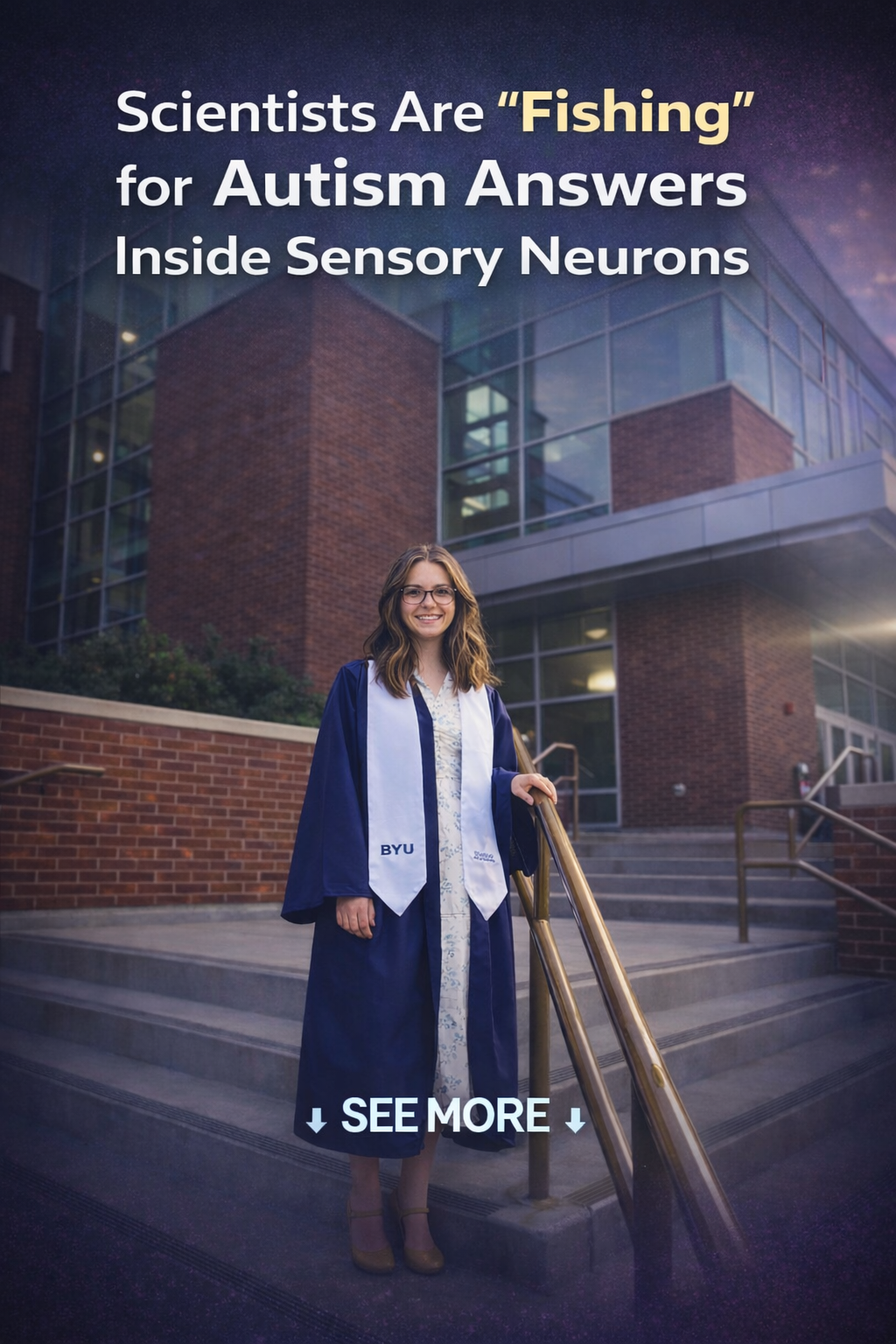
The questions Addie Hamilton (PWS ‘25) asks in the lab don’t have easy answers. She studies neurons that process sight, hearing, smell, taste, and touch. These neurons are located deep within the brain, which means finding them is a challenge. Yet Hamilton’s passion for scientific discovery drives her to overcome each obstacle she faces, allowing her to identify the neurons and help process the data she gathers.

In Dr. Suli’s lab, Hamilton researched multisensory integrating neurons found in the optic tectum of Zebrafish, which are believed to play a role in autism spectrum disorder. These neurons help the brain use signals from multiple senses to coordinate a response. For example, when driving a car, people usually rely on visual cues, like road signs and lines, and on auditory cues, like honking, to process a decision.
“The hypothesis is, if we alter the neurons that do that, then you see autistic-like phenotypes,” Hamilton explained, referencing behaviors like social withdrawal or hypersensitivity. By identifying and localizing these neurons in the zebrafish brain, the team hopes to better understand how similar systems might function in humans.
Hamilton’s been a part of Dr. Suli’s zebrafish neurobiology lab since her freshman year. She was initially drawn to the lab by her interest in autism spectrum disorder research and encouragement from her sister, who works in behavioral therapy.
Her desire to pursue research experiences stems from her family’s support. Hamilton grew up in a household where curiosity was celebrated. Her parents encouraged her and her siblings to explore the world by asking questions and chasing down answers. “My parents have definitely been a really big influence on me to put myself out there,” she says. They inspire Hamilton to step out of her comfort zone and pursue opportunities that help her learn and grow. That spirit of inquiry continues to motivate her today. Each time she presents her research, she sends a photo of her poster to her family, who respond with enthusiastic support.
Hamilton’s research was a collaborative effort. Her lab partner studied the intricacies of zebrafish interactions with its environment under the microscope, carefully noting her observations. Then, Hamilton analyzed the observations and created visualizations for the data, a skill she learned in Dr. Suli’s lab.
Hamilton spent long hours problem-solving with code and graphically representing the data that she and her lab partner found. Those long hours were recognized when she won first place in the neuroscience category at the 2024 Life Sciences Research Conference.

Though this research takes significant effort, Hamilton is motivated by the small discoveries. These moments aren’t just intellectual wins, they’re often spiritual. She remembered times when a seemingly impossible line of code suddenly worked after a prayer. “I hadn’t changed a single thing on my computer. I just pressed the run button to run the code, and it worked,” Hamilton recalls. “It’s experiences like that that I’m always going to remember.”
Through the challenges of debugging code, presenting research, and studying the delicate neural activity of zebrafish, Hamilton remained dedicated to advancing knowledge in her field. Hamilton recently graduated with a degree in genetics, genomics, and biotechnology from BYU and plans to use the skills that she’s developed in her work as an environmental educator in Colorado.
“Teaching students about ecosystems, wildlife, and environmental stewardship has been so rewarding,” Hamilton shares, “watching them have those aha moments as they understand how scientific concepts apply to the world around them gives me the same sense of purpose and excitement I felt conducting research in the lab.”
As she teaches her students, the questions that once drew Hamilton to zebrafish neurobiology continue to shape the way she approaches science and learning. Whether she is mapping sensory neurons or guiding young minds through the natural world, Hamilton remains committed to discovery.