
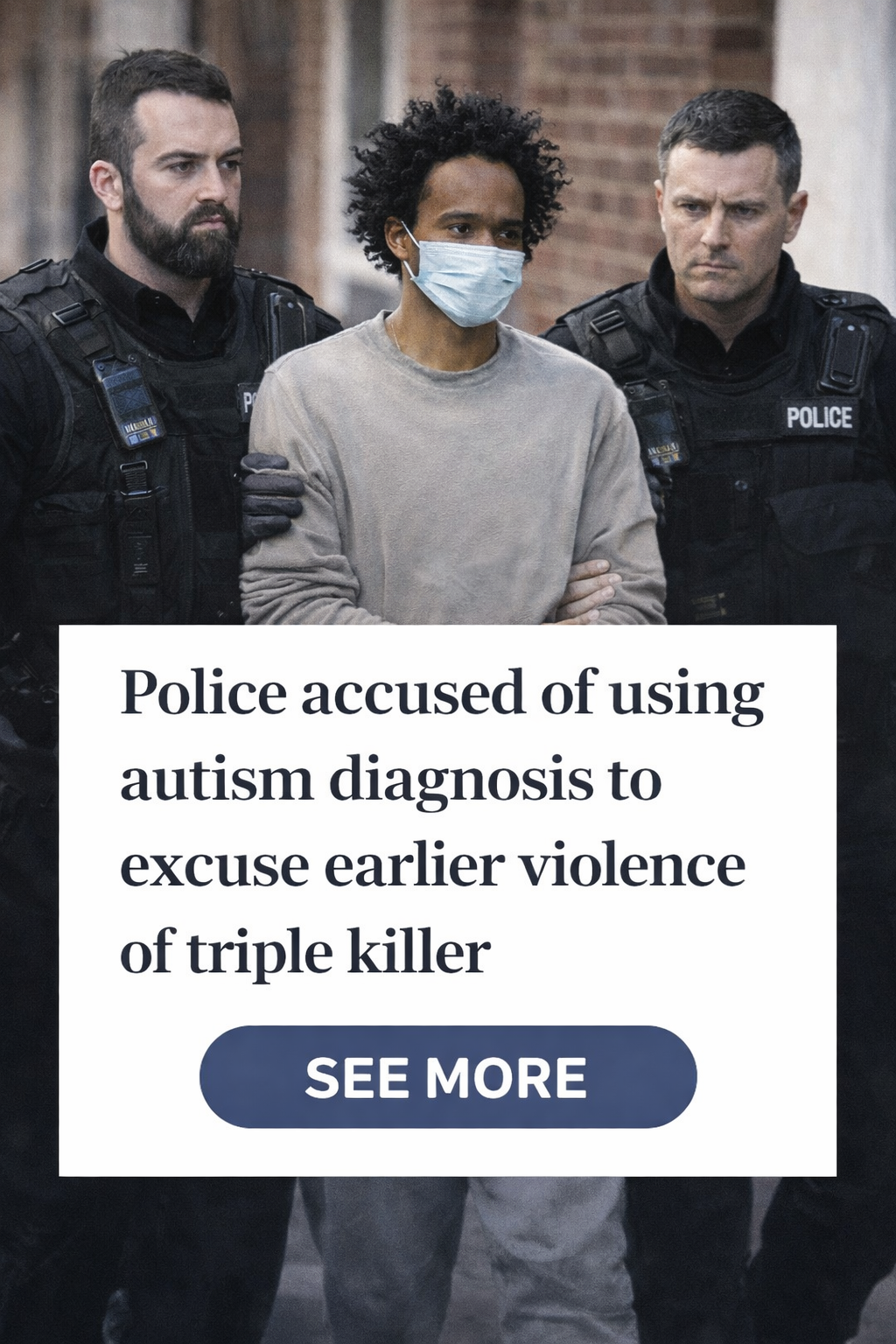
Inquiry finds that state agencies – including police, NHS, schools, social services – all missed chances to prevent attack

Police, doctors and other officials used the Southport killer’s autism to excuse his previous acts of violence, the inquiry into the attack has found.
Axel Rudakubana had a history of violence, including a conviction in 2020 for actual bodily harm (ABH) and possession of a bladed article, but the report said various organisations used his autism as an “excuse” for his violence.
The inquiry report concluded that in the years before the July 2024 attack – when he murdered Bebe King, Elsie Dot Stancombe and Alice da Silva Aguiar and wounded 10 others – police, the anti-terror programme Prevent and the NHS failed to realise his autism “escalated” the chances of him harming others.
Sir Adrian Fulford, the inquiry chairman, said autism did not always increase a person’s propensity to violence but did in some cases. Rudakubana was an example.
His autism meant his long-standing interest in violence and weapons “escalated to far beyond anything that could be regarded as normal”, the report said.
It continued: “It also contributed to [Rudakubana’s] tendency to perceive even the smallest of matters as a grave injustice towards him, his inability to let such situations go or to perceive two sides to a situation, and his willingness to escalate confrontations save when the very clearest and most firmly applied boundaries were set.”
These factors “significantly increased the risk he posed to others”, Sir Adrian said.
State agencies, however, including the police, NHS, schools, social services and Prevent all failed to see this.
“Agencies regularly simply used autism as an explanation, or even an excuse, for his conduct, including his violence,” Sir Adrian’s report read.
“Strategies and interventions were needed in order to address the risk he posed and the causes of it, but instead, as a result of a significant lack of understanding, the problem was left both unmanaged and underestimated.”

Addressing victims’ families and journalists at Liverpool Town Hall in a statement on Monday, Sir Adrian said: “[Rudakubana’s] deeply problematic behaviour was too frequently excused on the basis of his perceived or diagnosed autism spectrum disorder.
“Autism is not a mental illness. It is a neurodevelopmental condition.”
Police failed to arrest killer
Sir Adrian concluded that Rudakubana’s autism was a factor that Lancashire Constabulary police officers “wrongly allowed to divert them” down a “non-criminal justice route” when the teenager was found to have a knife on a bus in March 2022.
In November 2021, two and a half years before the Southport attack, Rudakubana’s autism was again cited as a reason why Lancashire Constabulary did not take action when he damaged a rental car and kicked his father in an outburst over “the food his parents had cooked him for tea”.
In his recommendations, Sir Adrian said that Lancashire Constabulary should strengthen training for new officers on autism spectrum disorder.
If Rudakubana had been arrested by police in March 2022, the Southport attack would not have happened, the inquiry concluded.
Police stopped Rudakubana on a bus after his parents reported him missing and he was searched and found to be in possession of a serrated knife. Officers decided not to arrest him and instead took him back to his parents.
Sir Adrian said the incident had essentially been treated as a “safeguarding issue” despite officers being aware that Rudakubana had been charged with assault in 2019.
ACC Mark Winstanley, of Lancashire Constabulary, told the inquiry he felt that not arresting Rudakubana was “within the range of reasonable options”.
The chairman, however, disagreed. He said that if police had arrested him it would have led to the discovery of al-Qaeda manual on his computer, and a likely prison sentence.
The inquiry also concluded that Rudakubana should have been investigated further by police when he admitted in 2019 to bringing a knife into school on at least 10 occasions.
Police interviewed the murderer in October 2019 after he contacted Childline asking: “[w]hat should I do if I want to kill somebody?”
He told police officers that he intended to use a blade to kill or to inflict really serious harm on another pupil.
Sir Adrian concluded: “It does not seem to me that the possible need for criminal investigation – whether by arrest or otherwise – was sufficiently considered.”
In December of that year, Rudakubana attacked a pupil at the Range High School with a hockey stick. He was later charged with ABH but was spared a custodial sentence and handed a 10-month referral order instead.
Chief Constable Sacha Hatchett, from Lancashire Constabulary, apologised for failing to arrest Rudakubana.
She added: “In all their interactions with [Rudakubana] and his family, Lancashire Constabulary officers were motivated by a genuine desire to help, and this has been reflected in the inquiry report.
“The inquiry process enabled us to examine and reflect in depth about our involvement with him in the preceding years.
“Lancashire Constabulary accepts that there was an opportunity to arrest AR on 17 March 2022, and that we did not adequately assess the risk he posed to others. I am extremely sorry for this.”
Council failures identified
Lancashire county council’s children’s social care repeatedly “stepped down” Rudakubana’s case to the authority’s “early help service”, the inquiry found.
The council was also made aware of concerns raised about the teenager’s online activity in December 2019, October 2021 and March 2022.
During the nine weeks of hearings, the inquiry also heard evidence from a social worker employed by the council who said Rudakubana had questioned whether the public’s view of the Taliban was unfair while he was with her.
The fact the then teenager had seriously assaulted his father, who then retaliated by striking him during an argument in January 2021, was also recorded by the council. However, it was not shared with other agencies.
“As early as August 2021, the fact that this had occurred had been lost from view,” the inquiry found.
Recommendations addressed directly to the council included asking for the authority to ensure that “all its front-line staff have received suitable training, or refresher training” by Oct 13 this year.
Sir Adrian also said the council should ensure its policies and training emphasise the “significance of multiple referrals when considering the relevant risks relating to a child”.
In a lengthy statement released after the report’s publication, Mark Wynn, chief executive of Lancashire county council, said he was “deeply sorry” for the failures identified in the inquiry report.
“Lancashire county council acknowledges the chair’s findings and thanks Sir Adrian Fulford for his thorough and rigorous examination of the events preceding this tragedy.”
He added: “We are deeply sorry for the failures identified and for the part we played in the systemic shortcomings that preceded the attack in Southport. We know that no words can ease the grief of the families who lost loved ones, or the pain of those who were injured and traumatised.”
Online harms ignored
When police seized Rudakubana’s laptop, tablets and a hard drive, they contained multiple images and articles relating to wars and international conflicts – including Gaza, Ukraine, Sudan, Korea, Iraq and the Balkans.
The inquiry report detailed: “There were cartoons of killings, violence and rape. There were others which insulted or mocked different religions, notably Islam, Judaism and Christianity (of particular note, there was a significant quantity of anti-Islamic material that included grossly offensive and graphic cartoons).
“There were materials that were seriously and offensively demeaning to women and girls.”
In November 2019, Rudakubana was referred to Prevent after the Acorns School reported that he had researched school shootings.
The referral to the Government’s counter-terror programme, however, was later closed.
The school subsequently blocked the teenager’s access to the internet.
Rudakubana then made attempts to override the security settings to allow internet access in December 2019.
The inquiry also heard how the teenager searched X for the stabbing of Bishop Mar Mari Emmanuel six minutes before he left home to carry out the attack.
The Australian cleric, who live-streams services on YouTube, had been delivering a sermon in April 2024 when he was stabbed several times by a teenage assailant.
Deanna Romina Khananisho, X’s head of global government affairs, told the Southport Inquiry on Tuesday she was “passionate” about a “free speech mission”, adding that removing such a video “under the guise of safety” would be a “tyrannical overreach”.
Sir Adrian said that “regrettably” X “did not show the same ready willingness to co-operate with the Inquiry as almost all other organisations and Core Participants”.
“X took an inappropriately narrow view of the inquiry’s first Section 21 notice and did not disclose any content data (e.g. posts, likes etc.) in contrast to the approach taken by Meta,” he added.

Addressing the issue of online harms in his statement, Sir Adrian said: “How someone is behaving online is, in my view, an effective potential predictor as to how they will behave offline, yet this route to understanding what was going on was entirely ignored.”
Prevent referrals not acted upon
Rudakubana’s violent actions were dismissed as symptoms of undiagnosed autism.
The inquiry determined that he should have been assessed by Prevent when he was first referred to the government’s anti-terror programme in 2019.
Instead, a police officer assessing his case did not consider his violent verbal threats and violent actions in school to constitute “extreme violence” because of his autism and the fact he believed he had been bullied.
In addition, the officer, who visited Rudakubana at his home, demonstrated “an unjustified acceptance” of his version of events, despite the evidence that he had lied to officials.
Dr Tina Irani, the inquiry’s expert psychiatrist, considered that Rudakubana’s autism increased, rather than reduced, his level of risk to others.
Rudakubana was first referred to Prevent on Dec 5 2019 by his school, after teachers became increasingly concerned by his behaviour.
They cited the fact he had been excluded from his last school for carrying a knife to school on 10 occasions and threatening to “stab someone”, making comments about teachers getting murdered and researching school shootings in the US during classes.
Two months later, he returned to his former school armed with a knife and hockey stick.
Rudakubana was referred to Prevent twice more but the programme never took up his case.
The Southport inquiry examined the three times Rudakubana was referred to Prevent, the multi-agency government programme aimed at stopping young people from becoming radicalised, before his fatal attack.
Sir Adrian found that the decision not to take up Rudakubana’s case after his first referral was a “critical error”.
In its closing statement to the inquiry, Counter Terror Policing North West said it accepted further steps should have been taken by the police officer in question before Rudakubana’s first referral was closed.
The unit, however, added it did not consider the information available at the time was “reasonable grounds to suspect that [Rudakubana] was vulnerable to being drawn into terrorism”.
Sir Adrian rejected that, saying the statement had the hallmarks of a “defensive rear-guard action” to justify the decision.
In a statement following the report, Deputy Assistant Commissioner Vicki Evans, the senior national coordinator for counter terrorism policing, said: “It is with my deepest regret that Counter Terrorism Policing contributed to the collective failure to manage the perpetrator’s risk.
“We will now review every facet of the report and respond to the recommendations for the Prevent programme alongside the Home Office.”
Schools’ warnings not heeded
Rudakubana was referred to Prevent by the Acorn School in December 2019, February and April 2021.
The inquiry found theat the Southport killer’s school did not pass on comments he made about the Holocaust to Prevent in 2022 because their previous three referrals had been refused.
The Acorns School said it did not refer following “limited feedback” about its other referrals.
Although staff have since said this was a “mistake”, the chairman of the inquiry found it had been done for “understandable reasons” after the third referral “seriously harmed the relationship between the school, Rudakubana and his parents”.
Sir Adrian also praised Range High School for its “unassailably correct decision” to exclude him permanently in October 2019.
Rudakubana had told Childline he had been carrying a knife to school and wanted to kill a boy he claimed was bullying him. The inquiry chair rejected his claims of being bullied.
Sir Adrian added that the three schools attended by Rudakubana had done “much that was credible” compared to other agencies and bodies.
In his recommendations, he urged all government bodies and local authorities to heed warnings made by schools.
Repeated referrals to Prevent were refused, despite the concerns raised including his history of carrying knives to school, showing no remorse for threats to fellow students and researching gory violence on school equipment.
Sir Adrian called for “a nationwide reminder of the importance of respecting the insight offered by the child’s school if they raise concern about the severity of risk that the child poses to others”.
He said: “As was the case with [Rudakubana] at the Acorns School, teachers will often spend more time observing the child (and their interaction with peers) than is available to other professionals.
“Warnings from teachers and/or schools with particular expertise should be given particular weight.”