
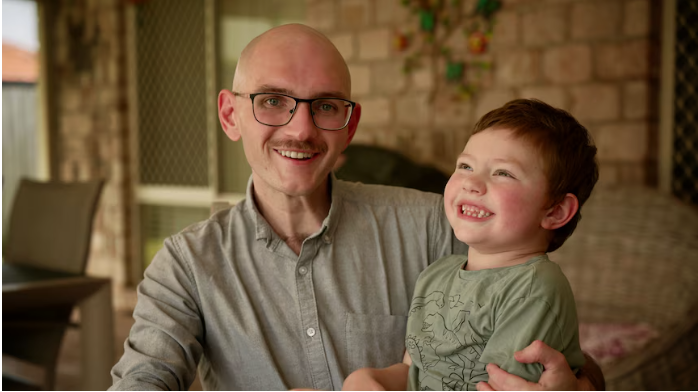
Eric Moore with his son Dimitri, who has been diagnosed with level 3 autism, requiring the highest support needs. (ABC News: Mark Leonardi)
Five-year-old Dimitri Moore has suffered a “massive deterioration in his behaviour” since the abrupt closure of Australia’s AEIOU centres for children with autism.
Queensland-based Dimitri attended an AEIOU centre four days a week from January last year until last month, when the not-for-profit AEIOU Foundation ceased all its services.
Dimitri Moore received behavioural therapy, speech therapy, and occupational therapy, as well as day care, at an AEIOU centre. (ABC News: Janelle Miles)
Australia’s 11 AEIOU centres in Queensland, Adelaide, and Canberra were a one-stop shop for children with autism, providing long daycare and therapies under the one roof. For many parents, the centres allowed them to continue working.
Their closure has put a spotlight on the adequacy of National Disability Insurance Scheme (NDIS) funding for children with “severe, profound, lifelong” autism.
Federal Health Minister Mark Butler is expected to outline further changes to address ballooning costs to the $50 billion scheme later today.
Before the AEIOU shutdown, Dimitri’s single dad Eric Moore said his son was slowly learning how to communicate after 14 months of intensive therapy at the Bald Hills centre, in Brisbane’s north.
Eric Moore says Dimitri made slow, but consistent, progress during his 14 months at an AEIOU centre. (ABC News: Mark Leonardi)
While his little boy speaks only in a few words, Mr Moore said Dimitri was able to follow simple instructions and was slowly developing life skills, such as learning to use a toilet, because of the evidence-based AEIOU program.
“His understanding has vastly improved,” the 34-year-old teacher said.
“We started learning some basic ways to communicate back and forth. He started being more expressive of his needs. That’s been a benefit for his general wellbeing.”
But after more than a year of slow but consistent progress, Mr Moore said Dimitri had regressed since the sudden shuttering of the AEIOU centres, leaving hundreds of children and their families in limbo.
“We’ve seen a massive deterioration in his behaviour,” Mr Moore said.
“His routines and everything need to be completely rebuilt. We have to find him new therapists.”
But he describes his and Dimitri’s situation as more fortunate than most, citing cases of parents having to negotiate time off work or quit their jobs entirely to take care of their children since the AEIOU shutdown.
“It just up-ends a lot of people’s lives,” Mr Moore said.
Eric Moore says Dimitri’s behaviour has deteriorated since the closure of his AEIOU centre. (ABC News: Mark Leonardi)
He’s been able to enrol Dimitri in Pine Rivers Special School, north of Brisbane, but is gutted by the loss of AEIOU in his son’s life.
“When they have a consistent team that all works together … a lot of these children have had, over the years that AEIOU operated … awesome outcomes,” Mr Moore said.
“There are kids who go to the school that I teach at now who are doing apprenticeships, who are becoming members of the workforce, who are doing really well, who went to AEIOU back in the early days.”
NDIS cuts blamed
The AEIOU Foundation went into liquidation after more than two decades of providing specialised early intervention services for thousands of children with autism.
AEIOU parents and staff have blamed the collapse on cuts to the NDIS packages of many of the children attending the centres.
Cancer specialist James Morton, who founded the AEIOU Foundation in 2005 after his own son’s autism diagnosis, hit out at management of the NDIS for the foundation’s demise.
Dr Morton said that in 2024, the packages of many children attending AEIOU centres had been cut dramatically.
He said NDIS delegates also started telling parents wanting to access an AEIOU centre for their children that the “AEIOU is not funded by the NDIS, their child should go to mainstream and learn from other children”.
“They made statements like: “AEIOU does not align with the NDIS,'” Dr Morton said. “Our numbers dropped and the funding that we had for the children plummeted.
“The problem is that the children and their needs are so complex that the standard childcare system can’t cope with them.
“It’s not a blame on the childcare system. It’s a reflection on the level of developmental delay that these children have.”
Dr Morton said putting a child who was non-verbal, not toilet trained and with high levels of social anxiety into mainstream childcare was “unreasonable” and “diabolical policy”.
Children frequently started at the AEIOU with challenging behaviours, including head banging and biting, he said.
“Eighty per cent of families enrolled their children in mainstream childcare prior to attending AEIOU and had to leave due to their child being unable to participate, not making any gains, or due to challenging behaviours,” Dr Morton said.
Australia’s 11 AEIOU centres in Queensland, Adelaide, and Canberra provided long daycare and therapies under the one roof. (ABC News: Lucas Hill)
After the AEIOU centres’ closure, he said one child had been rejected by 50 childcare centres, and another by 18.
Dr Morton said the AEIOU Foundation’s closure would send the care of children with “severe and profound” autism “back to the Dark Ages” and would result in bigger costs for the NDIS moving forward.
“It’s just the most shattering thing,” he said.
“It’s hard for me as a doctor, where every decision we make is evidence based, to understand what the NDIS has done in this space and what they call evidence, which is no evidence at all.
“The whole of government cost of 40 children with profound autism coming to AEIOU, compared to the same 40 children going to their local childcare centres, and accessing community-based therapy, is the same. But the developmental outcomes are very different.”
In 2021 the AEIOU Foundation opened a centre in Canberra. (ABC News: Luke Stephenson)
Dr Morton said about half of the 3,300 children who had attended an AEIOU centre since 2005 ended up being able to attend a mainstream school.
“About 80 per cent of children leave AEIOU with the ability to communicate, 70 per cent leave toilet trained,” Dr Morton said.
Griffith University autism researcher Jessica Paynter, who previously worked for the AEIOU Foundation, said children attending the centres were assessed when they entered the program, at 12 months, and when they left.
“The research tended to show positive outcomes for both children and their families,” the clinical psychologist said.
Griffith University autism researcher Jessica Paynter. (Supplied)
Dr Paynter described the loss of the AEIOU centres as “unacceptable”.
“We can’t have families having supports that have wrapped around them just pulled out from under them,” she said.
“AEIOU’s been around for 20 years. That’s a lot of experience and skills that have been developed over time that have now been lost.”
Dr Paynter said services should be seen as an investment, rather than a cost.
“I’m really concerned by the rhetoric that is emerging quite strongly at the moment about cost and the need to cut,” she said.
“These are human lives that we’re investing in.
“By cutting funds from one place, such as the NDIS, we’re only going to increase costs in other places, such as mental health, emergency wards or education settings.”
Canberra-based Martin Laverty, who was on the first National Disability Insurance Agency board and is now the chief executive of Aruma disability services, said not-for-profit NDIS providers were facing “viability pressures” after a “seven-year freeze in therapy pricing”.
Dr Martin Laverty, who was on the first National Disability Insurance Agency board and is now chief executive of Aruma disability services. (ABC News: Ian Cutmore)
Dr Laverty said the freeze had driven organisations, such as the AEIOU Foundation, out of business and predicted more would follow.
“Very sadly, the AEIOU Foundation won’t be the last to exit the NDIS because of the seven-year freeze,” he said.
“For those children, young people and families that were supported by the AEIOU Foundation and other therapy providers who have exited, those families have been left with uncertain futures, not clear about where they might find their services elsewhere.”
Children under nine years old with mild to moderate autism will transition off the NDIS and onto a program dubbed Thriving Kids from October.
But those deemed to have “significant permanent disability”, such as Dimitri, who was diagnosed as a two-and-a-half-year-old with level 3 autism — requiring the highest support needs — will remain on NDIS funding.
Mr Moore said Dimitri attended three mainstream daycare centres before going to AEIOU.
He was asked to leave the first two and was having regular meltdowns at the third.
Dimitri Moore, 5, was able to attend an AEIOU centre for four days a week. (ABC News: Janelle Miles)
After initially being rejected for NDIS funding for Dimitri to attend an AEIOU centre, Mr Moore was successful in a much “more thorough” reapplication, showing “AEIOU was the most cost-effective option”.
“I mathed out that — if he can’t attend daycare I have to quit work,” the young dad said.
“For a lot of families, they don’t have the time, the energy, the resources or the capacity to navigate such a complex system.
“Fo so many others, it’s a matter of getting what they’re given. It is grossly unfair because it is the children ultimately who suffer.”
At AEIOU, Dimitri received behavioural therapy, speech therapy, and occupational therapy as well as day care, all at the one centre, four days a week.
Dimitri Moore is one of about 3,300 children who have attended an AEIOU centre since 2005. (ABC News: Janelle Miles)
Despite AEIOU’s success with children over many years, federal NDIS Minister Jenny McAllister said the scheme funded individual supports “in line with a child’s assessed needs and developmental goals, not entire programs of support designed by providers”.
An NDIS spokesman said the agency administering the NDIS was “working closely with families and partners to assist children to transition to alternative services” since the AEIOU centre closures.
“Anyone needing help should contact their early childhood partner or the NDIS,” the spokesman said.
Queensland Disability Services Minister Amanda Camm said the state’s Education Department was offering support to assist families to find alternate care and education for AEIOU participants.