
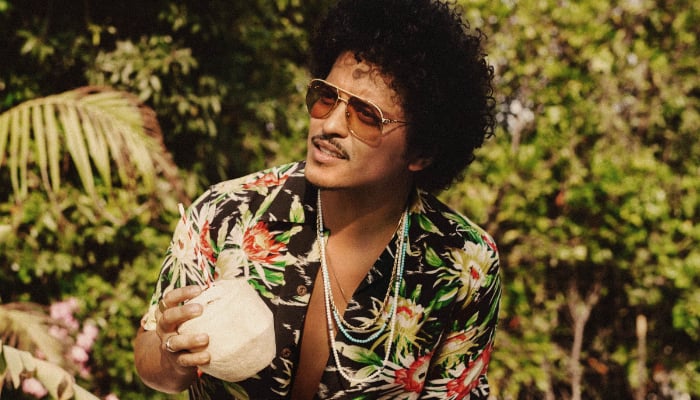
When we talk about one of pop history’s most dynamic entertainers — and one of its most culturally complex — we need to talk about Hawaii.
Among the flotsam and jetsam of ’90s pop culture, few moments feel more obliviously prescient than the time Pauly Shore interviewed Bruno Mars. Shore was an upstart media sensation, a stoner-VJ-turned-celebrity, on the basis of his MTV show Totally Pauly. Bruno, credibly if unverifiably billed as “The World’s Youngest Elvis Impersonator,” was just starting grade school. The footage, shot in Honolulu, shows him to be a little shy on camera and in conversation. But then he’s prompted to demonstrate the iconic Elvis Presley lip curl, along with a few moves. Without hesitation, he goes all the way in, slaying on cue like a seasoned pro.
Most people who’ve seen this encounter — which has racked up almost 1.4 million views since Shore posted a clip to his YouTube channel a decade ago — experience some form of amused astonishment. My own initial response followed a spark of recognition. I first met Bruno when he was this age: around 5 or 6, though Shore’s clip dubiously identifies him as a 4-year-old. I remember watching that superhero transformation, from a quiet little kid in the dressing room to a gyrating dynamo onstage. I can personally attest to the electricity in the room when he’d take the spotlight in a tiny sequined jumpsuit and oversize sunglasses, hips a swivel, lips a-sneer.
It’s impossible to revisit that spectacle now without sensing a flicker of destiny, knowing the arena-stomping phenom that Bruno would go on to become. And it can be slightly unnerving, trying to reconcile the savvy pop exhibitionist we know with the innocence of a child. (At one point Pauly cracks a joke about the G-string debauchery of Daytona Beach. It’s meant to sail over Bruno’s head, but he’s quick with a reply: “When I get older,” he says, prophetically.) But there’s good reason — beyond the celebrity-as-a-tyke clickbait industry — to think about the conditions that went into producing this golden child. A little digging reveals a tangled root system beneath the surface of one of popular music’s most incorrigible surface dwellers, raising issues of racial identity, aesthetic license and cultural birthright.
A smooth operator proudly claimed by both Latinx and Asian-American constituencies, the man formerly known as Bruno Hernandez has also been problematized and exoticized — as in a 2013 Rolling Stone profile that described him as “panethnically, almost futuristically, good-looking,” adding that “it’s as if his face was designed by a focus group.” Perhaps this sort of objectification would feel crasser if Bruno weren’t constantly inviting it, insisting on it. (Head to toe, so player, as the man says.) All too often when we Talk About Bruno, it begins and ends with this outrageous stance, as if to say that there’s nothing of further interest past the preening swagger. But the best way, maybe the only way, to understand Mars and his distinctive foothold in our 21st-century pop firmament is to consider the scene that created and nurtured him — meaning the hothouse entertainment bubble of his native Honolulu, around the time that Pauly Shore came calling. As is always the case in the islands, it helps to know a local. But we’ll get to that.
If you watched the 64th Grammy Awards last month, you saw Bruno Mars and Anderson .Paak open the show with their group Silk Sonic — more or less blowing the roof off Las Vegas’ MGM Grand Garden Arena with a go-for-broke performance of “777,” a song seemingly tailor-made for the moment. In fact, this was Silk Sonic in its natural habitat, and not only because the group had been in residence at the MGM Grand since late February. Mars and .Paak debuted their smooth-soul collaboration on last year’s Grammy Awards, unveiling a leisure-suit look and a lead single: a champagne-and-bubble-bath summons called “Leave the Door Open,” which went four-for-four on Grammy night this year, taking Bruno’s running tally of trophies to 15.
To any casual observer, this outcome fell right in sync with a pop career whose skyward trajectory has seemed unstoppable. Since 2010 — when, as a member of the Smeezingtons, he landed a Top 10 hit with CeeLo Green’s “Fuck You,” and followed it with his own courtlier chart-topper “Just the Way You Are” — Mars has been a galvanic force on the charts, and on whatever stage you’ve got. He has eight No. 1 singles to his name, and another 10 in the Top 10. He’s commanded the spotlight at the Super Bowl Halftime Show, not once but twice.
There are, of course, ways to describe Bruno Mars that don’t revolve around stats, or stunts. He’s an R&B singer who never met a money note he couldn’t milk. He’s an entertainer so eager to please that it’s easy to identify with the love interest he reproaches, with passive-aggressive martyrdom, in another of his early hits, “Grenade.” He’s a fastidiously retro-fab producer and deceptively clever songwriter who prefers his entendres like his women: shameless, and single. He’s an engine of frictionless pop pastiche with a vested interest in all manner of Black music, with which he maintains a rather pressurized solidarity.
Recall that Bruno’s first record label deal was with Motown, in 2004. The label dropped him within a year, ostensibly because he was too difficult to slot into an existing category. He has talked about this quandary, notably in a 60 Minutes profile on CBS in 2016. “I think everybody don’t know what color I am,” he told then-host Lara Logan. “It’s like, ‘He’s not Black enough. He’s not white enough. He’s got a Latin last name, but he doesn’t have — he doesn’t speak Spanish. Who are we selling this to? Are you making urban music? Are you making pop music? What kind of music are you making?” Notice how seamlessly the quote transitions from ethnic identity to marketing strategy, implying that the industry allows barely a distinction between the two. Take note, too, of the insistence that his racial ambiguity served as a liability, not an asset.
In his image and styling, his musical references and his preferred mode of delivery, Mars is obviously working within a Black musical continuum that includes everyone from James Brown to Bobby Brown, with some Michael and Motown and Philly Soul tossed in. At times he’s been flagrant about it. (Actually, that would be most of the time.) Perhaps you recall his Prince tribute at the 2017 Grammys, which met with an overwhelmingly positive response. Just before that homage, he spoke with Latina magazine for a cover story titled “Bruno Mars: Doing It for the Culture” (and written, as it happens, by TIDAL’s global Latin director, Jesús Triviño Alarcón). One statement he made in the piece resonated enough to get picked up by other outlets: “When you say, ‘Black music,’ understand that you are talking about rock, jazz, R&B, reggae, funk, doo-wop, hip-hop and Motown. Black people created it all. Being Puerto Rican, even salsa music stems back to the Motherland. So, in my world, Black music means everything.”
When he returned to the Grammys the following year, Mars took home seven awards, including three of the big ones, for Record, Song and Album of the Year, for 24K Magic. He also performed a track from the album — the New Jack Swing-jacking “Finesse,” with an irrepressible cameo by Cardi B. This time, not everyone was a fan. Singer, songwriter and bassist Meshell Ndegeocello, speaking to Billboard six weeks after the Grammys, dismissed Mars as a karaoke act. Others cried cultural appropriation; one commentator, the writer and activist Seren Sensei, carped that Mars “is not Black, at all, and he plays up his racial ambiguity to cross genres.”
Mars resisted the urge to clap back, at least for a time. Then last year, during a Silk Sonic visit to The Breakfast Club on Power 105.1 FM, host Charlamagne Tha God asked pointblank how he would answer those who called him a cultural thief. “I would say you can’t find an interview where I am not talking about the entertainers that have come before me,” Mars replied, as if he’d been expecting the question. “And the only reason I am here is because of James Brown, it’s because of Prince, Michael [Jackson]. That’s the only reason I am here.” He added: “This music comes from love. If you can’t hear that, then I don’t know what to tell you.”
Bruno Mars was born Peter Gene Hernandez IV in Honolulu on Oct. 8, 1985. According to his father, Peter Hernandez III, he entered the world with classic doo-wop playing in the hospital room, with colored lights aglow. He was, his father has recalled, “a round, tough-looking baby” — nicknamed Bruno as a toddler, because he reminded his dad of pro wrestler Bruno Sammartino.
Bruno’s father originally hailed from Brooklyn, of Puerto Rican and Jewish stock. A diehard Elvis fan obsessed with the film Blue Hawaii, he moved in 1977 to Honolulu, where he met a hula dancer and singer named Bernadette Bayot, who had immigrated from the Philippines at age 10. This meant that young Bruno grew up an ethnically mixed, brown-skinned kid in a place where that much was totally common. There wasn’t a substantial Puerto Rican community in Hawaii, but Filipinos had formed a serious presence in the first half of the 20th century, as more than 100,000 workers, mostly men, were recruited as contract laborers by the Hawaiian Sugar Planters’ Association. (Of course, sugar plantations had left an exploitative legacy in Puerto Rico, too.)
In his 2016 book We Gon’ Be Alright: Notes on Race and Resegregation, cultural scholar and historian Jeff Chang points out that “Asian American” is a fundamentally useless term in Hawaii. “There were ‘Locals,’ there were Native Hawaiians, and there were haoles,” he writes, using the Hawaiian term that refers to Caucasians. “Locals were the mostly nonwhite, often mixed-race sons and daughters who, during the early twentieth century, had forged a political and cultural identity oppositional to haole oligarchic rule. In that way, Native Hawaiians were always Locals. Locals weren’t all Hawaiian. Some haoles were Local. And if one had to ask, one wasn’t a Local.” Chang, born and raised in the islands, goes on to complicate this rough sorting mechanism, outlining some of the sociopolitical divisions within the majority Local coalition.
Hawaii is often famously described as a melting pot, but it’s also a place where differences are parsed with an appraising exactitude. Ethnicity forms a topic of conversation less fraught than on the mainland but no less spiked with presumptions. So it’s worth pointing out that in 1990, when Bruno was 5, Filipinos constituted about 15 percent of Hawaii’s population, according to Census data. And that African-Americans, including those stationed on military bases, made up just 2.5 percent.
Over the next decade, as young Bruno was forming the bedrock of his taste, pop culture felt awash in radiant young Black expression. The Fresh Prince of Bel-Air was a primetime hit on NBC, and In Living Color was blowing up on Fox. Chart-smashing musical artists like MC Hammer and Bell Biv DeVoe were appearing not only on MTV but also on Arsenio. Bruno soaked it all in. And as he set about building a framework for his love of Black culture, he naturally looked to the most robust community at his disposal — the hard-working nightclub and entertainment ecology that had coalesced in the showrooms and dinner theaters of Waikiki.
The most famous avatar of this scene, going back to its midcentury heyday, was Don Ho, who held court at the Waikiki Beachcomber for decades, warbling “Tiny Bubbles” to a tourist crowd. But there was also a subculture of soul, funk and Top 40 musicians in Honolulu — a small but thriving network partly captured on archival albums like the 2016 compilation Aloha Got Soul. (For more in this vein, consult the Honolulu-based independent label by the same name.)
In terms of sheer hustle and staying power, nobody could beat a group called Society of Seven, which opened at the Outrigger Hotel in 1969, and held a marquee residence there for more than four decades. (Their showroom was renovated and reopened in 2016 as the Blue Note Hawaii.) SOS, as they were also billed, was a tight-knit corps of ace entertainers, mostly Filipino, equipped with razzle-dazzle instincts and polymorphic musical gifts. They represented the gold standard for an old-fashioned yet scrupulously up-to-date nightclub act — complete with comic set pieces, celebrity impersonations and a culturally fluid style. And they embodied a tradition of exacting Filipino pop mimicry that many Locals embraced not only as a stereotype but almost as a law of nature. Bruno would have grown up embracing this idea. I’m almost certain that he did.
*****
The Love Notes was the group Peter Hernandez formed with his wife Bernadette: a doo-wop and rock ’n’ roll revue with a crowd-pleasing throwback vibe. By age 4, Bruno was a show-stopping part of the act. I witnessed him in action on a few occasions, marveling at the kid’s precocious prowess even as I shrugged off a preposterous blush of competitive envy.
I would have been in middle school, age 13 or 14, when Bruno was tearing it up as a preschooler. Like him, I was born into an island showbiz and entertainment complex, literally growing up in the spotlight. During the decade before I was born, my parents had toured all over the mainland with a high-octane group called the Tokyo Playmates, racking up miles and stories. Then they moved back to Honolulu, my father’s hometown, establishing a local renown as Teddy and Nanci Tanaka. You could think of them as Hawaii’s answer to Sonny & Cher, at least from the mid-1970s through the ’80s: They worked Waikiki showrooms and outdoor festivals, hosted the Jerry Lewis MDA Telethon and briefly had a TV variety show of their own. Like Sonny & Cher (whom they impersonated with camp perfection), they made it a family act. My folks used to reminisce about how I would sit on my grandmother’s lap as a toddler, drinking Shirley Temples in the lounge. Based on musical cues, I always knew the point in the show when I was about to be called up onstage. In the years to come, my little sister and I were fully integrated into the program, singing and dancing, the four of us often in matching stage attire.

Of course, my dad knew Peter Hernandez. (My dad knew everybody.) So it was only natural that we’d go see the Love Notes every now and then, catching their energetically paced show in a gesture of friendly support. I can’t say that I remember the details of my first Bruno encounter with absolute clarity, but the scene is cinematically vivid in my mind’s eye: a tiny dynamo bounding onstage in his rhinestones and pompadour, instantly the most riveting thing in the room, and far and away the most memorable part of the evening. The kid seemed not only perfectly in place, amid the gel lights and potted plants of a Waikiki showroom; he was practically ablaze with commitment. As someone who took to the stage more out of compliance than compulsion, I instantly recognized that fire, and knew it was something beyond my grasp. Suffice it to say that Bruno knew his calling, and I soon found mine. (Mine involves a much lower profile, a tiny fraction of the money, zero fame and marginal cachet. I love it.)
Having said all that, allow me to suggest that cultural appropriation is a rather complicated issue when you’re talking about a Filipino/Puerto Rican/Jewish kid from Honolulu, channeling Elvis Presley, of all people, for a room full of tourists from Osaka, Omaha and Orange County. And when, several years later, a teenaged Bruno was conjuring Michael Jackson as part of the Aloha Las Vegas Revue — well, that’s hardly any less complicated. What’s not all that complicated is the earnest charge that ran through those expert pieces of youthful mimicry. It’s the same current that flows through Bruno’s multi-Platinum career today, whether he’s balladeering with his heart on his sleeve or tossing M.J. in a blender with P-Funk and a dash of hip-hop swag.
Still, the tensions in Bruno’s art and artifice remain undeniable, and probably irresolvable. Delving into his island roots is by no means an attempt at absolution. But for someone like me, it’s impossible to miss some telltale signifiers in his music, and not just on an ukulele-strumming throwaway like “The Lazy Song.” It’s the way he pronounces “shhtrawberry” in “That’s What I Like,” a song whose chorus adheres to the plantation syntax of pidgin English. Or the way his exuberant reggae forays on a tune like “Show Me” genuflect not only to Kingston, but also to KCCN 100.3 FM, which broadcast a whole range of Jawaiian music when Bruno was a kid, and still does. Even the way he outfitted his old band, the Hooligans — in uniform, with no special marker outing him as the frontman — feels redolent of the Waikiki showroom acts of his youth.
Silk Sonic is the logical next step in this progression, a sly, post-ironic reanimation of ’70s smooth-soul and celestial funk — and, crucially, a meeting of kindred spirits. Anderson .Paak is, like Bruno, an artist of mixed race, with a mother who was born in South Korea and raised by a Black family in Los Angeles. Of course Anderson is Black himself, and his fraternal bond with Bruno confers an implicit cosign. So too does Bootsy Collins, who named the group and occasionally materializes on the album as an interplanetary master of ceremonies.
Mars probably knows that none of this will satisfy his harshest critics. He even seems to grant that they might have a valid point. But his temperament and training don’t allow for self-conscious hesitation. According to every standard he grew up with, the attitude and intention are what matters, and replication is a love language. I have no doubt that he’ll keep finding ways of scavenging gems from our jukebox wreckage, like a mynah bird picking his way along Kalakaua Avenue, singing a song.
A version of this paper was originally presented at the 2022 Pop Conference, hosted by New York University’s Clive Davis Institute of Recorded Music, where the author is an adjunct instructor.