
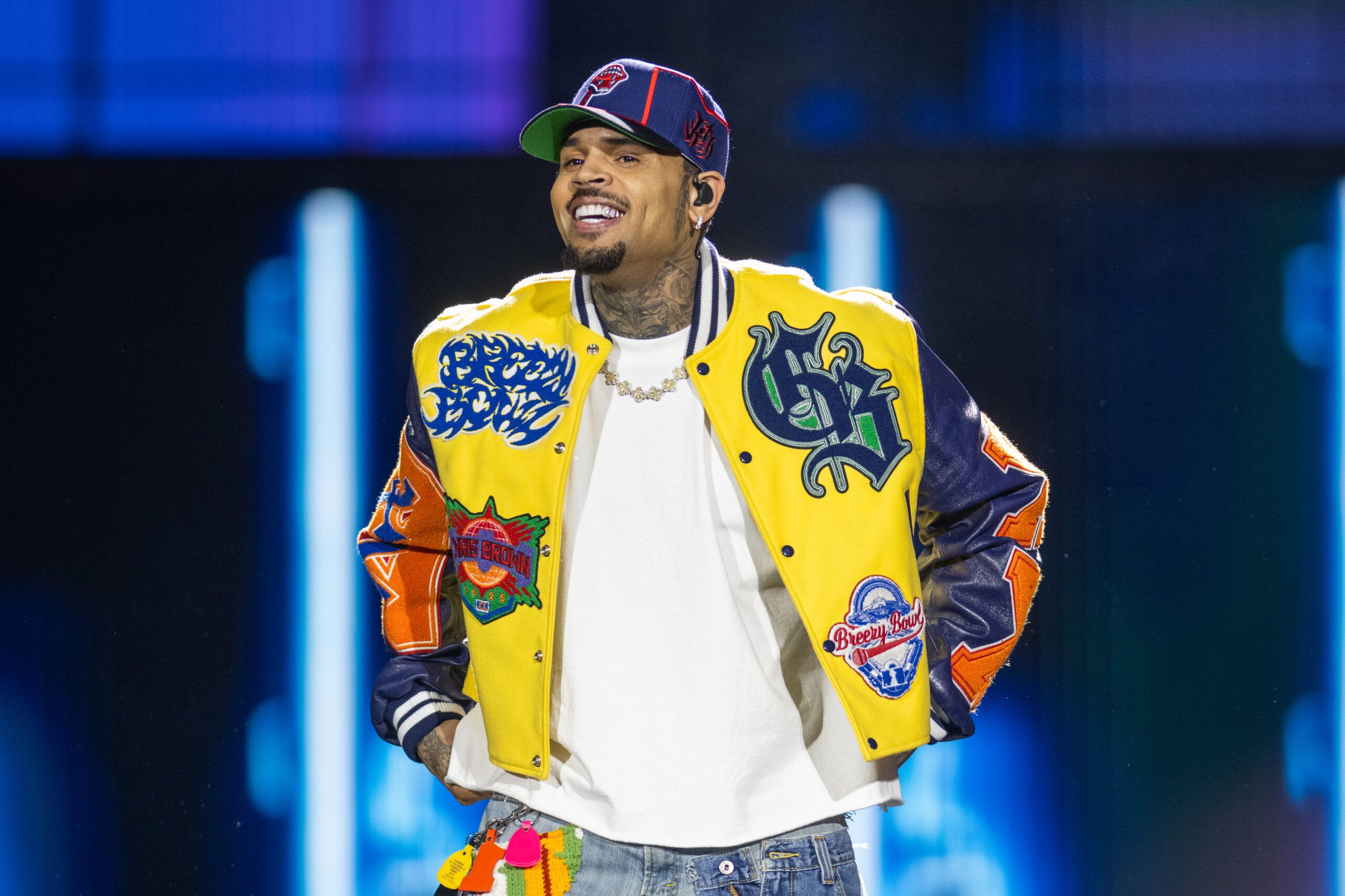
Videos of his sensual performances of “Take You Down” are all over the internet. So are debates about his past.
At every show during his Breezy Bowl XX tour, Chris Brown leads a beautiful woman to a red lounge chair, where he serenades her with his song “Take You Down” before climbing between her legs and grinding into her. The woman onstage changes each time — sometimes she’s a well-known figure like Travis Kelce’s ex Kayla Nicole or Brown’s opening act Summer Walker, and sometimes she’s just a gorgeous civilian seemingly hand-selected from the crowd.
The stunt, widely recorded by concertgoers, draws comments online that are feral and overwhelmingly positive, from “I watched this an unhealthy amount of times” to “Not to be dramatic but I would be screaming and die.” People rave about his sensuality, but that’s not all they’re captivated by — a video of his energetic choreography has 2.2 million likes and thousands of comments lauding his talent. His song “It Depends” inspired a viral dance trend that has been posted about more than 23,000 times on TikTok, contributing to the song’s climb up the charts. Even Kevin Hart participated, with an assist from Ludacris.
But elsewhere online and in the court of public opinion, Brown is a more polarizing figure. People question why there’s so much support for this man with a lengthy “legal issues” section of his Wikipedia page.
“I haven’t forgotten what he did to Rihanna” is a common refrain, referencing a domestic violence incident from February 2009 in which he harmed his then girlfriend, leaving her with severe facial injuries, after the Grammy Awards. He pleaded guilty to felony assault and was swiftly canceled — but not for long.
Many of Brown’s supporters roll their eyes in response to comments about Rihanna, encouraging them to get over it and passionately defending him. But that’s not the only time he’s been accused of violence: He faced accusations that he punched singer Frank Ocean in 2013, though Ocean never pressed charges; an alleged hit-and-run in 2013 resulted in a rehab stay and a probation violation that led to several months in jail; a 2016 lawsuit brought by his former manager Mike G claiming assault, false imprisonment and battery and was settled out of court; and a five-year restraining order granted to ex-girlfriend Karrueche Tran in 2017 involving allegations of threats.
He didn’t leave his legal troubles in the 2010s, either — he was arrested in May 2025 over an incident in which he allegedly smashed a tequila bottle over music producer Abraham Diaw’s head.
Criticism of the singer may follow him throughout his career, but it hasn’t limited his success — it just looks different now. Though he’s no longer dominating the Billboard Hot 100 like he did in the 2000s, he still has some hits, and his current tour is by far his most popular of all time. In 2025, he won a Grammy for Best R&B Album and was nominated for an MTV Video Music Award.
He doesn’t seem canceled anymore at all. Fans are still happy to turn out in droves to his concerts and run to his defense in online comment sections. Why?
‘Separate the art from the artist’
I spent hours reading posts about Brown on social media and spoke to a few of his fans about why they defend him, and many made the same argument: He’s extremely talented, and he always has been. In 2005, Brown broke out with his debut single, “Run It!,” making headlines at just 16 for his gorgeous singing voice and unbelievably smooth dance moves that earned him comparisons to Michael Jackson. Until his fall from grace in 2009, he was at the top of the world. Some people haven’t let go of that — he’s “one in a million.”
Brown is so gifted that his performances make the negativity and drama that follows him slowly melt away in the eyes of his audience, celebrity PR expert Chrissy Johnston tells Yahoo. It helps that his biggest hits were emotional bangers that conjure nostalgia for millennials who listened to “With You” or “Forever” at dances, out at the club or on the radio.
“The controversy [surrounding Brown] is hard to ignore. Some fans try to separate the art from the artist, others can’t and many just shrug it off if the song resonates with them or makes them feel good,” Johnston says. “It’s not necessarily about talent versus bad behavior; it’s more about how human beings have the ability to respect and admire someone’s talent, despite disagreeing with their choices.”
Endurance, not redemption
Brown’s ability to bounce back from cancellation might say more about our culture than his persona and talent, though. Publicist Toni Ferrara tells Yahoo that fans keep “choosing talent, nostalgia and profitability over accountability.”
“This is where we see the truth about ‘cancel culture.’ It was never permanent. It’s selective, it’s inconsistent and it favors the people with enough cultural capital to survive it,” Ferrara says. “America forgives differently when it comes to men, when it comes to celebrities and especially when it comes to artists who give us something we don’t want to lose.”
People are getting tired of being mad all the time. Sarah Schmidt, president of PR firm Interdependence, calls this “outrage fatigue.” She tells Yahoo that this comeback Brown is experiencing is “not about redemption — it is about endurance.”
Maggie, an author from Los Angeles, grew up listening to Brown. She’s not as big a fan as she used to be, but she has sympathy toward the singer. If Rihanna has forgiven him, as she told Oprah in 2012, can we keep holding that incident against him? Can we really hold him accountable for all the other accusations made against him if we’ll never truly know what happened and forgiveness isn’t ours to give?
“If he’s not actively harming people and being a menace, shouldn’t we all give the grace we would want in a similar situation?” Maggie says.
On the other hand, Nizel, a music fan and engineer from Chicago, is more skeptical of Brown.
“I’m all for forgiveness, but what is there to forgive when there is no remorse?” he tells Yahoo. “Chris Brown’s mostly female audience is perhaps the eighth wonder of the world.”
Brown knows he’s controversial. His Breezy Bowl XX concerts feature a video montage of news coverage about his legal troubles.
“It was hard,” he says in the video, according to the Arizona Republic. “It was real hard. No radio would play my music. Nobody would really answer their phones. … Nobody really wanted to be associated with you. Nobody wanted to be around you.”
He says he wanted to focus on his craft and become a better person, but didn’t want to try to meet anyone’s expectations.
That’s enough for Brown’s fans. They haven’t just forgiven him. They contribute to his success by streaming his songs and dishing out tons of money for concert tickets. It’s impossible to ignore that the most viral element of his tour is the moment in which he simulates onstage sex acts with women selected from his audience, seemingly leaving the ways he’s been accused of and admitted to harming women in the rearview and charting a new course he’s made for himself as a man whose star power transcends his actions.