
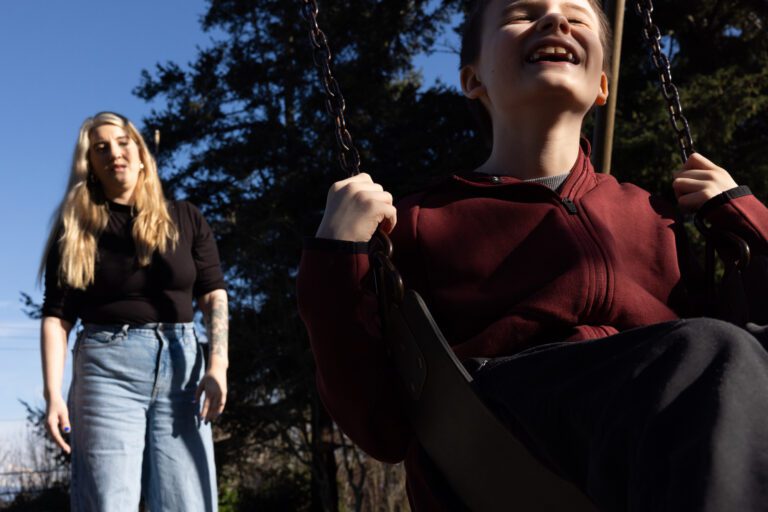

Roen Bolack has hardly attended school for months. The 8-year-old, who is autistic and non-speaking, lives on Lummi Island and attended Beach Elementary School last year.
But in May 2025, the Ferndale School District consolidated its Structured Learning Environment (SLE) programming (which provides disabled students with intensive supports), amid a $6 million deficit and the small island school’s declining enrollment. Roen had previously received intermittent special education, speech support and occupational therapy under the program at Beach, with a one-on-one aide.
The district told Roen’s parents he would have to attend Central Elementary in Ferndale instead — a more than 50-minute trip, depending on the ferry. Staff think Roen would be better served by a special education program at that school.
His parents fervently disagree, enough to seek out attorney Lara Hruska of Cedar Law PLLC, and take the Ferndale district to court alleging discrimination. Public schools are required by law to provide services to students with disabilities, but this dispute highlights the difficult and often emotional challenges that accompany how they provide those services.

Bolack’s parents had already tried sending Roen to Central’s program part time two years ago. He’d come home emotionally dysregulated, exhausted and unhappy. It got to the point where Ashley Swaen struggled to get her son to enter the door to Central when they arrived.
Hruska said the family recognizes Ferndale’s budget crunch but refuses to see Roen’s access to his neighborhood school become a casualty of that financial situation.
Most districts in the region face continued fiscal challenges, mainly due to state funding not keeping up with the real costs of operating a school district. Special education is a large part of that. At a town hall on school funding in January, Ferndale Superintendent Kristi Dominguez said last academic year, the district spent $14.8 million on special education, but received only $12.6 million from the state to cover those costs. The district’s total budget is around $93 million.
“Our position is that excluding the most vulnerable students and discriminating against kids with disabilities is not the appropriate response to a budgetary constraint,” Hruska said in an interview. “The most vulnerable students, disabled students, should be at the heart of the school, not on the sidelines.”
Celina Rodriguez, the district’s executive director of communications, said the district is “committed to providing appropriate educational services to all students,” but said she could not comment on the circumstances of an individual student.
She added that decisions on location of programs and services are based on a “number of factors,” including “student populations, available programming, staffing, and resources across the district,” and they’re made to “ensure students have access to the educational services and supports they require.” In response to a question about the consolidation of the district’s SLE programming, Rodriguez said the districts offers “specialized programs across our schools, but not all programs are offered at each school.”

At the end of that year at Central, Roen’s Individualized Education Plan (IEP) team decided Beach was the best place for him for the next year, Swaen said.
That’s where Roen flourished, his parents said. A February 2025 IEP report shows significant progress in communication, learning how to use his Augmentative and Alternative Communication (AAC) device better, and staying in the general education class for longer periods of time.
Swaen and her husband, Tosh Bolack, were shocked when in May 2025, the district said they couldn’t keep Roen at Beach, and he would have to attend Central instead. The sudden decision felt like the “rug got pulled out from underneath” them.
The parents don’t want to snuff Roen’s progress, they don’t want to move from a place where their son thrives and they don’t feel comfortable sending him to Central. The stalemate between the family and the district has meant Roen’s been largely out of school since the fall.
The district said in documents it didn’t have the staff to provide Roen with a special education teacher, a speech language pathologist nor an occupational therapist at Beach. (Those staff members previously came over to the island to provide Roen these services.)
Swaen and Bolack suggested a split schedule, a few days at Central and some at Beach. Then they said special education and speech services could be offered remotely. The district agreed to one day a week at Beach. But the family didn’t think that was sufficient.
“We were trying to compromise,” Swaen said. “[But] we came to the realization that we weren’t going to come up with a compromise.”
Swaen said their location on Lummi Island, and Beach’s designation as a remote and necessary school, make this situation especially challenging. It’s not the same as him being moved from a school to one just down the road, she said.
“Beach School really is the heart of our community,” she said. “When he is excluded, the effects of that are really, really profound.”


Family enters legal web
Hruska, who has argued various cases related to special education in Washington, said school districts are always trying to consolidate resources. Remote and small schools end up on the chopping block first.
“We’re saying we understand,” Hruska said. “We understand you have budgetary realities. We understand you have to consolidate services. We’re willing to compromise so that the student can go to his neighborhood school, just like his general education peers, and we think it’s discriminatory for them to force him to go off island.”
In August, the family filed a due process request to the Office of Superintendent of Public Instruction to challenge the district’s decision. In the filing, the parents allege that denying Roen “access to his neighborhood school — where he is succeeding — feels discriminatory and contrary to his right to an inclusive, stable education.” A hearing for that action is scheduled for July.
Last fall, Hruska sought a “stay put” motion that if granted, would have allowed Roen to continue at Beach until the dispute between the district and parents was resolved. But a judge denied the motion on the grounds that the district had discontinued the SLE program at Beach.
The district, in court documents, emails and an IEP report reviewed by Cascadia Daily News, continued to say staff felt they could best serve Roen’s needs in the program at Central Elementary, and that the district could not provide Roen with a Free Appropriate Public Education (FAPE) — a legal right for students with disabilities — at Beach. The K-5 Lummi Island school is small, with only two classroom teachers, some support staff and a principal who is only there once a week. Last year, one of those teachers was cut, and only stayed this year because of community fundraising. That position is now up in the air again.
After feeling they were getting nowhere, the family revoked Roen’s IEP last month, believing the action would allow Roen to attend Beach. That means he’s now considered a general education student.
“We’re really just on the ground level of access right now,” Hruska said, “and once we prevail on letting Roen go to school, we can talk about, you know, what’s he working on? What’s he learning? But they’re not even letting him in the front door right now.”
Without an IEP, the family said the district only needs to provide a one-on-one aide, whom the family and Hruska assert is available to support Roen. But Ferndale said Roen would need more accommodations than that — ones they can’t provide at Beach.
On Feb. 20, Hruska filed a discrimination complaint against Ferndale School District in Whatcom County Superior Court for preventing him from accessing Beach School. The district’s lawyers have not yet responded to the complaint. A hearing is set for April.
Bolack said his son can’t ride the school bus, so there would have to be a special vehicle to transport him from the island to Central and a paraeducator with him for the whole trip. The family wonders if this plan would be a cost savings for the district at all.

Hruska said Roen’s exclusion has been detrimental to his peers on the island, too.
“They’re losing access to him, and that’s a travesty, because he’s an important part of their school community,” she said. “… When you attack inclusion, it hurts all kids, not just kids with disabilities.”
Not attending school has been difficult for Roen, Swaen said. When he stopped going to school at first, he would cry when he saw his younger sister leave for Beach.
Bolack and Swaen spoke at a recent school board meeting and brought Roen with them. Swaen said they talk very openly with him and around him about the situation.
“We do wonder how this is affecting him,” Swaen said.
Swaen said she also wants to advocate for other kids with disabilities who are possibly dealing with similar issues. They suspect their daughter is also on the spectrum. They worry about her future at the school, too.
“What kind of message is this sending the students?” she said.