
For People With Autism, Can Restaurant Kitchens Be a Haven?
For three Halloweens in a row, Joseph Valentino was Emeril Lagasse.
He wasn’t the only kid in New Jersey who idolized chefs and wanted to be one when he grew up. For Mr. Valentino, though, the dream seemed especially hard to reach. Diagnosed with autism as a toddler, he still hadn’t spoken by age 5, when he first dressed as Emeril.
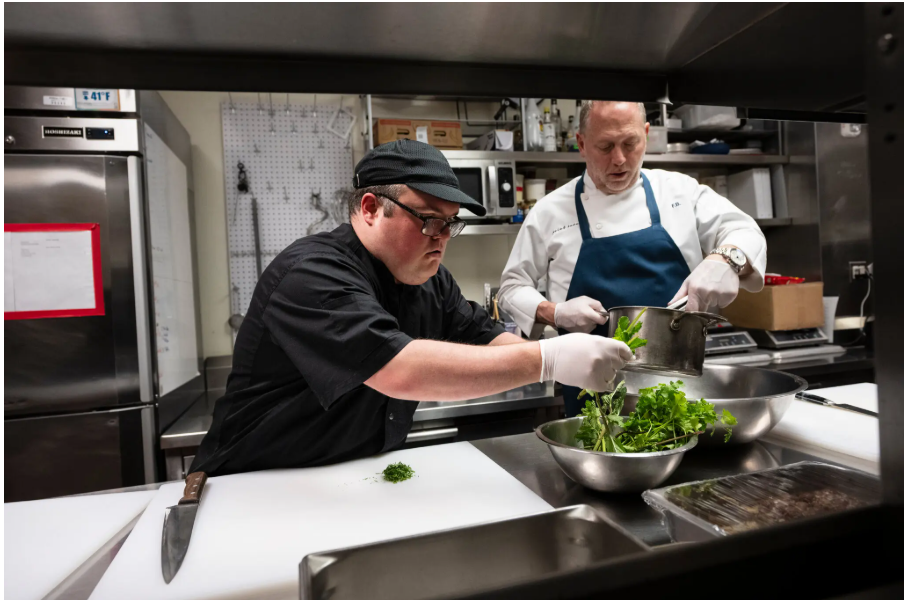
Today, at 27, he is a cook at Point Seven restaurant in Manhattan, working the cold food, pastry and raw bar stations, sometimes all at once. He says the path he took to get there was strewn with rejection. There were interviews that went nowhere, jobs in kitchens where he never felt welcome, deep periods of depression.
“I viewed myself as a liability,” he said.
His career is one of the inspirations for a new program, Chefs on the Spectrum, meant to train and place people with autism in fine-dining jobs.
Mr. Valentino and the owner of Point Seven, the chef Franklin Becker, introduced the initiative Tuesday night during a $2,500-a-head fund-raiser for the nonprofit organization Autism Speaks at Cipriani Wall Street in Lower Manhattan.
Mr. Becker, who is on the group’s board, pitched his Chefs on the Spectrum idea to the rest of the board as a way to help address two problems at the same time: the shortage of skilled labor in restaurants and a high unemployment rate among autistic adults.
Professional kitchens have long been known as havens for people with neurological and developmental disabilities. Chefs who describe themselves as dyslexic include Marco Pierre White, Jamie Oliver and Marc Murphy. Cooks who say they have some form of attention deficit can seem to outnumber those without.
But people on the autism spectrum have an exceedingly low profile in the business, whether because they haven’t been diagnosed or choose not to disclose it.
“I still haven’t met anybody with autism in the kitchen,” said Mr. Valentino, who cooked in cafeterias and catering kitchens before going to work for Mr. Becker last year. “I think that needs to be fixed, and I think this program will fix it.”
There are other initiatives that place people on the spectrum into hospitality jobs. Several coffee chains, including Bitty & Beau’s, which has 13 locations in the United States, are dedicated to employing people with intellectual and developmental disabilities.
But the focus on fine dining makes Chefs on the Spectrum unusual. Mr. Becker, who has an adult son with autism, has recruited more than a dozen chefs from around the country, including Andrew Zimmern, Daniel Boulud, Chris Bianco, Maneet Chauhan and Michael and Bryan Voltaggio. Their restaurants will hire workers from the program after receiving training in how to help those new employees thrive.

“There’s a preconception that there’s a risk in hiring autistic individuals,” Mr. Becker said. “The real risk is overlooking incredible talent.”
That talent can take several forms. Some cooks on the spectrum are meticulously organized at their stations. Some have an exceptional recall of recipes, and others are especially diligent about safety protocols, said Mark Fierro, who provides job-placement support and career coaching at TACT (Teaching the Autism Community Trades), a school for autistic adults in Englewood, Colo.
Some students in TACT’s culinary program perform with astonishing consistency. If a restaurant wants meat butchered into a certain cut, Mr. Fierro said, “they’re going to make them exactly the same way every single time.”
A common hallmark of autism is a cultivation of special interests, intense and passionate devotions to particular topics. For cooks on the spectrum, this can mean a penchant for intellectual spelunking into, say, the molecular structure of hydrocolloids, or the behavior of the molds that produce blue cheese and miso.
“Researching an ingredient, breaking down where it comes from, how to use it, the cultural context — all of that is a special interest,” said a chef in New York City on the autism spectrum who asked not to be identified because she fears that neurodivergence can be misunderstood. “My brain is never satisfied for information. It always craves more.”
Her proclivity for amassing and organizing data made her a “load-bearing pillar” of any kitchen where she worked, she said. It also sets her up to make unexpected associations that can lead to creative leaps.
“The needle for ingenuity gets pushed forward by people who don’t think the same way neurotypical people think,” she said.
Advocates for greater acceptance of autism in the kitchen say that working side by side can benefit people on and off the spectrum. At Chitarra Pastaria, a small pasta company in Cambridge, Mass., whose eight employees all have autism, tailoring jobs for each worker’s talents has been a valuable experience, said one of the founders, the chef Ken Oringer.

“You get to be able to appreciate people for their skill sets,” he said. “It really teaches you to have these relationships with people and learn what makes them tick and how they can be effective.” (Mr. Oringer has been recruited by Mr. Becker to join Chefs on the Spectrum’s pilot program.)
For some people on the spectrum, kitchens are places where they can put their aptitudes to good use without being held back by the challenges that social interactions often pose.
To help autistic people navigate the work, restaurants may have to make minor adjustments. One easy accommodation, said Keith Wargo, the chief executive of Autism Speaks, is to avoid face-to-face job interviews, which demand a complex set of communication skills, in favor of tryouts. Another is to swap LED bulbs for fluorescent fixtures, which flicker and buzz in ways that some people on the spectrum find stressful.
Some accommodations can have wider benefits. Mr. Fierro said he has advised employers to provide cooking timers to help TACT students with multitasking, a minor step that he said also helps neurotypical workers.
Steps, a company that runs job-training centers in Bangkok for neurodivergent adults, as well as cafes and a bakery that employ graduates, consulted with one large hotel group and advised it to place maps, labels and other signs in its kitchens there. The signs were meant to help workers who had memory or attention issues, but they proved popular with almost everybody.
“It helped onboard all new employees more quickly, it helped people work more efficiently during large events, and it increased employees’ sense of belonging,” said Courtney Konyn, the group’s communications director.
Chefs on the Spectrum is still taking shape, but it is likely that some of its training will be based on Mr. Valentino’s experience of navigating professional kitchens. He will try to answer questions about how they can work with people with autism. And he hopes that his career will help change views of autism.
“One day, I do want to become an executive chef,” Mr. Valentino said. “I want to be that one person that has autism and made it to the top of the brigade system.” Mr. Becker, he said, believes he has the qualities to make it happen.
“I have the passion and determination,” Mr. Valentino said. “And I don’t like being late to work.”