

Weed might seem relatively harmless compared to many other drugs, but one heart surgeon has revealed the gruesome truth regarding what it’s doing to your body, as you could be putting yourself at risk of a major health complication in the future.
Cannabis is becoming increasingly popular across the world following efforts from certain countries and states to legalize the drug, as its detrimental effects are considered to be on the lower end when placed next to some of its fellow illegal substances.
It can even have a significant benefit for people in certain medical situations, as videos have shown the transformative effect marijuana has for patients with Parkinson’s, and it can also prove to be helpful for people experiencing extreme pain.
However, it does appear to have a number of unexpected side effects that continue to emerge from new studies, including one recently branded ‘scromiting’, which links excessive vomiting to smoking weed, lasting sometimes for up to 48 hours.
As reported by UNILAD, there could even be a more dangerous side effect in the long term for weed smokers, as heart surgeon Dr Jeremy London has revealed that the connotation that cannabis is ‘safe’ is far from the truth.

Smoking weed could be far more dangerous than you think according to one heart surgeon (Getty Stock)
“Let’s all agree on one thing, that lungs have one simple function and that’s to bring air into and out of your lungs,” Dr London explained on his popular TikTok page. “Anything else is potentially harmful.”
He also adds that “smoking marijuana increases your risk of coronary disease and acute heart attack by 1.3 to 2 times [compared[ to those that don’t smoke marijuana regularly,” noting that there’s a similar increased risk for high blood pressure and increased cholesterol.
While it might not posses the same tar that makes cigarettes so dangerous, lighting up a joint is still something that will invariably damage your lungs over time, causing your body to change for the worse as you age.
“I have operated on multiple patients over the years that smoke marijuana regularly and I can tell you their lugs are totally black, and it looks like they’ve worked in a coal mine,” Dr London recalls.
“They’ve got such severe blockages that I have to do bypass surgery. These are folks that have never smoked a cigarette in their lives.”
It might make you think twice next time you roll up some weed, as it could be far more detrimental to the inside of your body than you might expect.
Plenty of people in the comments underneath Dr London’s video seemingly refuse to believe or accept what he’s saying, stating either a wide variety of other things that harm you like sugar, processed food, or even the Sun, or simply continuing on with the habit, fully aware of its negative side effects.
“Y’all, the point of the video is just for you to know the risk, not to tell you to stop smoking,” writes on comment, but many have seen Dr London’s advice as an attack on their favorite habit.
Featured Image Credit: Jamie Grill via Getty

The World Health Organization has identified a worrying new side effect for marijuana smokers, as warning surrounding the concept of ‘scromiting’ have been issued to anyone who indulges regularly in weed.
While it might be considered a little safer than some of the other illegal drugs – especially considering the fact that it’s legal in a growing number of countries and states across America – marijuana still has some negative side effects that you might want to consider before you smoke away.
Various studies conducted by scientists have identified the dangers of smoking weed as a teenager, as it has a harmful effect on your brain, and dropping it after an addiction can have a surprising number of effects on your body.
It does definitely have its benefits though, especially in a medical context for individuals with conditions like Parkinson’s disease, yet a new frightening side effect has emerged following a warning from the World Health Organization (WHO).
As reported by LADbible, new research conducted by scientists at the University of Washington School of Medicine has revealed a worrying link between the process of smoking cannibis and recurring bouts of vomiting, to the point where the term ‘scromiting’ has now been recognized as an official condition by the WHO.

New research has created a link between cannabis smoking and excessive vomiting, with the side effect referred to as ‘scromiting’ (Getty Stock)
This is also referred to as cannabis hyperemesis syndrome (CHS), which the study indicates includes “abdominal pain and episodes of intense or long-lasting vomiting.”
It appears to begin within 24 hours of the most recent use of cannibis, and can even continue for several days beyond that, making for a nasty side effect if you were to fall fowl to it.
Doctors have praised the new specific classification of this side effect, suggesting that it will have a positive effect on the way that cases are dealt with in the future.
“It helps us count and monitor these cases,” outlines Beatriz Carlini, an associate professor at the University of Washington. “In studying addition and other public health concerns, we have three sources of data: what clinitians tell us, what people in the communities tell us, and what health records tell us.
“A new code for cannabis hyperemesis syndrome will supply important hard evidence on cannabis-adverse events, which physicians tell us is a growing problem.”

Many weed smokers fail to connect their vomiting with the drug, leading to difficulties for doctors (Getty Stock)
One of the issues appears to stem from the reluctance of patients to accept that cannabis smoking is the source of their issue, especially as it is frequently used by people with existing conditions or health complications like chemotherapy or chronic illnesses.
“Some people say they’ve used cannabis without a problem for decades. Or they smoke pot because they think it treats their nausea,” explains Dr. Chris Buresh, an emergency medicine specialist at the University of Washington.
“It seems like there’s a threshold when people can become vulnerable to this condition, and that threshold is different for everyone. Even using in small amounts can make these people start throwing up.”
Featured Image Credit: Catherine Falls Commercial via Getty

Experts have warned of the shocking impact nicotine pouches can have on your body despite being sold as a ‘safer’ smoking alternative.
They are small pouches that are tobacco-free that contain nicotine to provide a smoke-free alternative to cigarettes.
It works by being placed under your top lip, resting against your gum to release the nicotine.
And according to scientists, it could become a gateway for people to start using more nicotine products.

The pouches are used to help people quit smoking (Peter Dazeley/Getty Images)
What do nicotine pouches do to the body?
Adam Leventhal, PhD, who is the director of the Institute for Addiction Science at the University of Southern California’s Keck School of Medicine, told SELF that nicotine pouches are safer than tobacco use or vaping, but they still come with the risk of nicotine dependence if people start using them who were not previously smokers.
Leventhal told SELF: “Your brain gets used to having nicotine in your system, so you don’t get the same mood or attention boost on it as you did previously.”
According to Dr Donna Shelley, professor and vice dean for research at the New York University School of Global Public Health, the pouches are not exactly ‘safe’.
“Some of the negative health effects of the nicotine pouches include gastrointestinal symptoms, like nausea, gum soreness and ulcers, and also some cardiovascular risks like elevated heart rate,” she told NBC News last year.
She added: “We don’t know the full safety profile yet.”
The pouches can cause issues such as:
- gum irritation
- nicotine addiction
- sore mouth
- upset stomach
In general, the use of nicotine can cause:
- heart, stomach, and fertility problems
- weakened immune system

It turns out that the pouches might not actually be risk-free, according to experts (Anastassiya Bezhekeneva/Getty Images)
Why are experts worried?
Because the pouches are free of cancer-causing chemicals or tobacco that can be found in cigarettes, it could have unintentionally become an appealing prospect for non-smokers.
“Usually when you say that something is free of something, it makes it seem less harmful,” said Tory Spindle, associate professor of psychiatry and behavioral sciences at Johns Hopkins School of Medicine in Baltimore.
“Our concern is that, well, does that make them more appealing to someone that otherwise would have never tried any tobacco product?”
He explained that ‘the challenge is, how do you make the products accessible to someone like that, while not inadvertently addicting a new wave of individuals who never would have tried nicotine?’
Rees said: “Teens and young adults who do not smoke or vape should avoid this product.”
One example of nicotine pouches, Zyn, became the first oral nicotine pouch to be approved for marketing by the FDA in January.
The agency said the pouches have ‘the potential to provide a benefit to adults who smoke cigarettes and/or use other smokeless tobacco products that is sufficient to outweigh the risks of the products, including to youth’, adding that the number of young people using the pouches ‘remains low’, with only 1.7 percent of American middle and high school student reporting using them in 2024.
Featured Image Credit: Anastassiya Bezhekeneva/Getty Images

Plastic surgeons believe they’ve discovered another unexpected side effect from popular weight loss drug Ozempic, as some speculate that patients’ skin isn’t behaving as it normally should.
Ozempic and other similar weight loss drugs have firmly taken over the world, as many people have now benefited from the rapid weight loss transformation you can achieve after starting the injections.
While it’s a bit gruesome when you discover how these drugs actually cause you to lose weight, the results themselves are hard to deny and they have allowed many people to achieve their ideal body where they might have otherwise found it too challenging, and they’ve even been linked to a potential cancer cure.
Many doctors have warned that we don’t yet know what the long term effects of these will be, and they also appear to come bundled with a number of nasty side effects, from the more common signs of nausea to bad breath and dental issues down the line.
Another worrying side effect appears to have been spotted by plastic surgeons now though, as these experts have discovered an unexpected change when getting up close and personal with their patients’ skin.

Plastic surgeons have noticed an alarming side effect among patients taking weight loss drugs like Ozempic (Getty Stock)
As reported by Allure, some of the top plastic surgeons in the United States have alerted that Ozempic is making the skin of those who take it behave differently than usual, noticing a marked difference in the quality.
One asserted that the skin quality of someone using GLP-1 injectors reminded him of an “old overused rubber band,” even making the comparison to the elastic waistband on an old pair of underwear that has worn out over time.
Additionally, another expert illustrated that the skin of Ozempic takers is “definitely thinner and weaker,” particular in the subcutaneous musculoaponeurotic system (or SMAS for short) layer, which is essential for anyone wanting to get a facelift later on in life.
“The success of the facelift is really based on the strength of the muscle layer,” explained Dr Jason Diamond, a plastic surgery expert. “You’re not pulling out the skin and using that to get the lift. The muscle layer being thin can definitely affect facelift results.”

GLP-1s like Ozempic appear to be making the skin ‘thinner’ and even appear ‘older’ (Getty Stock)
Dr Julius Few, another leading plastic surgeon, has found that patients taking Ozempic – which makes up around 25 to 30 percent of his clients – have skin that “doesn’t hold its elastic recoil the way it did.”
He even estimates that the weight loss drug “almost seems to age the quality of the skin, like the skin takes on the appearance of an older person.”
Novo Nordisk, the company behind Ozempic, has rebuked these claims and insisted that they “are not aware of any studies looking at the effect of semaglutide specifically on facial fat,” but these plastic surgeons continue to comment on what they’re seeing on a daily basis, so it’s definitely something to consider before you opt for the drugs as a weight loss solution.
We have enough to worry about with concerns about global warming burning us off the face of the planet, an AI uprising bringing the Terminator movies to life, and one of the world’s many power-trip political leaders nuking us into oblivion, but adding to this, we should now be worrying about the food that we eat.
HBO’s The Last of Us showed us a harrowing timeline where flour turned humanity into mushroom monsters, and while that’s just fiction, there are some real-life dangers thanks to what we consume.
Having previously covered how keeping cooked rice in your fridge can turn it toxic, and why some foods should be kept away from the freezer, we’re now being warned about what eating uncooked pork can do to our health.
We already know that air fryers can unexpectedly lead to undercooked pork, and even though overcooked meats can give an increased risk of cancer, you’ll want to think twice about how you cook after seeing this ‘nauseating’ scan.
Doctor Sam Ghali has shared a CT scan on X, showing the unexpected sight of someone’s lower half sporting a series of unusual dark spots.
Ghali says this is one of the most ‘insane’ scans he’s ever seen, explaining how the shot of the pelvis displays ‘linear densities’ that are actually a sign of cysticercosis.
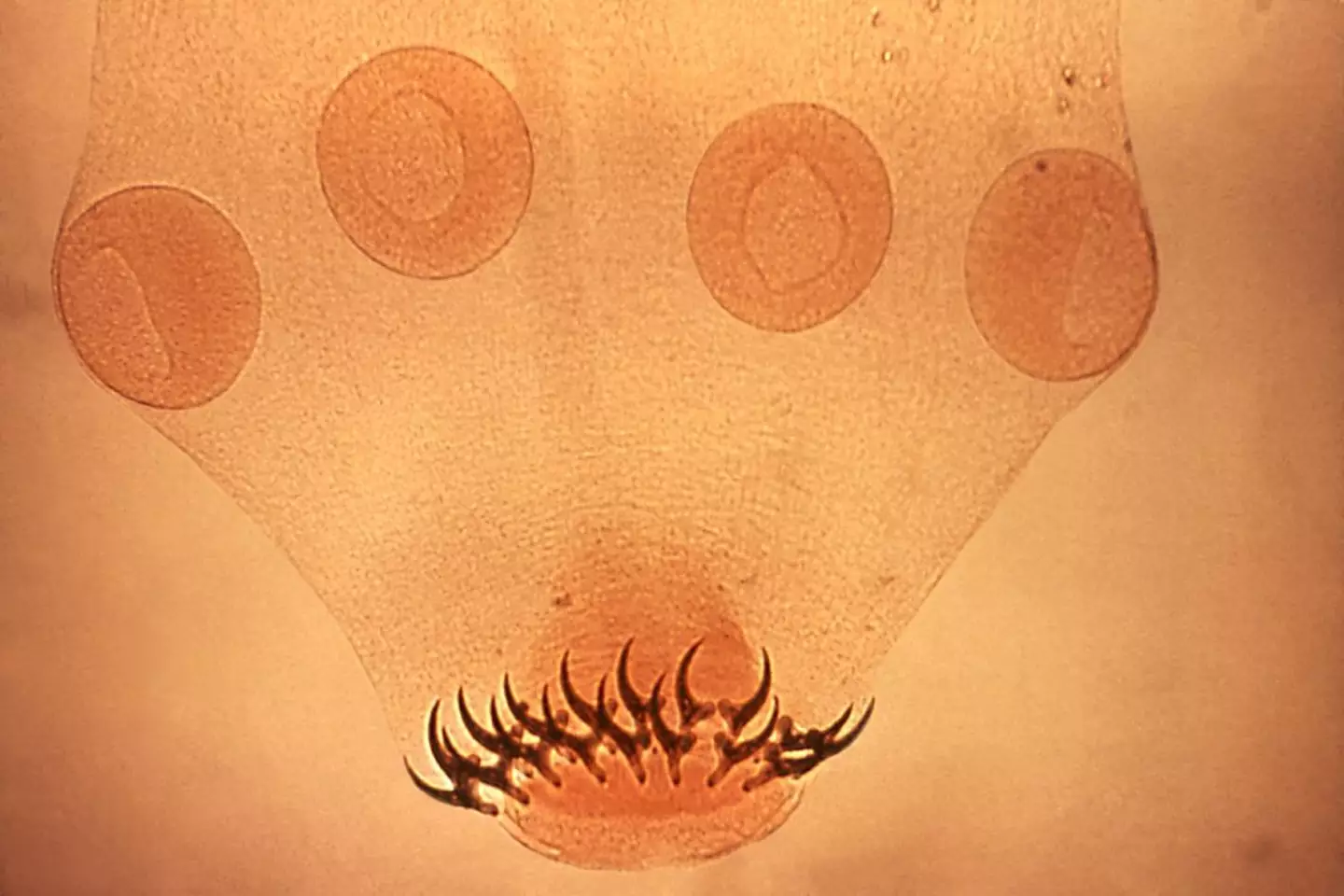
Taenia solium can be especially dangerous if it moves to the brain (Smith Collection/Gado / Contributor / Getty)
The spots are actually larval sacks of Taenia solium, which is known best as the pork tapeworm. This life cycle begins when a human consumes raw or undercooked pork, leading to them getting an infected gastrointestinal tract and passing this on to other humans.
Ghali warns that these cysts can travel anywhere in the body, so although this lucky patient only appears to have them in the legs, others are known to have been infected in the brain.
In an area like the legs, pork tapeworms don’t cause much of an issue, with the initial scan only being taken because they’d fallen and injured their hip.
The cysts tend to harden over time, leading to what we know as ‘rice grain calcification’. He reminds us that the real problem happens if the Taenia solium makes it to the brain and calcifies there.
Neurocysticercosis can cause seizures and even be deadly if not treated. The real problem is that neurocysticercosis is referred to as the ‘great imitator’ because it can mimic numerous other neurological disorders.
Ghali says that the moral of the story is to always do your best to keep clean, wash your hands, and never (under any circumstances) eat raw or undercooked pork.
With a new fear unlocked, one person replied to the video saying: “See that’s why I don’t eat that nasty undercooked bacon they have. In other countries, UK, Canada, Japan, none of the places I’ve been to make crispy bacon outside of US.”
Another added: “I’m just going to act like I didn’t just eat slightly undercooked pork belly the other day.”
A third said: “Omg, I literally just finished eating bacon!! 🥓🫣.”