
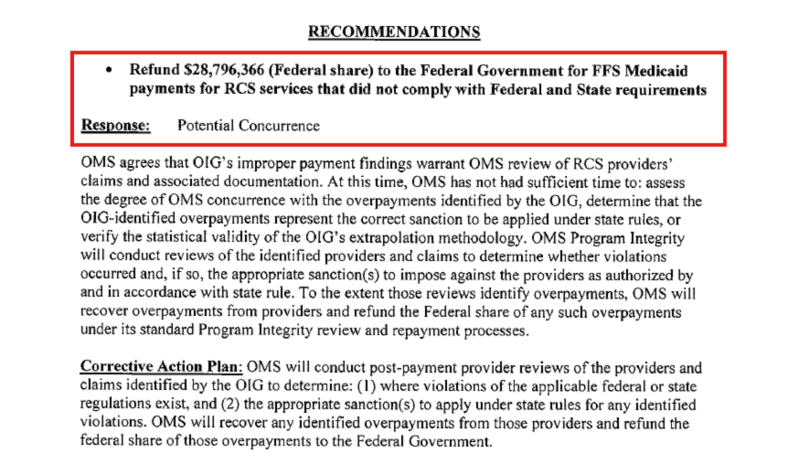
The U.S. federal government is demanding a $28.7 million refund from Maine as an audit uncovers rampant documentation failures in rehabilitative and community support services.
The Mills Administration continues to face criticism over the mismanagement of Maine’s largest welfare program, MaineCare, including a federal report published Thursday that threatens to blow yet another hole in the state’s budget.
[RELATED: One Portland Office Building Has Five Medicaid Agencies and a Somali Money Transfer Office…]
The audit also sheds new light on Maine Attorney General Aaron Frey’s Jan. 10, 2025, directive to Department of Health and Human Services (DHHS) employees that they refuse to cooperate with Justice Department lawyers.
It also could provide a hint as to why DHHS Commissioner Sara Gagné-Holmes has expressed fear of a congressional subpoena in relation to a House Oversight Committee investigation into MaineCare finances.
In the short term, the Mills Administration and Democratic lawmakers will find themselves in a fiscal straitjacket for the remainder of the current legislative session.
The fiscal wreckage of the audit is substantial, with federal auditors estimating that DHHS made at least $45.6 million in improper payments in 2023 alone. Of that total, the feds are demanding that the state refund the $28.7 million federal share immediately.
But the bleeding doesn’t stop there.
The OIG flagged another $22.4 million ($14.2 million federal share) as “potentially improper,” citing documentation so unreliable or incomplete that officials could not verify if the services were actually rendered. The report, published by the Office of Inspector General (OIG) for the federal Department of Health and Human Services, only looked at one small part of MaineCare—notably, not the part attracting significant attention due to fraud concerns. The auditors for this report examined payments for services provided to children diagnosed with autism in 2023, as well as claims for reimbursement submitted to the federal government by the Maine Department of Health and Human Services (DHHS). The results are comically bad. Or, at least, they would be if federal clawbacks didn’t presage more tax increases from Augusta.
The audit’s sample was a perfect 100-for-100: every single “enrollee-month” reviewed by the OIG contained errors, suggesting a lack of oversight, or perhaps no oversight, for Rehabilitative and Community Support (RCS) services. Investigators found that 81 percent of sampled months lacked required comprehensive assessments or necessary staff and parent signatures, meaning there was often no valid proof that care was ever authorized.
Nearly two-thirds of sampled months failed to meet basic documentation requirements, such as supporting the number of units actually billed to the state. In some cases, providers used “cloned” session notes—identical descriptions copied and pasted across different visits—which failed to show any unique progress for the child. Perhaps most shocking, 92 percent of the sample included “nontherapy time,” with taxpayers footing the bill for lunches, breaks, and naps. One out of every five sampled months even featured providers who could not prove they had the licenses or certificates required to treat children in the first place.
This regulatory lapse grew as spending on these services surged from $52.2 million in 2019 to $80.6 million by 2023. That period correlates perfectly with Gov. Janet Mills’ (D) decision to drastically expand MaineCare eligibility multiple times. The OIG laid the blame squarely on a decade-long oversight vacuum, noting that the state has not performed a statewide postpayment review of these providers since the program began in 2010.
Maine officials “potentially concurred” with the demand to refund the initial $28.7 million, stating they will conduct their own reviews of the flagged claims and update state rules to finally implement the oversight they skipped for the last 15 years.