
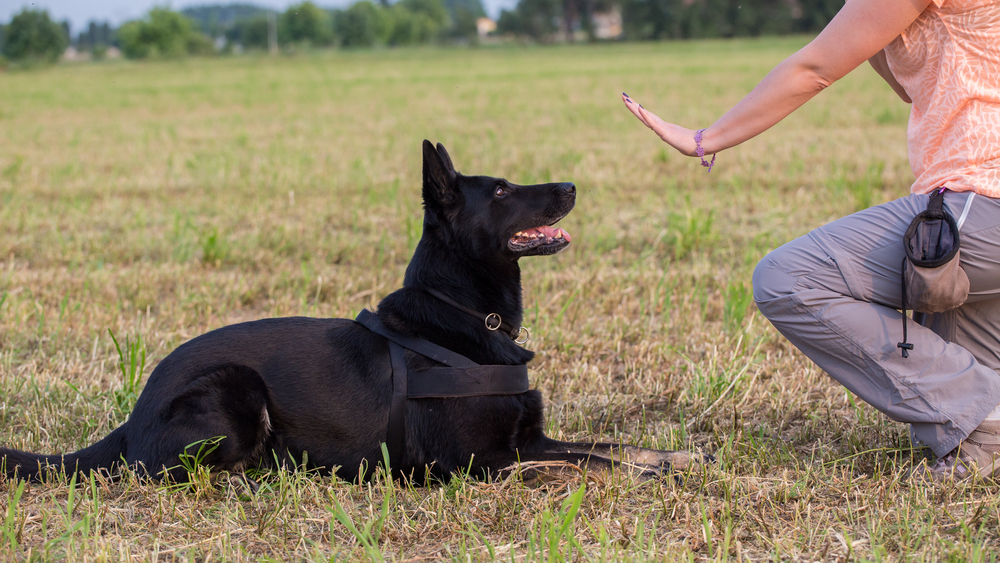
If your dog only obeys when you use hand signals and seems to ignore verbal commands, this is very common—and usually not a hearing problem or stubbornness. It means your dog has learned to prioritize visual cues over verbal ones.
The good news? This is completely fixable with the right training approach.

Why Dogs Rely on Hand Signals More Than Voice
1. Hand Signals Were Reinforced More Strongly (Most Common)
Most people teach commands like this:
-
Say “sit” while moving the hand
-
Reward the sit
-
Repeat
Over time, your dog learns:
“The hand movement predicts the reward.”
The word becomes background noise.
2. Dogs Are Visual Learners
Dogs naturally:
-
Read body language
-
Watch movement closely
-
Respond faster to visual cues
Hand signals are often clearer and more consistent than speech.
3. Verbal Cues Changed Over Time
Dogs get confused if:
-
Tone varies (“SIT!” vs “sit…”)
-
Different words are used (“down” vs “lay down”)
-
Commands are repeated
Inconsistency weakens verbal cues.
4. The Dog Is Waiting for Confirmation
Some dogs hesitate because they’re thinking:
“Is this really what you want?”
The hand signal acts like a green light.
5. Hearing Changes (Less Common)
If your dog:
-
Doesn’t respond to sounds
-
Sleeps through noises
-
Is senior
Hearing should be checked—but most dogs in this situation hear fine.
How to Tell If It’s Training (Not Hearing)
✅ Responds instantly to hand signals
✅ Reacts to other sounds (door, treats, leash)
✅ Follows voice sometimes indoors
➡️ This is a training history issue, not deafness.
What NOT to Do
❌ Don’t repeat commands louder
❌ Don’t wave hands automatically
❌ Don’t assume your dog “won’t listen”
❌ Don’t drop verbal cues entirely
Yelling or repeating weakens voice commands further.
How to Teach Your Dog to Respond to Voice Commands

Step 1: Say the Word First (Always)
-
Say the verbal cue clearly
-
Pause 1–2 seconds
-
THEN use the hand signal if needed
This teaches the word predicts the action.
Step 2: Fade the Hand Signal
Over several sessions:
-
Make the hand signal smaller
-
Slow it down
-
Delay it
Reward immediately when your dog responds to the voice alone.
Step 3: Pay Heavily for Voice-Only Responses
When your dog obeys without the hand signal:
-
Jackpot with treats
-
Praise calmly
Make voice responses more valuable.
Step 4: Practice in Low-Distraction Settings
Start:
-
Indoors
-
Quiet spaces
-
Short sessions (3–5 minutes)
Only later move outdoors.
Step 5: Use One Clear Word Per Command
Be consistent:
-
One word
-
Same tone
-
Same timing
Clarity builds confidence.
What If My Dog Still Waits?
That’s okay—hesitation is part of learning.
-
Shorten sessions
-
Reduce pressure
-
Reward effort
Confidence comes before speed.
How Long Until Improvement?
With daily practice:
-
Notice improvement in 3–5 days
-
Reliable voice response in 2–3 weeks
-
Strong response under distraction in 1–2 months
Is It Bad If My Dog Uses Hand Signals?
Not at all.
Many trainers intentionally teach both.
But your dog should respond to voice alone when needed—for safety and communication.
Final Takeaway
Your dog isn’t ignoring you—they’re responding to the cue that has always mattered most. Shift the reward history, slow down your signals, and your dog will learn that your voice matters too.
🐾 Dogs do what’s clear and rewarding—make your words count.