
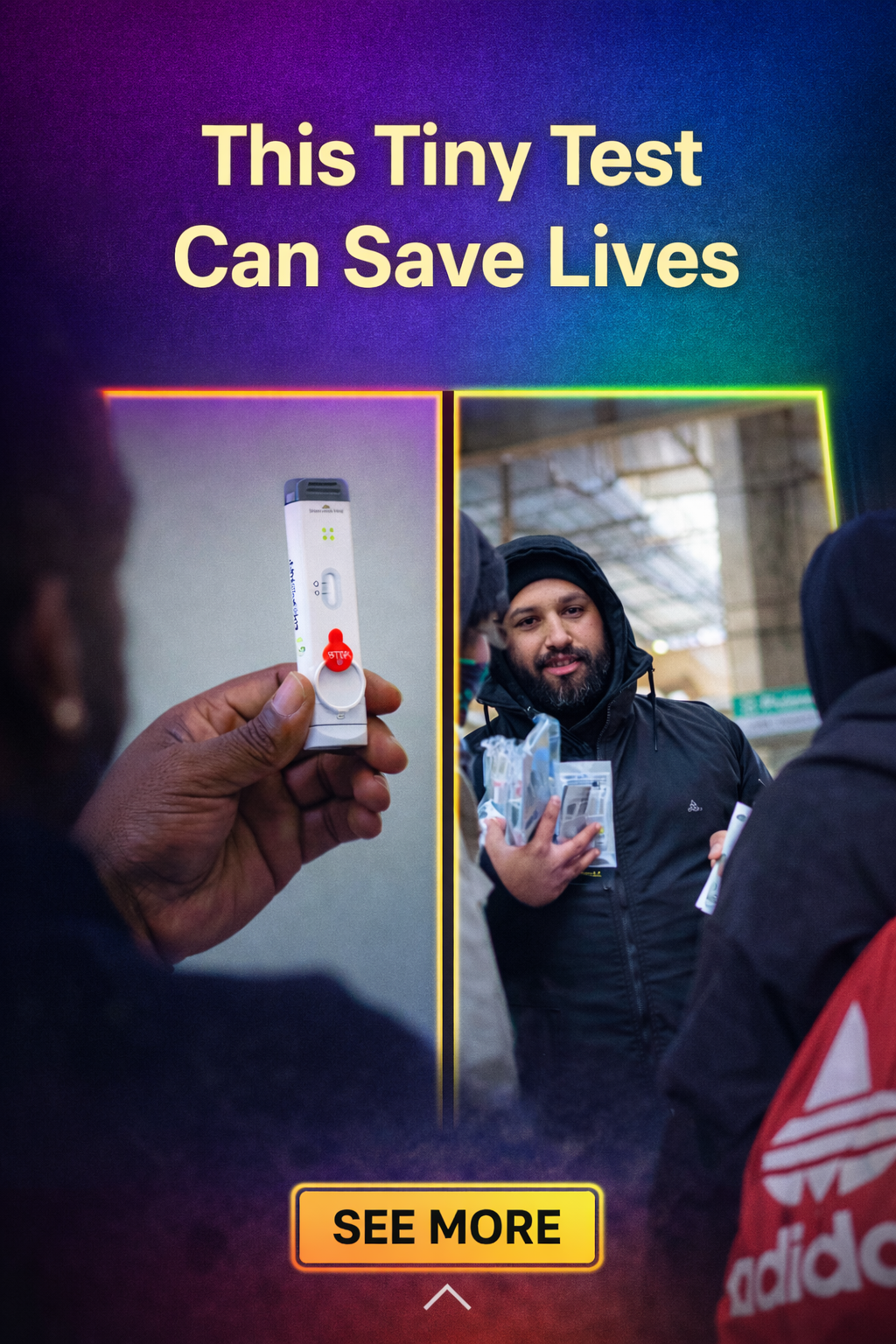
A young man approached a card table set up under the Green Line tracks on the city’s West Side and asked the woman behind it if she had any clean needles or naloxone, a medication that can reverse the effects of an opioid overdose.
While rummaging through a box of supplies in search of those items, the woman also handed him another small package: a fentanyl detection device, which is designed to screen illicit drugs for the presence of that highly potent — and potentially fatal — substance.
Fentanyl, a synthetic opioid 100 times stronger than morphine, is often mixed in with other narcotics or pressed into counterfeit pills, posing a high risk of overdose for unsuspecting users and the leading cause of death for Americans aged 18 to 45, according to the Drug Enforcement Administration.
The woman, who works for the local nonprofit West Side Heroin/Opioid Task Force, briefly explained how the device works as the man slipped the package into his coat pocket.
“It’s pretty cool,” she added. “Stay safe.”
Roughly a dozen outreach workers for the task force fanned out across the West Side on a recent weekday to distribute fentanyl detection devices, one of several drug harm mitigation strategies the organization uses to try to keep the community safer as well as prevent overdoses.

“They absolutely test what’s in their drugs. They want to know what’s in their drug supply,” said the Rev. Fanya Buford-Berry, director of the task force. “Some people purchase heroin thinking it’s heroin but then they find out there’s fentanyl in it.”
The Centers for Disease Control and Prevention lauds fentanyl testing as “an important harm reduction tool.” While abstinence from drugs is the only way to prevent overdose, testing can help decrease the risk of overdose when used in concert with other harm reduction strategies.
“Look for organizations in your city or state that distribute (fentanyl testing strips), keep them on you, and use them,” the CDC says on its website.
The task force usually passes out kits that include fentanyl detection strips inside plastic sandwich bags, along with sterile water and little paper condiment cups, which are used to perform the test; illicit pills should be crushed first before testing.
A small amount of drugs are then placed in the clean, dry containers and mixed with a small amount of water, according to instructions on the CDC’s website. The test strips are placed in the water for 15 seconds and then taken out and left on a flat surface for a few minutes, before reading results.
On this particular day, the task force also distributed a newer product called Defent One, an all-in-one, prepackaged portable fentanyl detection device that looks similar to a COVID or pregnancy test and eliminates a few of the typical testing steps.
The device is sold by the private California-based company Defense Diagnostics Inc., and hundreds of them were recently donated to the task force for local distribution. The single-use product typically retails for $10, with discounts when multiple devices are purchased at the same time.
Some task force workers conjectured that the ease of use and convenience of a prepackaged device might prompt more folks to test their drugs, especially those who are younger.

Defense Diagnostics CEO and founder Ahmad Hussain, who was raised in west suburban Carol Stream and attended DePaul University, said the all-in-one fentanyl detection device is “designed to be used on the go.”
“No matter where they are, whether it’s a musical festival … service workers, people who work in night life, college students — it’s been very beneficial for those audiences,” he said. “This is just a way for people to make informed decisions.”
Hussain said he was motivated to create the product after fentanyl killed his 19-year-old cousin about a decade ago.
“The more and more you talk about it, you realize most people are no further than a couple degrees separated from an opioid tragedy,” he said.
The devices were also distributed over the summer at Lollapalooza in Grant Park, Hussain added.
“Because they have such a wide range of music, for us, we saw it as an opportunity to cover many demographics and it was such a big event, it was just a way to increase awareness across a larger range of groups of people.”
The CDC cautions, though, that while fentanyl testing can reduce harm it still has some limitations.
For example, fentanyl might not be detected if it is in the drugs but no trace happens to be in the sample that’s tested, which is known as “the chocolate chip cookie effect.” Just as one bite of a cookie might not happen to contain chocolate chips, one small sample of drugs might not include fentanyl even if the larger supply is tainted, the agency’s website explains.
Testing might not identify some analog drugs, powerful synthetic opioids that are chemically similar to fentanyl; it also can’t reveal how much fentanyl is in a supply, just that its presence is detected, the CDC added.
The agency urges use of fentanyl testing in combination with other steps to mitigate harm such as never using drugs alone and not mixing different drugs, as well as always keeping the overdose reversal medication naloxone, also known by the brand name Narcan, on hand and at home.
“Don’t rely on a previous source or experience,” the CDC warns. “Knowing where your drugs come from doesn’t mean they’re safe. And even if you have used drugs before, your body could react differently every time.”
The CDC website also includes information on drug treatment and recovery.

Members of the task force also routinely connect folks with those services locally, Buford-Berry said.
But harm reduction strategies such as fentanyl testing can be critical for people who aren’t ready to seek treatment or begin recovery, as well as in the event of a relapse.
“When you’re ready for care, we’ll get you into care,” she added. “Until then, we want to make sure people stay alive. Every day a person is allowed to stay alive, they can choose recovery. They can’t choose recovery if they’re dead.”
In mid-December, President Donald Trump signed an executive order that designated illicit fentanyl to be a “weapon of mass destruction” as opposed to previous language classifying the opioid crisis as a nationwide public health emergency.
“Illicit fentanyl is closer to a chemical weapon than a narcotic,” the executive order said. “Two milligrams, an almost undetectable trace amount equivalent to 10 to 15 grains of table salt, constitutes a lethal dose. Hundreds of thousands of Americans have died from fentanyl overdoses.”
However, many drug harm reduction and recovery advocates in Illinois as well as across the nation have condemned this reclassification, fearing that the language implies someone struggling with addiction could face harsher penalties for using fentanyl.
“Advocates who lost children, friends and family to overdose have advocated against this approach, as it could stop someone from asking for help during an overdose emergency,” said a Dec. 29 statement from the Illinois Harm Reduction and Recovery Coalition.
The coalition — whose members include the West Side Heroin/Opioid Task Force as well as the Aids Foundation of Chicago, the Sex Worker Outreach Project Chicago and other local organizations — was formed in 2017 to fight stigma surrounding drug use and promote life-saving substance abuse strategies.
The coalition’s statement noted that the executive order doesn’t mention drug treatment or overdose prevention strategies.

“The bottom line is clear: fentanyl is a public health crisis,” the statement added. “This (executive order) offers no proven solutions for the overdose crisis — its intention is to expand war powers, not lifesaving solutions. Declaring fentanyl a weapon of mass destruction justifies reckless violence while ignoring the proven health solutions that actually reduce overdose deaths of Americans.”
Across the state, public health authorities have recently launched a variety of harm reduction initiatives designed to decrease the risk of drug overdoses.
The Chicago Department of Public Health offers free Narcan, fentanyl testing kits and drug harm reduction training.
Cook County officials in September began a campaign dubbed “Get Naloxone,” featuring digital marketing, billboards and posters in English and Spanish.
Rush University Medical Center began hosting Narcan nasal spray training sessions for barber college students in summer 2024, enlisting prospective barbers and beauticians in the fight to combat the opioid epidemic.
Narcan vending machines dispense the overdose reversal medication for free at a half-dozen CTA stops across Chicago.
A new law that took effect Thursday requires libraries across Illinois to stock supplies of medications that can reverse opioid overdoses; libraries must also “take reasonable steps” to ensure a staff member who has been trained to recognize and respond to opioid overdoses is always present.
“We know this is just a realistic part of a library’s work,” Ellen Riggsbee of the Evanston Public Library told the Tribune, a few days before the law went into effect. “It’s a public library and we have to ensure the safety of everybody who comes in.”