

As autism diagnoses continue to rise across the United States, schools are under growing pressure to better support students on the spectrum. About 1 in 31 children has been identified with autism spectrum disorder, according to the Centers for Disease Control and Prevention, a shift that is reshaping classrooms nationwide.
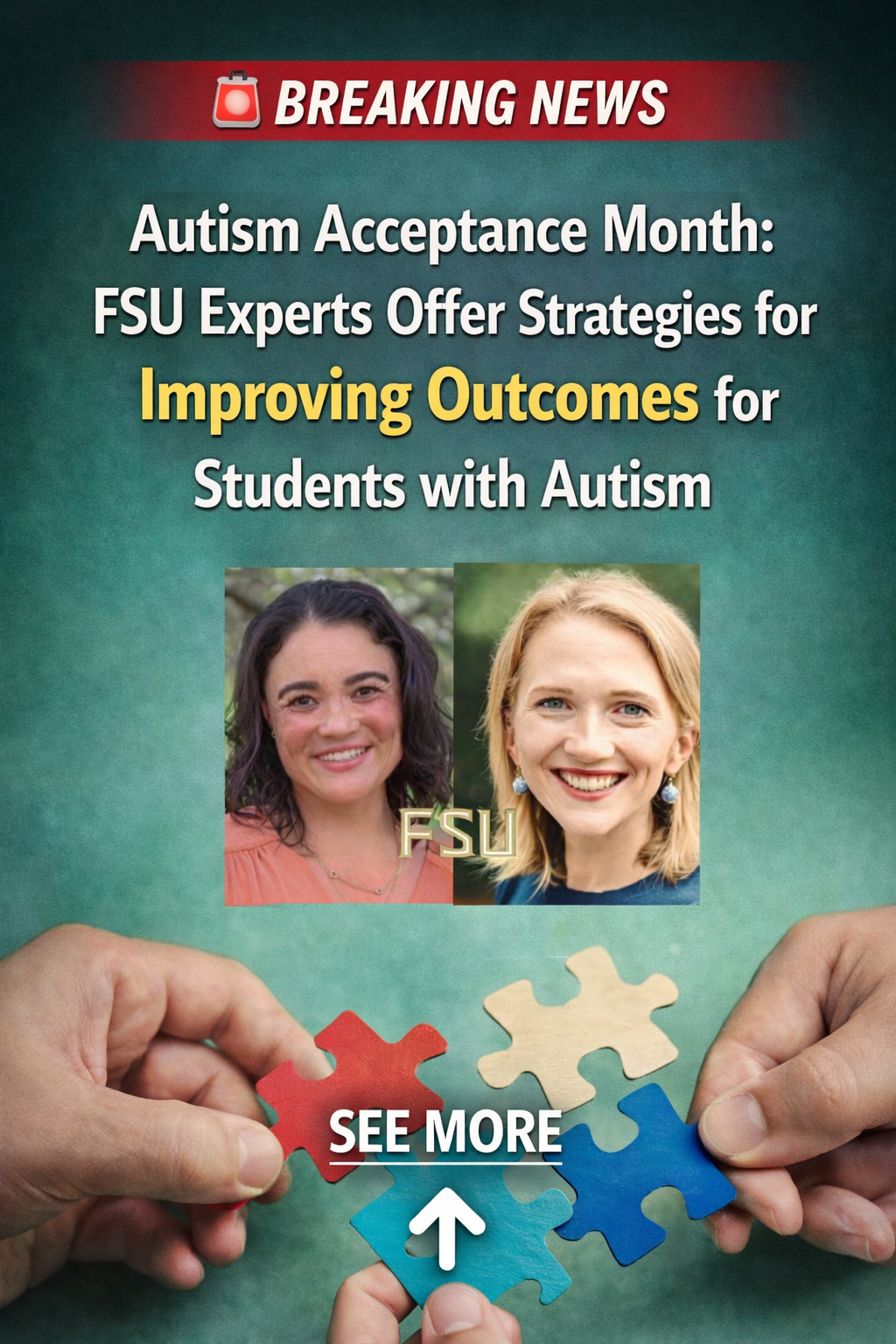
At Florida State University, researchers Jenny Root and Veronica Fleury from the Anne Spencer Daves College of Education, Health, and Human Sciences are studying how schools can meet that need. Their work focuses on evidence-based teaching strategies and inclusive classroom practices that improve both academic and social outcomes for students with autism.
The Autism Society recognizes April as Autism Acceptance Month, which brings attention to the need for greater understanding, support and inclusion.
Root and Fleury are available to speak with media about what strategies work in the classroom and how educators can better support autistic students.
Fleury’s research focuses on optimizing learning opportunities for individuals with autism spectrum disorder. She examines how autism influences students’ ability to participate in learning and explores instructional strategies that support academic and social development in young children. Fleury has more than 20 years of experience working with children with autism and she received the 2023 Research Award from the Council for Exceptional Children’s Division on Autism and Developmental Disabilities.
What are some of the most important ways schools and educators can better support students with autism in classroom settings?
Our best chance at promoting positive outcomes for individuals with autism is through early intervention and high-quality education that incorporates evidence-based instruction. Providing teachers with exemplary training in the characteristics of autism and the use of research-supported practices is critical.
Evidence-based practices center on predictable environments, explicit teaching methods and behavioral supports that prioritize frequent practice and immediate feedback. To keep pace with the growing body of research, educators must also have ongoing opportunities to monitor students, continue learning and adjust instruction as needed.
Based on your research, what strategies or approaches show the most promise for improving learning, communication or social outcomes for students with autism?
My current intervention work focuses on using shared book reading (i.e., adults reading aloud to children) as a context to develop early literacy and language skills in young children with autism. Reading aloud is a developmentally appropriate way to build foundational skills for reading success. Because it is inherently social, many children with autism require additional support to actively engage in book-reading activities. While the fundamental skills remain the same, how we teach them may differ. Autistic children may require more frequent reading opportunities, carefully selected books aligned with their interests, explicit vocabulary instruction and behavioral support to sustain engagement.
Jenny Root, Anne and John Daves Endowed Associate Professor, Anne Spencer Daves College of Education, Health, and Human Sciences; affiliate faculty, Florida Center for Reading Research
jrroot@fsu.edu
Root’s research focuses on developing and evaluating evidence-based instructional methods that promote meaningful academic learning for students with autism and intellectual disability, as well as supporting teachers in implementing effective practices. She has authored more than 50 peer-reviewed publications and received the 2025 Presidential Early Career Award for Scientists and Engineers.
What are some of the most important ways schools and educators can better support students with autism in classroom settings?
Many classroom expectations are based on implicit norms about how students should behave, communicate and demonstrate learning. For students with autism, these norms can create unnecessary barriers.
While it is important to support students in navigating different expectations, it is equally important for educators to provide flexibility. By allowing flexibility in how students engage, respond and demonstrate understanding, educators can focus on meaningful learning rather than surface-level compliance.
Supporting students with autism is often framed as providing additional help, but a more productive lens is to reconsider how classrooms are designed in the first place. When educators embed support for communication, predictability and engagement into instruction, they reduce the need for individualized workarounds and create more equitable learning environments.
Based on your research, what strategies or approaches show the most promise for improving learning, communication or social outcomes for students with autism?
Students are more successful when they are taught not just what to do, but how to use supports independently. This includes learning when to use a strategy, how to adapt it and how to ask for help when needed.
Instruction should include opportunities for decision making, self-monitoring and gradually reducing adult support over time. When designed this way, it helps students build skills they can apply across settings beyond the classroom.