
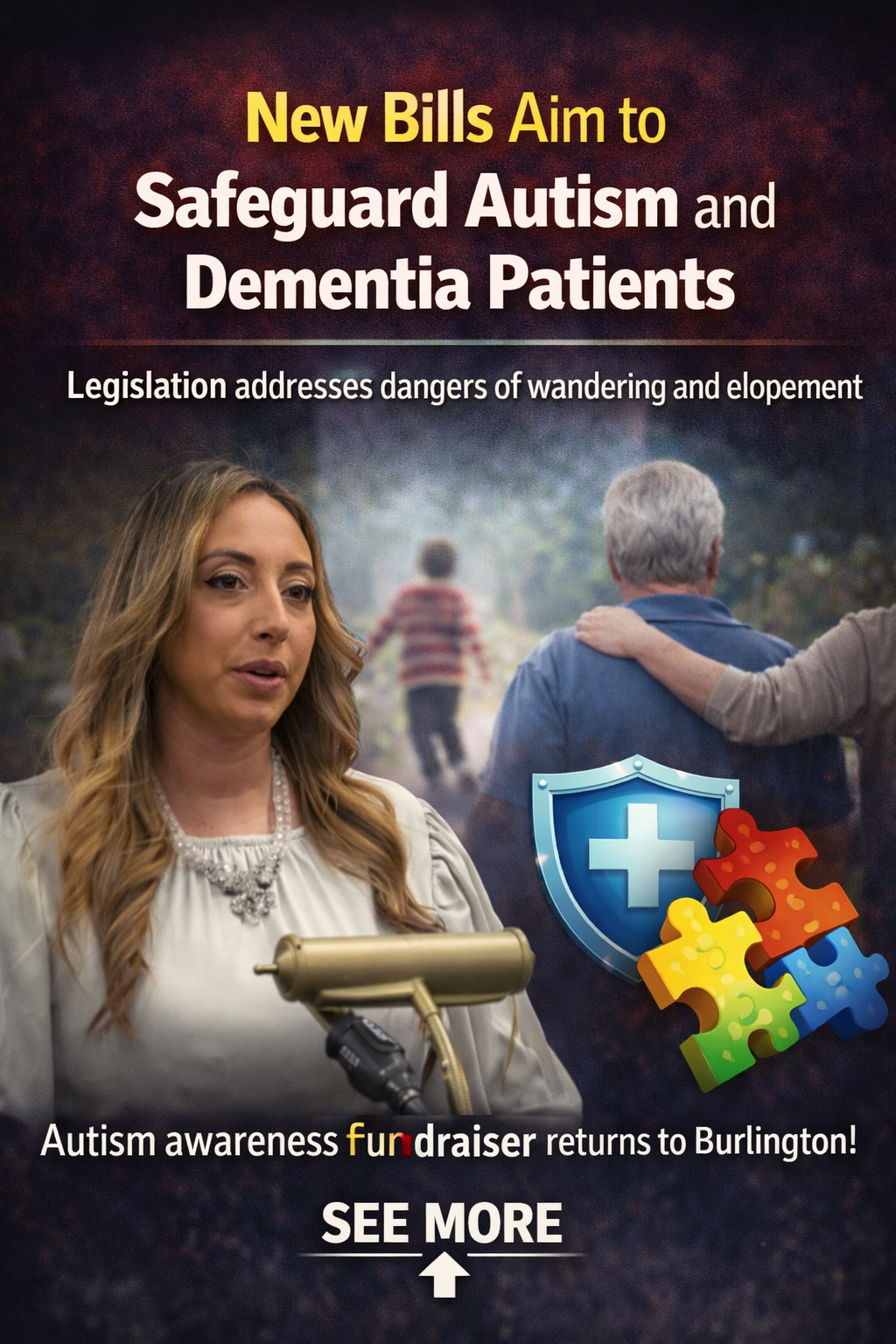
Proposal includes police training, school coordination and tracking devices


Shari Bailey said she was brought to tears this week when a lawmaker texted her with the news that the House had passed a bill, inspired by her daughter, that aims to improve outcomes for people with autism or dementia who wander off.
It was one piece of good news in a series of positive developments for a package of bills Bailey is backing that address the problem of “elopement.”
The House unanimously passed House Bill 634 on Wednesday, requiring police training for situations involving elopement, which is not standardized statewide. The vote came one week after the Senate unanimously approved its own version of the measure, Senate Bill 745, putting the legislation well on its way to final passage.
“I’m overwhelmed, in a good way,” Bailey, a Harford County mother, said after the vote.
The two bills are the main pieces in a package of five bills that are advancing under the umbrella of the LEAD act — Laila’s Elopement Awareness and Dissemination Act. The bill is named for Bailey’s autistic daughter, Laila, who once ran off without a trace, a terrifying reality for many families taking care of people with disabilities. She was later found unharmed.
The two bills are the main pieces in a five-bill package advancing under the LEAD Act — Laila’s Elopement Awareness and Dissemination Act. The legislation is named for Bailey’s autistic daughter, Laila, who once ran off without a trace, a terrifying reality for many families caring for people with disabilities. She was later found unharmed.
The package would affect how schools, health insurers and state agencies respond to elopement. It also refers to House Bill 634 and Senate Bill 745, which require police training for such situations.
The House later approved House Bill 1182 on Wednesday, allowing parents of autistic children and children with other disabilities to share tracking device data with their child’s school so administrators can help locate a child in the event of elopement.
Del. Aaron M. Kaufman, a Montgomery County Democrat, said he was “elated” to support legislation “that will save lives and put the minds of parents at ease.” Without a Senate version, House Bill 1182 must clear a Senate committee before it can be considered by the full chamber.
This is the first year for the package of elopement bills, and their rate of advancement is unusual for new proposals in Annapolis, where lawmakers are typically more comfortable with legislation after they have reviewed it multiple times. Bailey said she is encouraged by the progress of the two main bills and hopes the remaining measures will advance in the final month of the session.
“This is such a good step for Maryland … It’s going to touch so many lives,” she said.
The Centers for Disease Control and Prevention estimates that about 1 in 31 8-year-olds has autism. Several autism advocacy organizations say roughly 45% to 50% of children with autism are reported to wander from safe locations and out of adult supervision.
Similar safety risks also affect people with dementia, who may become confused or frightened and leave without warning. Other developmental disabilities can also lead to elopement behavior.
The legislative package was partially inspired by Bailey’s experience in 2020, when her then-6-year-old daughter eloped while under the supervision of a caregiver.
Fortunately, Laila was found that day. But the experience of worrying over whether her daughter would be found led Bailey to work with Maryland lawmakers so that other families can have more resources when they face elopement by a family member.
Laila was found that day. But the experience led Bailey to work with Maryland lawmakers to ensure other families have more resources when a loved one goes missing.
Not all of the LEAD Act package is advancing. Bills with significant fiscal impacts face additional scrutiny as lawmakers weigh costs in a tight budget year.
That includes House Bill 1117, which would require Maryland Medicaid and other state programs to cover monitoring devices by classifying them as medical equipment for individuals at higher risk of elopement. The devices would include both the equipment and a monthly service fee, averaging about $848 per person annually, according to state analysts.
Federal matching funds could offset some of those costs, but budget constraints remain a concern. The bill has not yet received a committee vote.
Some advocates are worried that tough decisions will have to be made, even if lawmakers agree on the merits of the legislation.
“There are some hard choices to be made this session, absolutely,” said Melissa Rosenberg, executive director of the Autism Society Maryland. “It would be great if they can do it. I would imagine a lot of the things that we’d like to have done are very expensive. The state is going to have to prioritize.”
Two other bills are advancing, though their timelines remain uncertain. One would expand required school mapping to include a one-mile radius around school grounds, including nearby bodies of water, as many fatalities among autistic children who wander involve drowning. It is awaiting a final House vote, possibly this weekend, and does not have a Senate counterpart.
Another bill would require the Maryland Department of Health to create a webpage of resources for caregivers of individuals — due to age, disability, chronic illness or other functional limitations — including guidance on safety planning for wandering and elopement. That measure was approved by the House Health Committee on Friday and is headed to the full House. It also does not have a Senate version.
Meanwhile, the clock is ticking toward Monday’s “crossover” deadline, when bills must move from their originating chamber to the other to remain on track. Advocates like Bailey believe there is still time to resolve fiscal concerns that could stall other parts of the package.
But Bailey also notes that the education about elopement as an issue has also been valuable, as she’s testified for bills in the LEAD Act this year.
Bailey said raising awareness has also been a key outcome of her advocacy.
“I’ve gotten things like, ‘Wow, I did not know what elopement was until I saw your bills,’” she said. “Education has been a tremendous piece of insight through all of this.”