
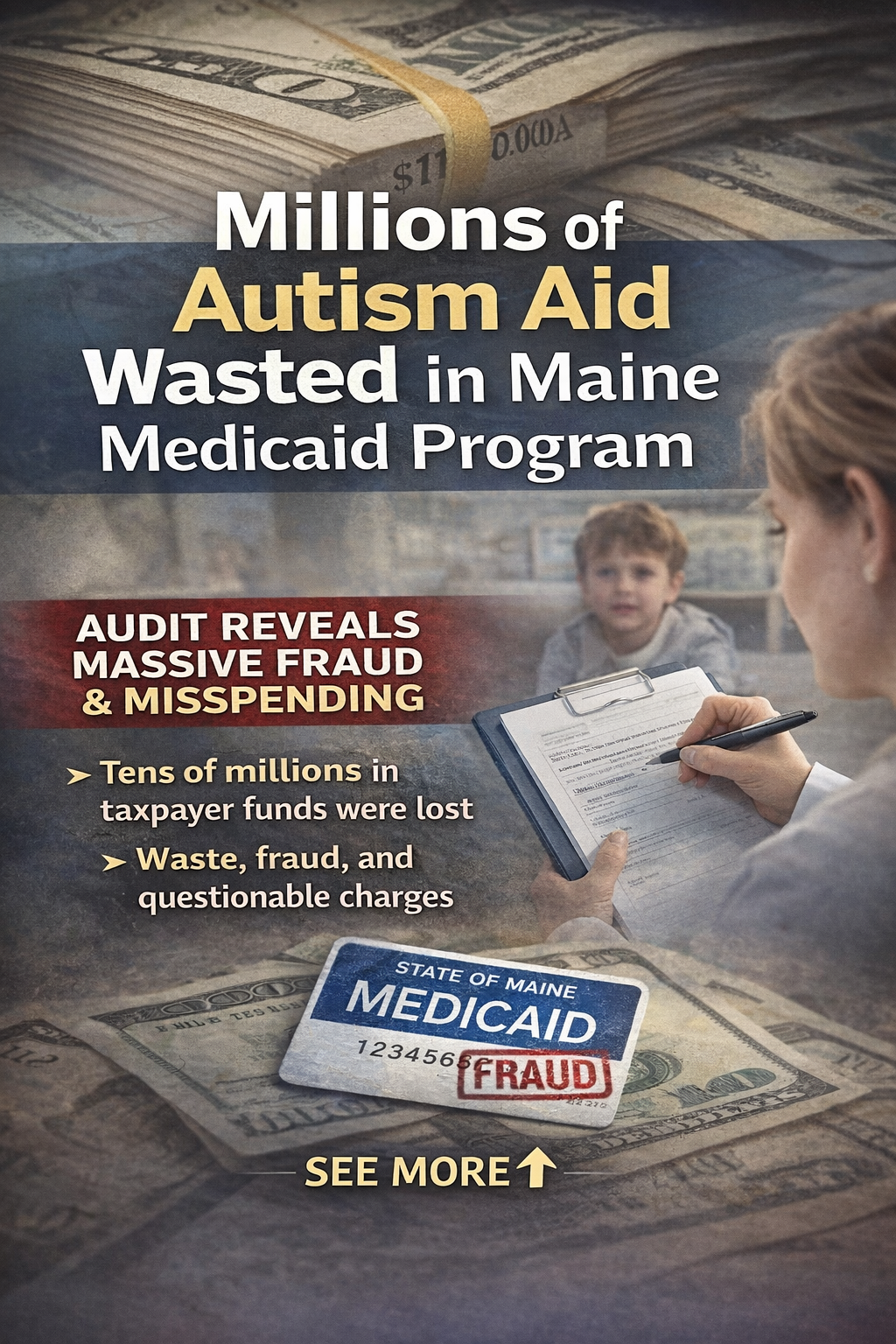
Maine’s Medicaid-funded autism services are rooted in the goal of ensuring children with autism receive early, effective support. Few would dispute the importance of those services, but compassion without accountability isn’t compassion, it’s negligence.
A newly released federal audit reveals that Maine’s autism services program has become a case study in how big government programs can drift from their mission, hemorrhage taxpayer dollars, and fail the very people they are supposed to help.
According to the U.S. Department of Health and Human Services Office of Inspector General (OIG), Maine made at least $45.6 million in improper Medicaid payments for autism related services in just one year. Even more troubling, these failures were systemic and entirely preventable. The good intentions of these programs do not excuse bad governance.
The Care Medicaid Was Supposed to Be Buying
MaineCare’s autism-related Medicaid payments were intended to fund legitimate, structured therapeutic services, primarily Rehabilitative and Community Support (RCS) services. In Maine, RCS services for children with autism include Applied Behavior Analysis (ABA), a commonly-used therapy for managing autism symptoms, and other treatments.
These services are designed to help children with autism build communication, social, behavioral, and daily living skills through individualized treatment plans. Treatment plans are delivered by qualified providers and must be documented through detailed session notes showing progress toward measurable goals. Medicaid rules are clear: services must be therapeutic in nature and tied to an approved plan. In other words, taxpayers were meant to pay for evidence-based treatment.
No Therapy, No Treatment, Still Billed
One of the most striking findings of this report is how often MaineCare was billed for time that clearly did not qualify. Medicaid is not meant to apply to meals, naps, recreation, or even routine academic instruction. All of these events that might be part of a child’s day, but are not medical treatment, were frequently being charged to MaineCare.
In many cases, children’s records showed long stretches of downtime or routine activities, yet providers billed continuously as if therapy was happening the entire time. Providers’ notes were often incredibly vague. Hours were charged without clear evidence of what interventions were used, what goals were being worked on, or whether any progress was made. For example, according to the report, one session note did not contain any data collected and stated only that the child “had a pretty good day.” Some providers even relied on copy-and-paste session notes, recycling vague phrases across multiple sessions.
This goes beyond bad paperwork. It reflects a system where basic standards were ignored and where weak oversight made it easy for bad practices to become routine. When that happens, the integrity of the entire program suffers, not just financially, but ethically, because families who rely on these services deserve confidence that the care being billed in their child’s name is real, appropriate, and effective.
The Cost of This Mismanagement
The federal audit took a close look at how MaineCare paid for autism services in 2023, specifically, fee-for-service payments for RCS services. The audit examined $76.7 million in MaineCare autism related payments made in 2023, covering more than 165,000 individual billing lines for RCS services. To make the review manageable, auditors grouped those claims into 11,777 “enrollee-months”, meaning all services billed for a single child in a single month.
Auditors then selected a random sample of 100 enrollee-months, representing 31 different providers and 96 children, with monthly payments ranging from just over $1,000 to more than $22,000 per child. What they found was staggering.
Not in most cases, not in many cases, but in every single enrollee-month reviewed, there were improper or potentially improper payments. Based on the sample, auditors estimated that Maine made at least $45.6 million in improper payments in just one year, with another $22.4 million being potentially improper. Of that total, $28.7 million came from federal taxpayers, money Maine may now be forced to repay.
This wasn’t just about a few careless providers or minor paperwork errors. The problems showed up across providers, across claims, and across the entire system, which points to an entire program where rules exist on paper but are rarely enforced in practice.
Rising Costs and Who Really Pays the Price
Spending on autism-related Medicaid services in Maine hasn’t just risen over time, it’s skyrocketed. In just a few years, payments jumped from about $52 million in 2019 to more than $100 million by 2024. But as the federal audit shows, that growth happened without the basic checks needed to make sure the money was being used as intended. Oversight didn’t keep pace with expansion, and accountability was largely absent. When a program grows this quickly without guardrails, it creates the perfect conditions for waste, misuse, and breakdowns in quality.
When systems like this break down, the consequences go far beyond Augusta. They impact real Maine families who end up shouldering the burden. Taxpayers are left footing the bill for tens of millions of dollars in questionable spending, while families who depend on autism services are forced to trust a system that hasn’t been holding itself accountable. Waste like this drains resources from providers who are doing the work the right way, undermines confidence in programs meant to support vulnerable children, and increases the risk of federal clawbacks that could lead to tighter budgets or reduced services down the road. In the end, both taxpayers and families lose because the State failed to protect the integrity of a program people rely on.
Conclusion
The federal audit of Maine’s autism-related Medicaid spending reveals more than a costly administrative failure; it exposes what happens when government spending is allowed to grow so rapidly with so little oversight.
Tens of millions of taxpayer dollars were paid out to cases with missing documentation and questionable billing. Little effort was made by the State to verify that services were actually delivered as required, and for years, basic safeguards were ignored. The result was predictable: skyrocketing costs paired with declining accountability and quality.
Maine can support children with autism while still demanding accountability, but it must choose to do so. That means enforcing rules consistently, reviewing claims before problems spiral, and treating taxpayer money with the care and attention it deserves, not as a mere box to check after federal auditors intervene. Until that happens, Maine taxpayers will continue to shoulder the cost of a system that promises care, but too often delivers waste.