
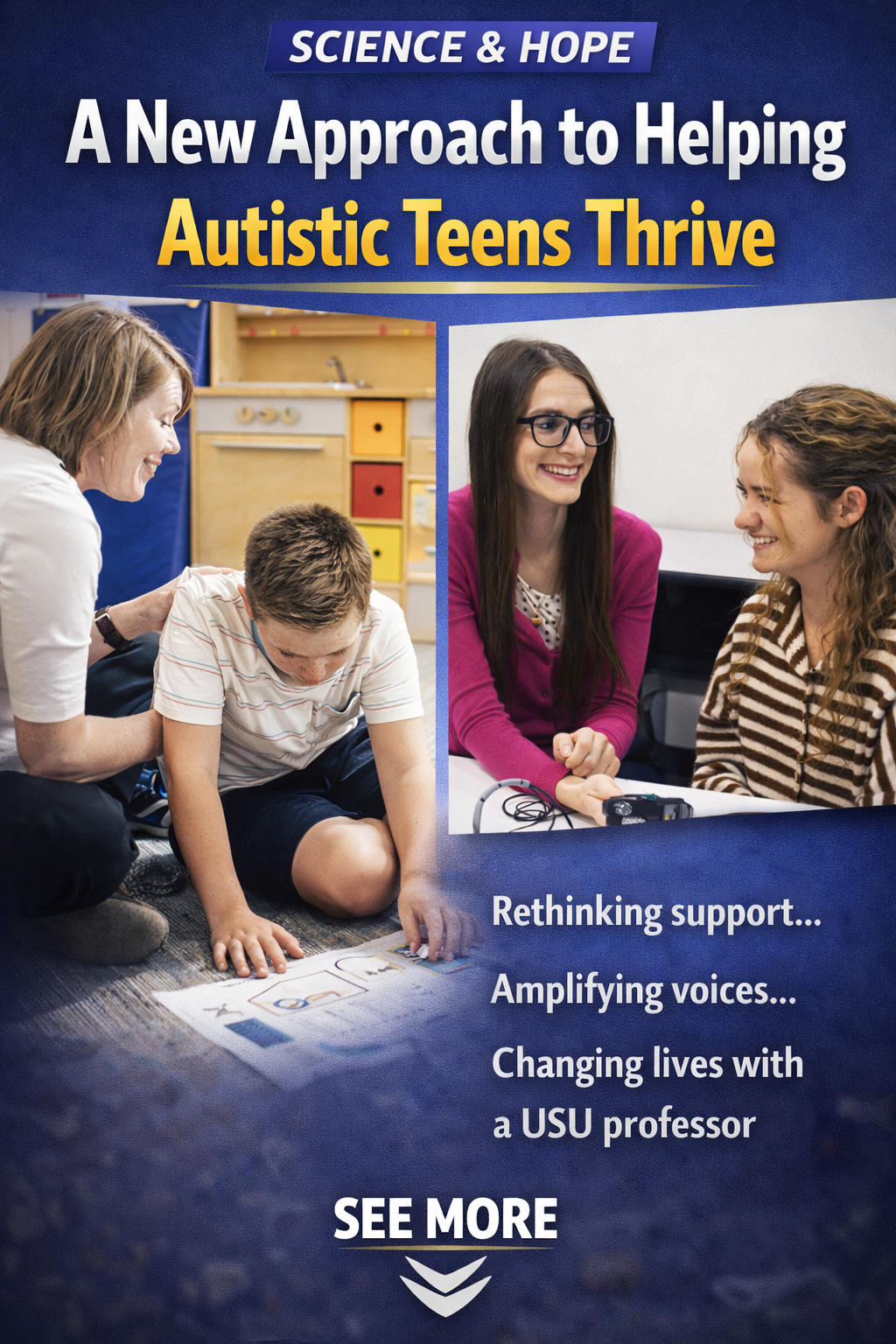
If you were to step onto the ground floor of the Lillywhite building at Utah State University, you would find a space filled with purpose — the lab of Camille Wynn, a researcher and new USU assistant professor.
Wynn’s work goes beyond science. She’s uncovering the truths behind human connection, breaking down stereotypes and building bridges between worlds that often feel divided for teens on the autism spectrum.
Wynn, a Utah native, recently joined the Department of Speech and Hearing Sciences located within the Emma Eccles Jones College of Education and Human Services. A proud product of USU’s educational system, Wynn completed her undergraduate, graduate and doctoral studies on the Logan campus.
Now, after three years as an assistant professor at the University of Houston, Wynn has returned to USU to continue her research on communication in autistic teens — supported by a recently funded grant from the National Institute of Deafness and Other Communication Disorders, an institute within the National Institutes of Health.
Her NIDCD-funded research analyzes speech coordination patterns to understand what makes conversations successful among autistic and neurotypical teens. Her goal is to find ways to make conversation easier and more meaningful for both groups. Wynn is supported by co-investigator Alan Wisler, assistant professor of mathematics and statistics at USU, as well as consultant Audra Sterling at the University of Wisconsin-Madison.
“There’s a stereotype that autistic people have poor conversation skills,” Wynn said, “but research is showing that autistic people oftentimes have good conversations, but it’s often with other autistic people. If we can find the differences in what makes conversation successful for neurotypical and autistic individuals, we can work toward bridging the gaps and fostering better communication.”
Wynn’s passion for improving communication between autistic and neurotypical adolescents goes back to her experience working at the Autism Support Services: Education, Research and Training (ASSERT) program — a training and research center in the Department of Special Education and Rehabilitation at the USU Logan Campus which aims to improve the lives of autistic individuals.
While she was at ASSERT, Wynn also started working with Stephanie Borrie, professor of speech-language pathology and interim associate dean for research in CEHS. Borrie also researches conversation, but with a focus on adults with neurological disorders such as Parkinson’s disease. While working with Borrie — who later became her graduate mentor — Wynn had a significant realization.
“I thought about how these principles might apply to autistic children and teenagers. I knew there was a lot of interesting work to be done in this area,” Wynn said. “Communication is so important — and it’s eye-opening when you’re not able to communicate with someone. I’ve always had a passion for conversation and communication and want to find ways to help give that to people.”
Now Wynn is chasing her mission that combines her scientific expertise with previous clinical experience as a speech-language pathologist at Cassia Regional Hospital in Burley, Idaho.
“Camille brings positive energy and commitment to research and teaching,” said Karen Muñoz, department head of Speech and Hearing Services at USU. “Her innovative work in speech and hearing sciences drives impactful change as she develops strategies that empower people to find greater success and purpose in everyday interactions.”
Wynn’s first and most critical task for her research is to collect data. This process involves gathering audio recordings of conversations among autistic and neurotypical adolescents in various pairings. For example, some conversations occur between two autistic participants, others between two neurotypical participants, and others between one autistic and one neurotypical participant.
During these recordings, participants have different types of conversations with each other — everything from a simple icebreaker to problem solving where they work together to complete a task. From there, the next step is to organize the data, which is led by Wynn’s undergraduate and graduate students at USU.
“Every piece of data we gather and every participant we schedule brings us closer to meaningful discoveries. I’m excited for what’s ahead as we prepare to welcome more participants next semester,” said Megan Cole, an undergraduate student majoring in communicative disorders at USU.
After collecting the data, the audio recordings will be analyzed with help from Wisler, Wynn’s co-investigator on the project. This step looks closely at the acoustic properties each conversation — including pitch, loudness and speech rate — to better understand how adolescents coordinate their speech patterns with each other and how this impacts conversation.
“With my background in speech analysis, I’m particularly excited about this project because Camille is so clinically minded,” Wisler said. “Her research interests are driven by her work and clinical experience. I think it’s easy to get sidetracked and not focus on actual outcomes and how they will affect people, but Camille is very cognizant of those needs, which I think makes the work that much more impactful.”
Wynn agrees. She said it’s not just about the research itself but the impact it has on individuals.
“Most of the feedback I get comes from parents of autistic adolescents,” Wynn said. “It can be hard to get their children there for the study, but they make it a priority because they’ve watched their kids struggle with loneliness and social isolation, and they think this research is important. They often say that if this can help autistic teenagers in the future, it is something they are willing to invest their time in.”
Wynn has seen this impact first-hand during her research.
“I remember a time when we had two autistic adolescents having a conversation, and they really connected. It was amazing,” she said. “At the end of the conversation, they were so happy and even exchanged phone numbers. That’s my goal — to help people connect — and I want to create more of these meaningful moments.”