

Brett Coomer/Houston Chronicle


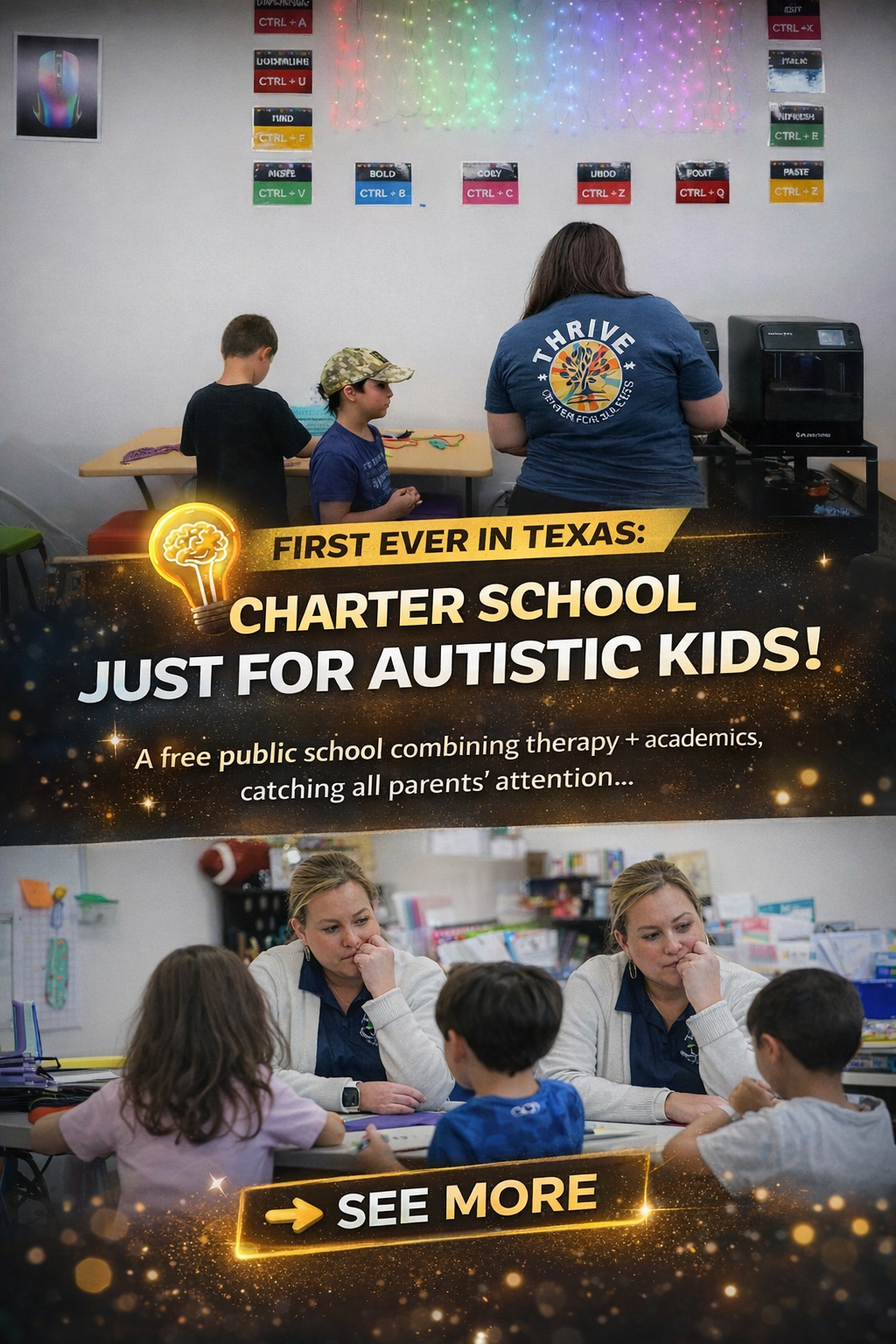
Magnolia’s Thrive Center for Success was designed for autistic students down to even the smallest detail.
Inside a former automotive engineering firm, dimmable lights help students who are light-sensitive, a sensory room offers trampolines and marble rolling boards to help them regulate emotions, and an outdoor atrium uses rubberized flooring — not turf — because some students with Pica disorder may try to ingest it.
Outside, a fenced path allows students to practice fire drills on the school’s lawn without the risk of elopement, when children with autism run away after feeling overwhelmed or triggered.
Advertisement
Article continues below this ad
What may surprise parents, who are used to juggling insurance and outside therapy providers, is that Thrive is free. The school is a public charter serving students with autism — part of a small, but growing, share of the state’s charter school population.
Out of nearly 1,000 public charter schools in Texas, only five are specifically for students with disabilities: Thrive Center for Success outside of Houston as well as charters in Lubbock, Plano and San Antonio. These schools have emerged in recent years to provide more comprehensive services amid rising rates of disabilities like autism and dyslexia.
“This is a relatively small proportion of the 960 total public charter school campuses statewide, but these programs generate outsized interest among families and policymakers,” said Brian Whitley, vice president of communications for the Texas Public Charter School Association. “We expect there will be more in the future.”
Advertisement
Article continues below this ad
Thrive draws most of its students from Harris and Montgomery counties, where the rate of public school students diagnosed with autism has almost tripled since 2015, according to state data. During the 2014-15 school year, about 10,230 students in the two counties were diagnosed with autism. Now there are 28,448 students, which doesn’t children early in their schooling and not diagnosed yet.
When Thrive opened in 2022, it almost immediately drew a wait list. Founder Elizabeth Goldsmith, a former physician assistant and mother of a child with autism, quickly saw the demand outpace capacity. The school now enrolls 179 students, with more than 400 on the waitlist. For next year, just 24 seats are available — and 265 new lottery applications are already in.

Brett Coomer/Houston Chronicle
Thrive currently serves grades kindergarten through eighth grade, but will expand to high school next year with its first ninth grade class. It expects to reach a capacity of 312 students. The board is considering a second campus in Cypress to help meet demand, Goldsmith said.
And traditional school districts are taking note. Lamar CISD in southwest Houston recently announced plans for an in-district charter school for students with autism, Bright Futures Academy at Beasley Elementary, which will serve around 300 students, communications officials said.
Thrive’s model
Rising autism diagnosis rates help explain the demand, but the school’s model is also a draw.
Many children with autism receive Applied Behavior Analysis therapy for some period of time, which many clinicians recommend despite controversies around it. Doctors may also recommend occupational therapy, speech therapy and more. Families often end up juggling multiple appointments, doctors and clinics to get their children the services they need. And while it’s covered by insurance, the companies often stop paying for it when a student moves into the academic setting.

Brett Coomer/Houston Chronicle
Goldsmith said the goal at Thrive is to combine ABA therapy with academics, and provide other therapies in-house that autistic children may need.
“One of my colleagues calls it ‘a working hospital for students with special needs,’” Goldsmith said.
In order to do that, Goldsmith and her team created their own staff pipeline. Instead of hiring teachers with little experience in ABA, they found ABA practitioners who wanted to become teachers and helped them get their alternative education certificates. That ensured an ABA lens touched every part of a Thrive student’s education, she said.
Take Louisa Dominguez, who teaches foundations students at Thrive. She was working in an ABA clinic when Thrive approached her. While she previously worked in a school setting, she didn’t have plans to return.
“What really drew me to give in and commit was the fact that the school’s model was to bring the concept of public education and combine it with ABA, and basically unite those two worlds,” Dominguez said.

Brett Coomer/Houston Chronicle
Because students arrive with a wide range of abilities, Thrive offers three entry levels. Foundations serves mostly nonverbal students or those most affected by autism. Transitions sits in the middle, blending ABA with academics. Academics includes traditional classes, taught with an ABA lens.
Goldman said their approach has seen a lot of student success.
“We’ve seen students who have been completely nonverbal start talking and talking a lot and using communication devices. A lot of our students have become toilet trained,” she said.
Last year, Thrive had one student move from foundations to academics in only a few months.
Since its debut, Thrive has drawn families from outside Houston, with some moving from places like California and Mexico City just to attend.
“In Mexico, there are no resources for schools like this,” parent Iris Calderon said. “It’s private, it’s super expensive, and the teachers are not prepared to deal with autism at basically any level. When I saw that Thrive existed with everything in one place — I mean the academic part plus the therapeutic management of the kids — it’s all you can ask for when you have a kid with autism.”

Brett Coomer/Houston Chronicle
Bringing it home
Goldsmith herself struggled to find a school for her son when he showed progress in his ABA therapy.
“He was doing great, but it’s insurance based, and he got to a point where he was ready and capable of learning academics, but insurance doesn’t cover the academic pieces in those settings,” Goldsmith said. “When I looked at sending him to a traditional school, I felt that without the ABA piece, he really wouldn’t have the tools he needed to be successful.”
She visited a Florida school that combined ABA with academics. She left inspired and wondered: “Why was this model not here in Texas?”
So she decided to bring it home.
“It’s my vision to show that a school tailored to meet the specific needs of students with autism could create greater outcomes in these students,” Goldsmith said.

Brett Coomer/Houston Chronicle
Goldsmith’s experience echoes the story of another mom, Jasmin Dean, who has dyslexic children. She founded Celebrate Dyslexia Schools in San Antonio where students receive intensive dyslexia remediation for a few years and then can transition back to a traditional setting.
Both moms got informal coaching on the charter application process from Audrey Young, a member of the State Board of Education and former special education director.
“What I love was that (Dean and Goldsmith) saw a problem, and they didn’t just focus on their own child. They wanted to make it better for everyone else,” Young said. “Both of those parents can easily afford to send their children to private school or to private therapies, but they didn’t do that.”

Brett Coomer/Houston Chronicle
Why aren’t there more schools like this?
Despite demand, schools like Thrive are rare in Texas because charter schools are hard to start and maintain.
Both Dean and Goldsmith had to apply multiple times before winning approval, as the state now greenlights only a few charters each year. In fact, Texas has closed more charters than it has approved recently, ending 17 agreements in the past two years.
Plus, unlike private schools, charters are public, so they have to follow the same special education requirements as traditional public schools. Funding can be a struggle.
Thrive operates with a roughly $7 million annual budget and serves fewer than 200 students per year. They get a Texas Education Agency grant for schools serving large numbers of autistic students. This year, Thrive received $3.1 million from the grant, but without that, they might not be able to offer the same level of services that they do now.
Thrive receives $14,000 per student funding from the state, but educating students costs closer to $30,000 per student, Goldsmith said.

Brett Coomer/Houston Chronicle
RELATED: More Texas students are diagnosed with dyslexia — TEA grants and new tech give some schools a leg up
Thrive leaders advocated for change in how Texas pays for special education, moving away from a flat funding model to one that is based on intensity of services. Lawmakers passed it in the last session. Goldsmith said that will help make the school and others like it sustainable, especially as they try to maintain a lower student to staff ratio than most public schools.
Whitley with the state charter association said it’s also hard for these specialty charters to grow once approved.
“They need to keep class sizes very small and often have specialized facilities requirements, like doors that don’t open directly outside,” Whitley said. “This is why expanded facilities funding for public charter schools, passed as part of House Bill 2 last legislative session, makes an enormous difference for these programs.”
Adding to the challenge of disability-focused charter schools is the state’s accountability system. If a charter fails academically or financially three years in a row, the state can close it, with little recourse.
STATE GRADES: Houston area charters received more F ratings from the TEA than traditional schools, data shows
Initially, Thrive struggled with its accountability ratings, earning an F in its first year. Goldsmith said one reason could be the fact that a large number of their students came from homeschool or purely ABA settings and were transitioning to academics for the first time.
Since then, the school has earned a C, and staff hope for continued growth. To do so, they track student data daily to ensure students are being challenged — but not too much — with their academic assignments.

Brett Coomer/Houston Chronicle
What do Thrive students think?
Thrive students Blake Phillips, 12, and Charles Peth, 11, said their experience has been night-and-day from their previous school.
“The reason why I came to Thrive is because I have autism and ADHD, and that made it really hard for me to work in a normal public school,” Blake said. “I don’t know what overstimulated me. In my old school, I would always have a tantrum, and I would always just get mad, and until I came to Thrive like, year by year … I just became a better person.”
For Charles, the biggest plus has been the community.
“It’s easier to find people with your quirks,” he said. “I had one, two friends in my old school, but in this school, I feel like everyone’s a friend.”