
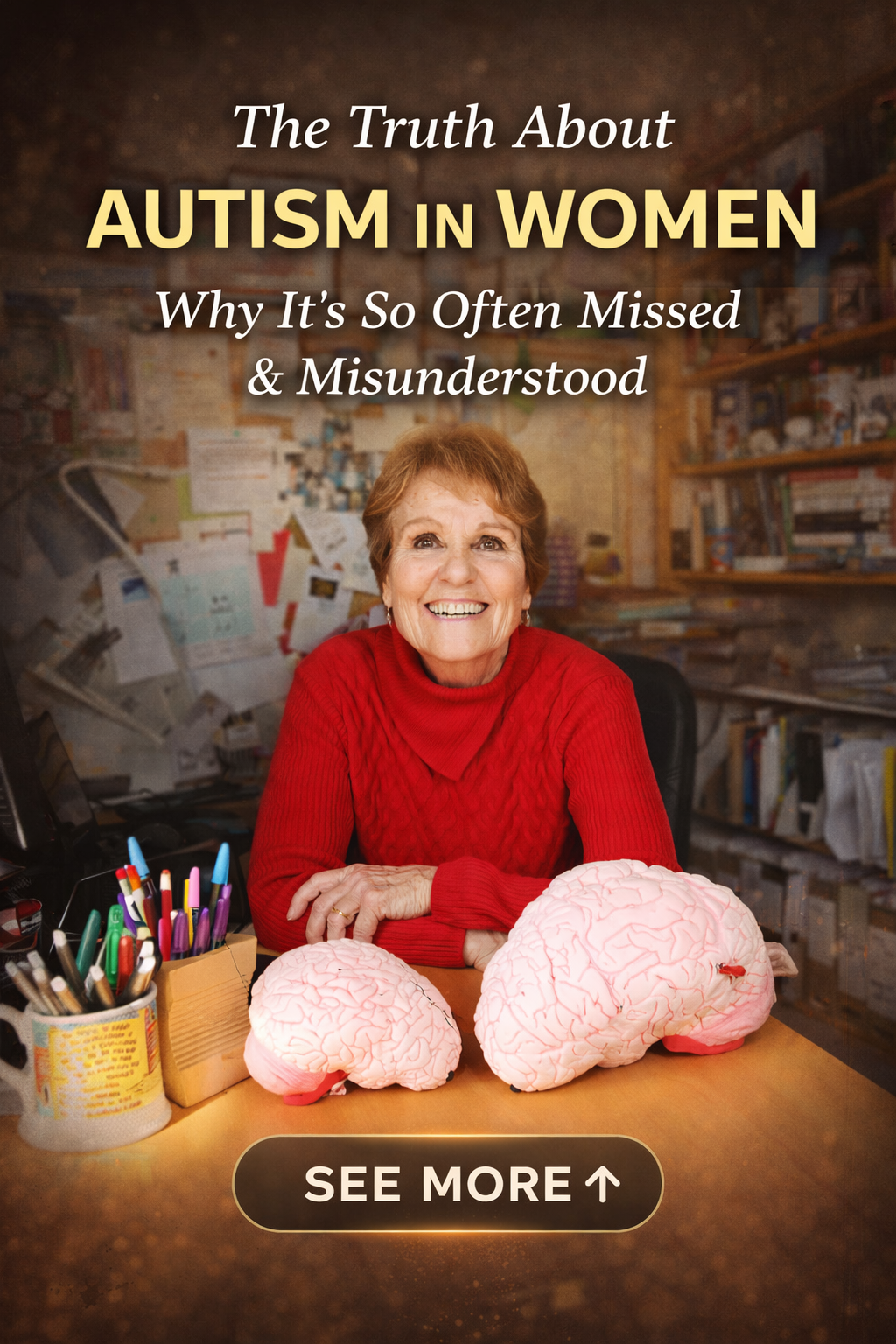
Recent research suggests rates of the condition in both sexes may be equal – so why have so few women been diagnosed in the past?

When Prof Gina Rippon began her career in neuroscience in the 1980s, autism in women was thought to be so rare as to be anomalous. It was only in the 1960s that autism was formally diagnosed in children in Britain, and the earliest estimates put its prevalence at less than one in 2,000 children. The latest figures put the prevalence of autism at around one in 100 people.
“70 per cent of the research only looked at male brains,” Prof Rippon explains. “Occasionally a few female brains would be included, because it was thought that there weren’t enough women to study.”
At the root of this was the belief that the differences between men and women’s behaviour could be explained by biological differences, says Prof Rippon, who admits she was once a “paid-up member of the male-female brain brigade”. But when she was tasked with writing a book about the differences between men and women, she started to rethink the differences from the ground up. The evidence that scientists had relied on to explain differences between the sexes, including why more men than women had autism, she says, “turned out not to be so great”.
What Prof Rippon calls the “male spotlight problem” has shaped everything we think of when we talk about what it means to have autism or show autistic traits. However, a recent study in the BMJ has suggested that the rates of autism in women and men may be equal.
The researchers looked at the rate of autism diagnoses in people born in Sweden between 1985 and 2000 and tracked these people until 2022. They found that, while males were more likely to have a diagnosis in childhood, females caught up during adolescence, and by the age of 20, the male-to-female ratio had evened out at nearly one-to-one.
So why have so few women been diagnosed with autism in the past? Prof Rippon, who is professor emeritus of cognitive neuroscience at Aston University in Birmingham, has conducted extensive studies of autism in women. Her research gives us some clues.
Differences between men and women
Autism is a condition that is understood to come with a mix of challenges to social communication, interaction and imagination, such as struggling to work out how other people are thinking or feeling.
This is sometimes referred to as the “triad of impairment”, an idea that was introduced by Dr Lorna Wing in 1981. At that point, most of the research used to diagnose autism had been carried out on men.
More up-to-date science suggests that in autistic women, “the social communication difficulties are there, but they often present completely differently,” says Prof Rippon. Autistic men are often stereotyped as quiet people who prefer to spend time alone, but women with autism “are often very anxious to be social – they really care if they are included”.
Women with autism also tend to have “a higher level of sensory sensitivity” to things like clothing textures and bright lights. “It’s much more common in women and girls, and it can be a much more disabling, life-changing problem than the social difficulties,” says Prof Rippon.
Women and girls with autism will often show “obsessional interests, a very narrow focus”. Whereas boys or men might be fascinated by the weather or train routes, women may have intense interests in more socially normative topics like make-up or clothes. “So when parents are asked whether their children have any unusual interests, they might not think to say that their daughter has 300 Barbies in height order in her bedroom, or think of it as something unusual,” says Prof Rippon.
There are also women with autism who present in more “male” ways – and autistic men who have traits more closely aligned with the female phenotype that Prof Rippon has proposed. Women with stereotypically male traits “ticked the right boxes with respect to the gold-standard autism tests, which are much more biased towards finding boys than girls”, says Prof Rippon. “So by definition, the women and girls who actually were diagnosed behaved much more like the male picture of autism than women diagnosed later in life.”
Women work harder to hide their autism than men
Central to Prof Rippon’s understanding of autism in women is the concept that autistic women often “mask” or hide their symptoms and traits, and can become very adept at doing so. Conversely, men with autism seem less likely to mask or may do so with less success.

Uta Frith, an emeritus professor of cognitive development at University College London, recently told the Times Educational Supplement that there is “no scientific basis” for the concept of masking, and that the concept of an autism spectrum “has widened to the point of collapse”.
“I agree with Frith that we need to rethink how we should define this condition,” Prof Rippon says. “But there is a considerable body of research work, both behavioural and neuroscientific, which provides clear evidence of camouflaging and masking behaviour, particularly in late-diagnosed autistic women.”
Prof Rippon points to one study from academics at the University of Cambridge published in 2019, which looked at brain scans from both men and women who did and did not have autism. It found that masking “is heightened in autistic women” compared with the other groups, and also showed up differently in the brain when compared with autistic men.
Prof Frith “does point out that everyone masks to some extent, and the research is not suggesting that this is a unique characteristic of autism, or even a sign of autism”, Prof Rippon explains. “But it is a consistent pattern of behaviour in autistic women, as well as some men. It also seems to be much more frequent and intense than in [people without autism].”
Over a long period, masking can take a toll on women’s mental health. Research suggests that women with autism are more likely to experience mental illness than both women without autism and men with autism, especially when it comes to depression, anxiety and sleep disorders. This seems to hit young women the hardest: one study found a diagnosis of depression in more than a third of adolescent girls surveyed, compared with about one in 10 girls who do not have autism.
Is autism in women actually overdiagnosed?
Uta Frith also claimed that problems common to women recently diagnosed with autism, such as high social anxiety, “can perhaps be treated much better than under the label of autism”. This has caused a stir, as it has been taken to imply that people with “typically female” traits of autism should not be diagnosed with the condition at all.
“She didn’t say they don’t need a diagnosis – which of course is what was heard and which has caused such a furore,” Prof Rippon explains. She does think that the debate about whether autism is overdiagnosed has become “toxic”, however.
Rather, Prof Rippon believes, it’s time to stop lumping all people with autistic traits under the same label, an idea that is gaining traction in the field more widely. Simon Baron-Cohen, another prominent autism researcher, has suggested splitting up autism diagnoses into “type 1”, which would be used to describe people with autism who also have learning disabilities, and “type 2”, for people who have autism but don’t have learning disabilities.
“We should definitely be looking at sub-groups, and, paradoxically, I don’t think we should be talking about ‘male’ and ‘female’ autism,” Prof Rippon says. “It might feel like a step backwards to those who embraced the idea of a spectrum as maximally inclusive, but I think the science does support the idea that there are distinct sub-groups currently being very unhelpfully clustered under a single umbrella.”
For Prof Rippon, though, this means going further than updating the questions asked by doctors and specialist assessors in order to better include women. “I think there needs to be a major revision in how psychological disorders are described and categorised to include many more characteristics, such as genetic and endocrinological [hormonal] profiles, and the social norms that exist in different groups of people in society, and potentially much more besides,” she says.
Prof Rippon thinks that artificial intelligence might one day be used to identify the different patterns of behaviour displayed by people, to help experts like her understand more about conditions like autism. For now, though, it seems there is still much to be understood about what it means to have it.
As Prof Rippon points out, “there’s a saying that if you’ve met one person with autism, you’ve only met one person with autism – it’s very true.” As so many women and girls with autism still struggle to be recognised and accepted, we would all do well to remember that fact.