
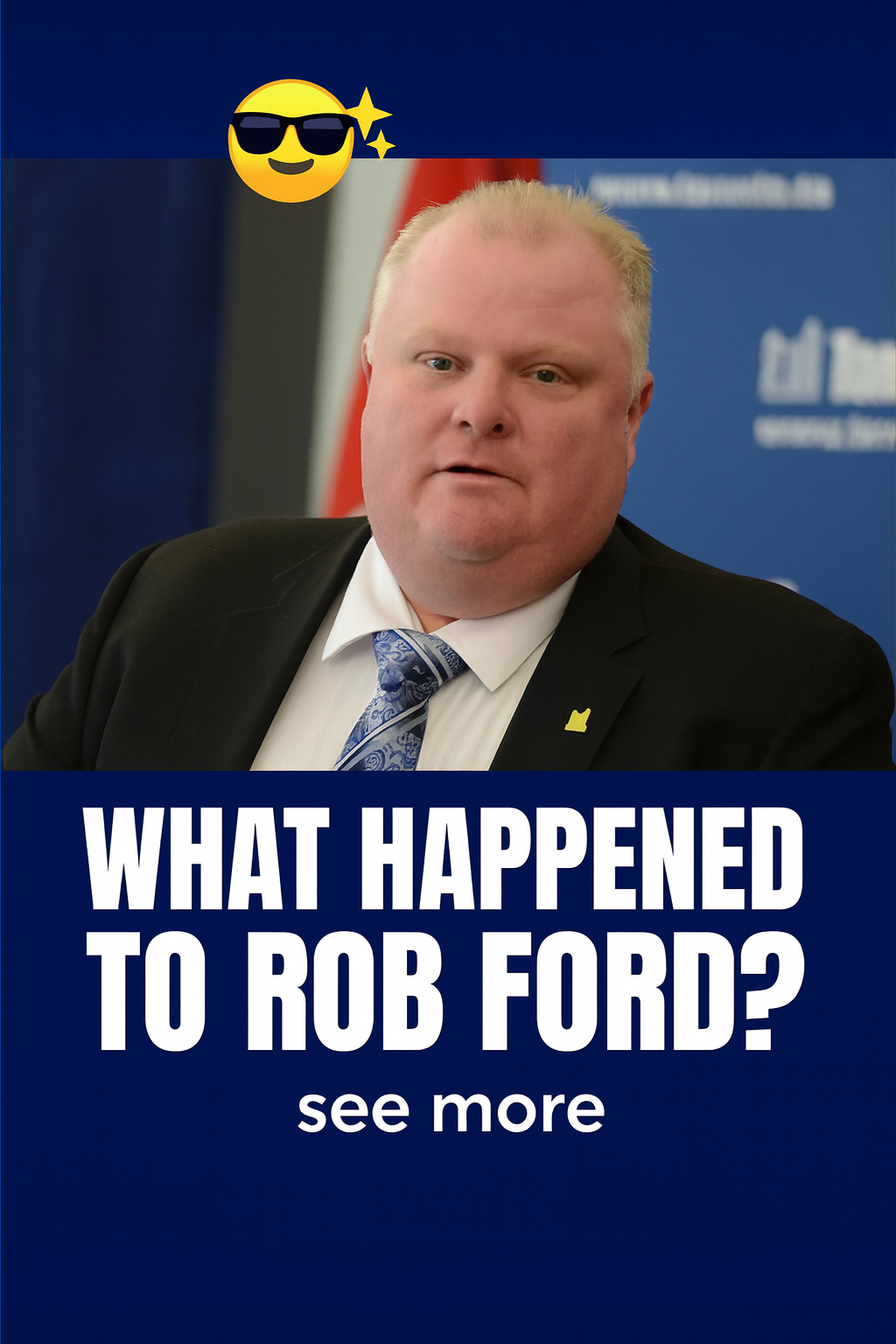
In 2014, infamous Canadian politician Rob Ford was diagnosed with a rare and aggressive cancer
:max_bytes(150000):strip_icc():focal(1027x356:1029x358):format(webp)/rob-ford-toronto-mayor-main-062025-597ec06d26f9407384f0f4c343d79209.jpg)
In 2013, the world was stunned when a video surfaced of Toronto Mayor Rob Ford appearing to smoke crack cocaine.
The Toronto politician was elected mayor in 2010, quickly gaining popularity and passing several reforms. But in 2013, everything took a turn when a video surfaced of him appearing to smoke crack cocaine. The notorious footage — and his erratic behavior that followed — became the subject of an influx of headlines, jokes on late-night talk shows and viral memes.
Despite the scandals, Ford held onto a loyal base of supporters and refused to step down for years, remaining in office and cementing his status as one of the most polarizing political figures in recent history.
Now, his rise and fall are being revisited in Trainwreck: Mayor of Mayhem, which was released on Netflix on June 17.
So, what happened to Rob Ford? Here’s everything to know about the controversial politician’s life after his crack cocaine video scandal.
Why was Rob Ford controversial?
:max_bytes(150000):strip_icc():focal(764x269:766x271):format(webp)/rob-ford-toronto-mayor-062025-dfbd9254efb34391888ee5bab36deb48.jpg)
Both before and while Ford held a position in office, he found himself at the center of several controversies.
According to Trainwreck: Mayor of Mayhem, he “faced scrutiny for an impaired-driving conviction in Florida in 1999,” which was over a decade before he became mayor.
He was then accused of lying about a possession-of-marijuana charge, and in 2006, he issued an apology after he “lied about swearing and yelling at a couple while intoxicated at a hockey game,” per the documentary.
“I made a mistake, I’m only human and I don’t know what more to say, I apologize,” he said.
According to the documentary, Ford continued to have a big fan-base despite the controversies. One citizen admitted he was a “loose cannon,” but said he was “resonating” with people because he was advocating for eliminating wasteful spending.
Ford’s friend and executive assistant, Tom Beyer, opened up about his mixed community response, saying, “I would be driving the campaign bus, and I’d get two responses. People would be waving and cheering, and others would be giving me the finger.”
Additionally, Ford got himself in legal trouble after using office stationery as a councillor to ask Toronto lobbyists to give money to his football foundation (in his free time, Ford coached a high school football team), which sparked a conflict-of-interest court case.
Per the documentary, the judge ruled that it was a conflict of interest, and that the only punishment the law allowed was removal from office. Ford then appealed, and eventually won the case.
In 2013, after he showed up drunk to a gala, media outlets also began heavily reporting on Ford’s “drinking problem,” per the documentary.
How did Rob Ford get caught smoking crack?
:max_bytes(150000):strip_icc():focal(686x278:688x280):format(webp)/rob-ford-toronto-mayor-2-062025-24e7641f71fe46b5a8d292a311f24e75.jpg)
In the documentary, investigative journalist Robyn Doolittle, who was working at The Toronto Star, recalled the day in 2013 she received a call from someone claiming to have a video of Ford smoking crack.
“It was April Fools’ Day, which is never the day you wanna get a call like that,” she said, adding that she “handled it as professionally as [she] could” and inquired on more details.
Doolittle met the caller and another individual in a parking lot and saw the video, which she said was “so obvious it was Rob Ford smoking out of a glass pipe.”
They wanted to sell the video for $100,000, but “Canadian media does not pay for news,” she said. Thus, she and her colleagues gathered in a meeting to find a way to publish the story without having the tape themselves.
About two weeks later, U.S. website Gawker published a story in which the editor recalled seeing the same video, which meant The Toronto Star could do the same.
Ford denied the claims, saying he “does not use crack cocaine” and cannot “comment on a video that I have never seen or does not exist.”
Many people thought the media fabricated the story, with one Toronto citizen saying it was a “clear agenda” to take Ford down.
Six months later, on Halloween, Toronto Police Chief Bill Blair announced in a press conference that officials had gotten their hands on the video previously reported by the outlets. According to Doolittle, “the video was captured in a massive gun smuggling raid after a horrible shooting in Toronto.”
Ford initially denied it, but came forward a few days later, telling reporters, “Yes, I have smoked crack cocaine.”
He continued, “But, no, do I? Am I an addict? No. Have I tried it? Probably in one of my drunken stupors, probably approximately about a year ago.”
What happened after Rob Ford’s crack video scandal?
:max_bytes(150000):strip_icc():focal(745x233:747x235):format(webp)/rob-ford-toronto-mayor-1-062025-9f13fef2e2c14567b772a88aaa516efc.jpg)
After the crack cocaine video surfaced, Ford was involved in a slew of other scandals.
According to The Guardian, more disturbing videos emerged, from Ford allegedly staggering around a room and ranting about killing someone to him calling the city police chief a derogatory name and attempting a Jamaican accent.
By November 2013, the city council voted to “strip Ford of most of his duties and slashed his budget to 40 percent of what it used to be,” per NPR.
In April 2014, a second video emerged that appeared to show Ford again smoking crack, leading the politician to acknowledge his addiction and announce that he was entering rehab.
“I have tried to deal with these issues by myself over the past year. I know that I need professional help and I am now 100% committed to getting myself right,” he said, per BBC. “I have a problem with alcohol, and the choices I have made while under the influence.”
He returned to office in June, but his term as Toronto mayor ended on Nov. 30, 2014.
While he intended to run for a second term, Ford eventually withdrew from the race after he was diagnosed with a rare, aggressive form of cancer called liposarcoma in 2014, per The Guardian.
How did Rob Ford die?
:max_bytes(150000):strip_icc():focal(764x253:766x255):format(webp)/rob-ford-toronto-mayor-3-062025-085d406c503546a1b1af53fb7334b927.jpg)
After being diagnosed with cancer, Ford underwent chemotherapy while campaigning for his old council seat, which he won “by a landslide,” per The Guardian.
He promised to run again for mayor in 2018. Ford declared himself cancer-free in September, but was hospitalized one month later after two tumors were found on his bladder, per The Guardian.
In March 2016, Ford died at 46 years old, nearly 18 months after his diagnosis.
His family announced the news in a statement, saying, “With heavy hearts and profound sadness, the Ford family announces the passing of their beloved son, brother, husband and father,” per The Guardian.
Where is Rob Ford’s widow Renata Ford now?
:max_bytes(150000):strip_icc():focal(669x250:671x252):format(webp)/rob-ford-toronto-mayor-wife-renata-062025-38ecbc4c91074ff6b6c29d8f978c247a.jpg)
In addition to his personal controversies, Ford made headlines for some struggles with his wife, Renata Ford, whom he married in 2000 and shared two children with, per The Guardian.
According to the outlet, there were reports of a domestic dispute between them in 2008, which led to Ford being charged with assault and threatening death. However, prosecutors eventually withdrew the charges and cited inconsistencies in his wife’s statements.
According to her LinkedIn, Renata served as her husband’s strategic policy advisor from 2000 until his death. In 2018, she received three years of probation, 100 hours of community service, a two-year driving ban and a $1,100 fine for an impaired driving incident in 2016, for which she pleaded guilty, per CBC.
According to CBC, Renata ran for office in 2019 as a candidate for Maxime Bernier’s People’s Party of Canada.
“After a period of trials and tribulations, I’m healthier, and I’m more ready than ever,” she said at an event in September 2019, per the outlet. “The time is right for me now to run to be a member of Parliament.”
Renata did not win the race, and she and her two children — Stephanie and Doug — have been living out of the spotlight.