
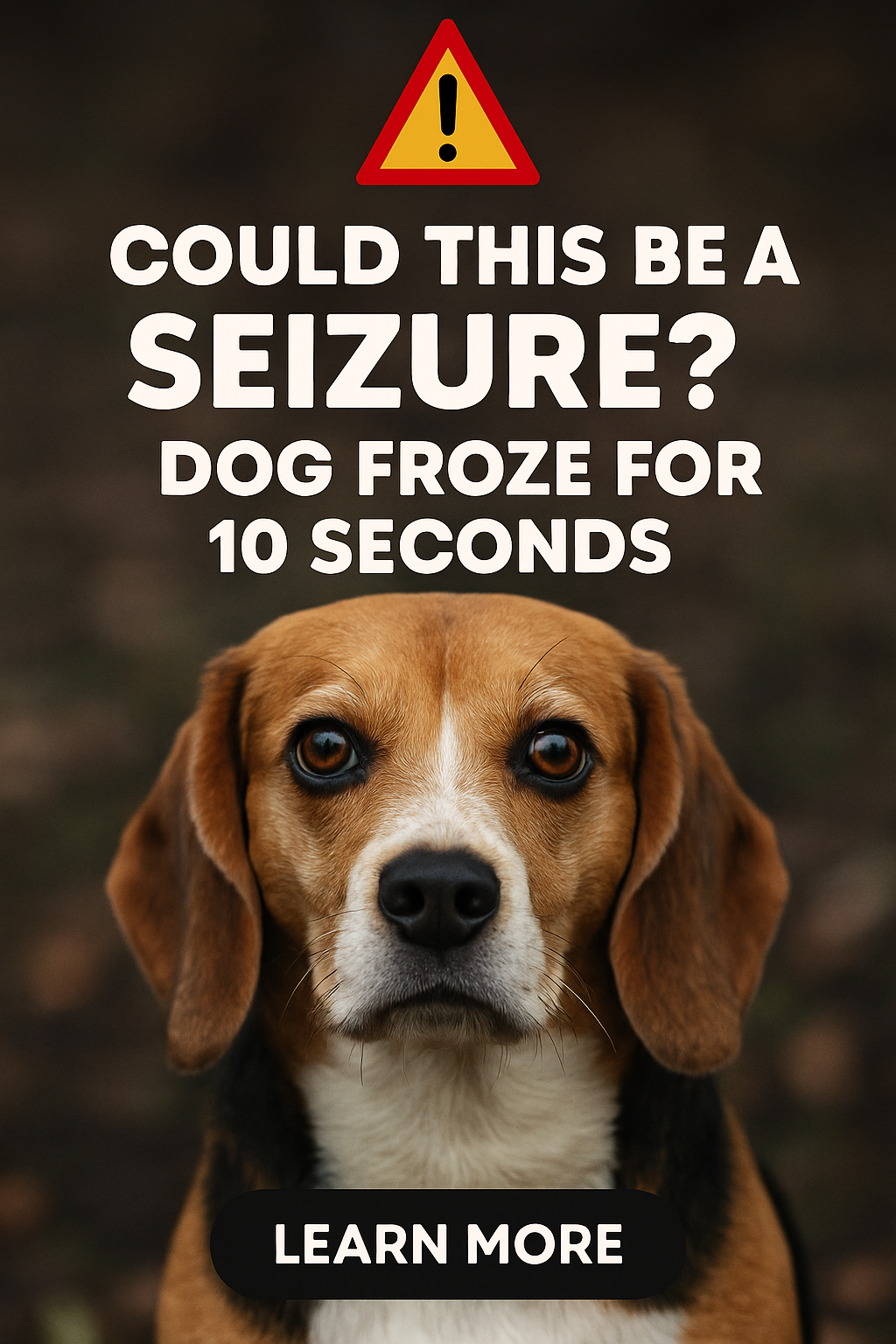
When your dog suddenly freezes, stares blankly, or becomes totally unresponsive for 5–10 seconds, it is one of the most unsettling behaviors a pet owner can witness. It is extremely easy to dismiss it as “zoning out,” but veterinarians warn that this can be an early neurological red flag — often the first sign of hidden health problems that are treatable if caught early.
This deep-dive article explains:
✔ What actually happens in your dog’s brain during a freeze episode
✔ The 6 most common medical causes
✔ How to tell a harmless “daydream” from a seizure
✔ What to do immediately during an episode
✔ When it’s an emergency
✔ Realistic examples + illustration descriptions
📸 Illustration Concept #1 — “The Freeze Moment”
Dog sitting or standing still, eyes open but glassy, head slightly tilted or neutral, body stiff. Slight vignette to draw focus to the dog’s face.
⭐ What Is a “Freeze Episode”?
A freeze episode is a brief event where your dog:
-
Stops moving completely
-
Stares ahead without reacting
-
Does not respond to their name
-
Appears conscious but “disconnected”
-
Sometimes has subtle twitching of eyelids, lips, or whiskers
Most episodes last 5–12 seconds — short, silent, and easy to miss.
To the untrained eye, it looks like nothing.
To veterinarians, it may indicate early neurological dysfunction, seizure activity, oxygen issues, or pain reflexes.
⭐ 6 MOST LIKELY CAUSES OF 10-SECOND FREEZING
1️⃣ Focal (Partial) Seizures — The #1 Overlooked Cause
Unlike dramatic full-body seizures, focal seizures affect a tiny region of the brain — but they can be just as serious.
What it looks like:
-
Dog freezes mid-step
-
Blank stare
-
Slow blinking or eyelid twitch
-
One corner of lip trembling
-
Mild head bob
-
Episode lasts seconds, not minutes
-
Dog resumes normal activity as if nothing happened
Why it matters:
Focal seizures often precede generalized epilepsy.
The earlier they are recognized, the better the prognosis.
Common in:
Border Collies, Beagles, Labs, Australian Shepherds, mixed breeds.
📸 Illustration Concept #2 — EEG-like glow effect showing seizure focus
Dog in foreground freezing; subtle overlay of brain highlighting a small activated region.
2️⃣ Syncope (“Mini Fainting”) — A Cardiac Emergency
Syncope is caused by temporary lack of blood flow to the brain, often due to heart rhythm irregularities.
Key signs:
-
Freeze → wobble → recover
-
Gums may briefly turn pale
-
Dog may collapse for a moment
-
Often triggered by excitement or exercise
Why it’s dangerous:
Untreated heart conditions can lead to sudden cardiac arrest.
High-risk breeds:
Boxer, Doberman, Cavalier King Charles Spaniel, older medium/large dogs.
📸 Illustration Concept #3 — Dog fainting moment
Dog on the ground with owner kneeling beside it, monitoring breathing, indoor clinic lighting.
3️⃣ Pain-Induced “Shock Freeze” (Neurospinal Pain Reaction)
A sharp bolt of pain from:
-
Intervertebral disc disease
-
Pinched nerve
-
Spinal inflammation
-
Neck or back injury
…can cause a dog to halt mid-motion and freeze.
How to recognize:
-
Dog suddenly stops and stiffens
-
Arches or lowers back
-
Avoids turning head
-
Cries out if touched
Many owners mistake this for “stubbornness” or “spacing out.”
📸 Illustration Concept #4 — Dog frozen mid-step
Dog’s back slightly arched, stiff posture, owner reaching gently toward it.
4️⃣ Cognitive Dysfunction Syndrome (Dog Dementia)
For senior dogs (8+ years old), brief freeze episodes can be early cognitive decline.
Signs include:
-
Staring into corners
-
Getting “stuck” in small spaces
-
Wandering
-
Night pacing
-
Forgetting commands or routines
Why it happens:
Brain aging leads to reduced neuron communication — similar to Alzheimer’s in humans.
📸 Illustration Concept #5 — Senior dog confused, facing corner
Soft warm lighting, highlighting age-related features like grey muzzle.
5️⃣ Sensory Overload or Anxiety-Triggered Freeze
If the nervous system is overwhelmed, dogs may enter a brief freeze response (just like humans experiencing panic).
Triggered by:
-
Loud noises
-
Sudden movement
-
Being startled
-
Conflict with another pet
Typically resolves quickly with no after-effects.
6️⃣ Normal Behavior (Rare, but Possible)
Some dogs simply “zone out” momentarily when deeply focused on sound or scent.
However:
➡ Normal zoning out = the dog can snap out of it immediately
➡ Seizure freezing = no response to name, touch, or sound
If you have to tap or call repeatedly, it’s NOT normal zoning out.
————————————————————-
⚠️ HOW TO KNOW IF IT WAS A SEIZURE
| Behavior | Normal Freeze | Possible Seizure |
|---|---|---|
| Responds to voice | Yes | No |
| Duration | 1–3 sec | 5–20 sec |
| Lip/eye twitch | No | Yes |
| Post-episode confusion | No | Sometimes |
| Happens more than once a week | Rare | Common |
If your dog doesn’t react when you clap, call, or touch…
👉 Assume seizure until proven otherwise.
⭐ WHAT TO DO DURING A FREEZE EPISODE
✔ Stay calm
✔ Record the episode with your phone (vets rely heavily on video)
✔ Note the time, duration, triggers
✔ Keep your dog away from stairs/sharp furniture
✔ Speak softly but do NOT restrain them
❌ Don’t shake your dog
❌ Don’t force them to move
❌ Don’t put hands near the mouth
⭐ WHEN IT’S AN EMERGENCY
Seek veterinary care immediately if:
⚠️ Episodes happen daily or weekly
⚠️ Your dog collapses afterward
⚠️ There is drooling, paddling, or urination
⚠️ Your dog is under 1 year (congenital issues)
⚠️ Your dog is over 8 years (brain tumor risk increases)
⚠️ The freeze lasts over 30 seconds
⭐ TREATMENT DEPENDS ON THE CAUSE
If the cause is epilepsy → Anti-seizure medication
If the cause is heart problem → ECG + cardiac meds
If pain/spine issue → X-ray, MRI, anti-inflammatory treatment
If cognitive dysfunction → supplements + brain support diet
If stress/fear → behavior therapy + calming aids
The good news?
👉 Most causes are treatable when identified early.
📸 Illustration Concept #6 — Vet consultation
Dog sitting on exam table, vet reviewing video on owner’s phone, warm clinic lighting.
⭐ 6 Facebook Status Options (Longer, more emotional)
1️⃣ “My dog froze for 10 seconds and didn’t respond to me… I thought it was nothing until I learned what it can mean.”
2️⃣ “Seizures don’t always look dramatic. Sometimes they look like a quiet freeze. This shocked me.”
3️⃣ “If your dog suddenly stops, stares, and disconnects… please read this. It could save their life.”
4️⃣ “My vet said this was a hidden sign of early neurological trouble. I had no idea.”
5️⃣ “Does your dog stare into space or freeze? It might not be ‘daydreaming.’ I wish I knew sooner.”
6️⃣ “A 10-second moment can reveal a serious health issue. Don’t ignore these signs.”
⭐ If you want, I can now create:
✅ Story Image
✅ Red alert version
✅ Dramatic version
✅ Minimal version
✅ With Learn More button
Just say: “Tạo story cảnh báo” or send the exact picture you want modified.