
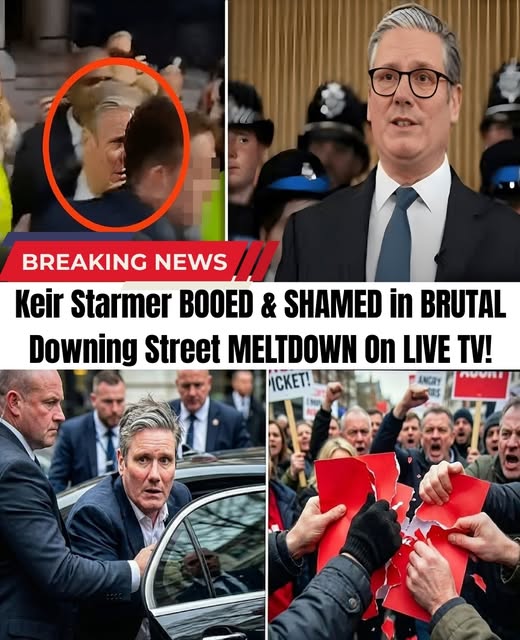
Keir Starmer faced a brutal public backlash outside Downing Street, where he was met with a chorus of boos and accusations from a furious crowd. The scene unfolded live on television, capturing a moment that starkly illustrated his declining authority and the growing discontent among his supporters.

As Starmer approached the iconic black door, he exuded an air of confidence, seemingly unaware of the storm brewing just outside. The atmosphere shifted dramatically as the crowd’s anger surged, transforming a routine day into a chaotic spectacle. Chants of “Get back!” echoed through Whitehall, drowning out the usual political banter and revealing a raw, palpable fury directed squarely at the Labour leader.
What began as a small protest quickly escalated, with the crowd swelling to hundreds, brandishing signs and shouting accusations that pierced through the political veneer. Longtime Labour supporters, once loyal to Starmer, now expressed their disillusionment, branding him a “traitor” and a “master of gradual betrayal.” The palpable betrayal resonated deeply; these were individuals who had once championed his leadership.
Inside the building, aides exchanged worried glances as the noise outside intensified. Starmer’s carefully crafted statements were rendered irrelevant by the public’s roaring discontent. His team, 𝒄𝒂𝓊𝓰𝒉𝓉 in a dilemma, opted for a swift exit rather than engagement, a decision that only amplified the optics of a leader under siege.
As he stepped into his car, the crowd’s hostility reached a fever pitch. A woman held up her Labour membership card and tore it in half, a striking symbol of the shattered loyalty that had once defined the party’s base. The footage went 𝓿𝒾𝓇𝒶𝓁, encapsulating the day’s devastating impact on Starmer’s image and leadership.
Once inside the Commons, the atmosphere was electric with anticipation. News of the Downing Street debacle had spread like wildfire, and MPs were eager to capitalize on Starmer’s vulnerability. The opposition wasted no time in launching a barrage of questions, each one aimed at reminding the chamber of the chaos that had unfolded just hours earlier.
Starmer’s responses felt rehearsed and defensive, failing to resonate against the backdrop of the crowd’s fury. The session morphed from a debate on policy to a character assassination, with MPs dissecting his credibility and leadership. The weight of the earlier protests hung heavy in the air, reinforcing the sentiment that he was losing grip on his role.
By the end of the day, the narrative had shifted dramatically. Social media buzzed with clips of the protests and parliamentary exchanges, painting a grim picture for Starmer. This was not just a bad news cycle; it was the beginning of a potential political unraveling that could redefine his leadership.
As protests erupted across major cities in the following days, it became clear that the discontent was far from isolated. Former supporters gathered in Manchester, Birmingham, and Newcastle, echoing the same grievances that had been voiced outside Downing Street. The images of disillusioned Labour members resonated, marking a pivotal moment in British politics.
May you like


The question loomed large: could Starmer survive this unprecedented backlash? The media frenzy and public sentiment suggested a storm was brewing, one that would test the very foundations of his leadership and the Labour Party itself. As the dust settled, one thing was certain: this was a defining moment that could reshape the political landscape in the UK.
Absolute car crash on the BBC! Women’s Minister Bridget Phillipson froze when asked to define “a woman” amid the fight for single-sex toilets and changing rooms. She refused to commit to the Supreme Court’s biological sex ruling!