
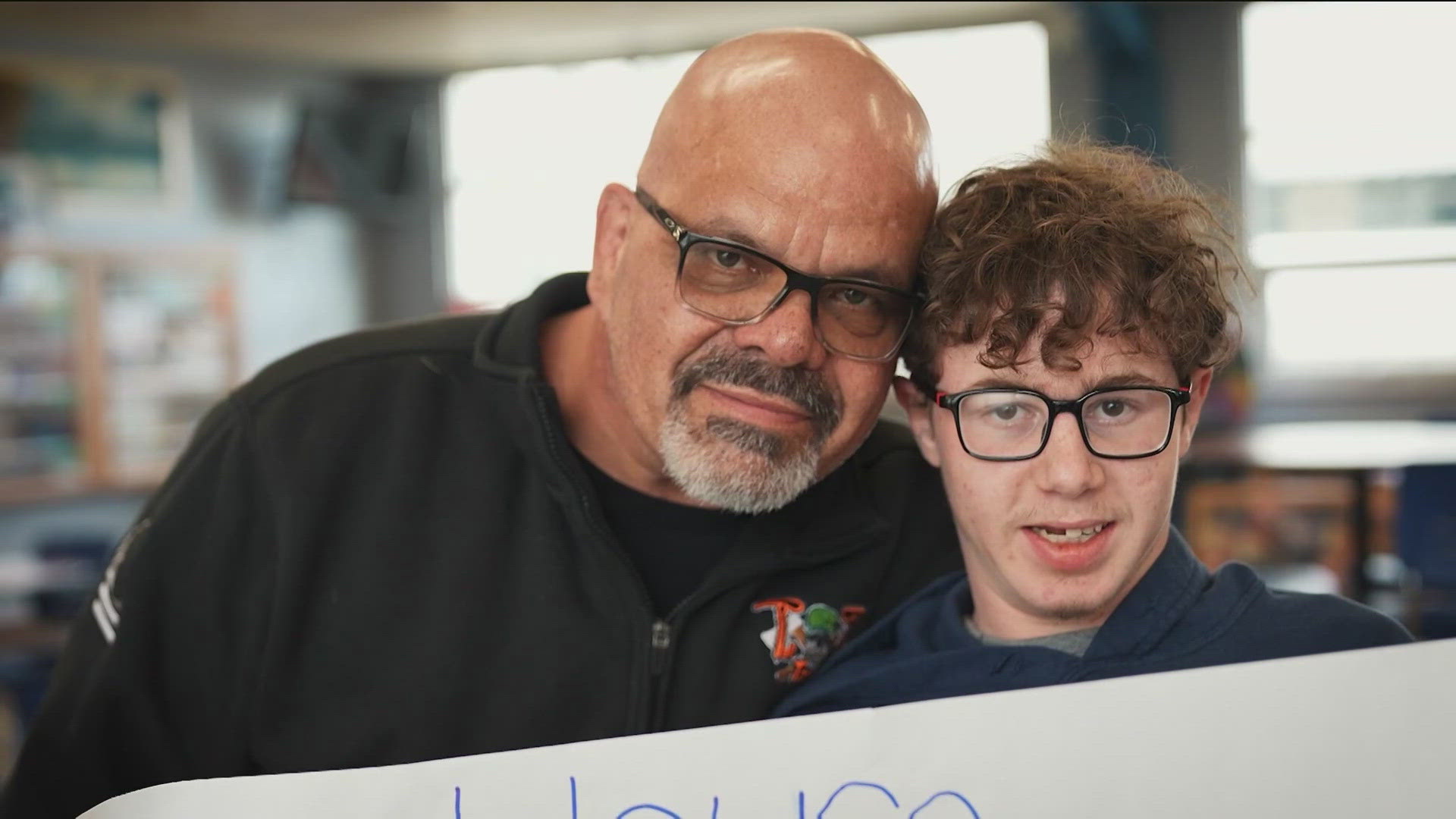
Alex Hunden spent weeks with almost no schooling. His family fought back, and now they’re taking it to federal court.
NAMPA, Idaho — David Hunden describes his 17-year-old son Alex as an upbeat kid who loves basketball, drawing, and can recreate their entire neighborhood from memory alone.
Alex is also nonverbal, autistic, has ADHD, Tourette’s syndrome, and is a Type One diabetic. He lives at Southwest Idaho Treatment Center (SWITC), a state-run stabilization facility for people with severe behavioral needs. Between hospital stays and treatment facilities, he’s been away from home for nearly three years.
When Alex was enrolled in the Nampa School District ahead of the 2024 school year, David expected his son to go to school. Instead, less than a week before classes started, the district told him Alex would receive “homebound” instruction, meaning teachers would come to SWITC rather than Alex attending school in person.
“I didn’t even know what homebound was until I got that phone call,” David said. “My son has always been in school.”
The decision, David says, was made without his input and without an IEP meeting.
What is an IEP?
Under the Individuals with Disabilities Education Act (IDEA), every child with a disability is entitled to a free and appropriate public education (FAPE) in the least restrictive environment, meaning educated alongside non-disabled peers to the maximum extent appropriate. Parents are guaranteed a seat at the table in the decision-making process through an Individualized Education Plan, or IEP.
Records provided to 7Investigates show the district didn’t hold an IEP meeting with the Hundens until weeks into the school year.
At their third IEP meeting – which David recorded – district leaders revealed they had based Alex’s placement on where he lived, not on his individual abilities.
“He lives in a residential facility,” a district representative said during the meeting when asked why Alex was placed in homebound instruction. When pushed back on whether that meets the legal standard for least restrictive environment, the representative replied: “It actually does in our district.”
A district representative said at the IEP meeting: “We have some scenarios that we definitely have to make sure we’re protecting that student and others for safety.”
No education for weeks
Alex’s attorney told 7 Investigates he received no education during the first five weeks of school. After that, he got just one to two hours a day: first at SWITC, then at Gateways Alternative School in Nampa.
Alex’s attorney, Kristian Beckett, says that falls far short of what federal law requires.
“They wanted him to prove his way in to be able to have an education and that’s just not how it’s supposed to work,” Beckett said. “No child should have to earn their right to an education.”
Beckett argues the isolation was especially harmful for Alex, who is nonverbal.
“Watching how other people communicate is essential for his ability to learn through modeling,” he said. “That’s one thing Alex really needed, social interaction.”
What Nampa School District says
The Nampa School District says federal privacy law prevents it from discussing the details of Alex’s case. But the district did defend its overall approach, saying in a statement: “Decisions are made based on each student’s unique needs with the goal of providing a free appropriate public education in the least restrictive environment.”
According to documents and audio provided to 7Investigates by the Hundens and Beckett, the district also pointed to Alex’s documented history of aggression and running from school, drawing on records from previous placements in Kuna and Eastern Idaho as justification for its gradual approach to increasing his time in a classroom setting.
Two independent hearing officers ultimately agreed with the Nampa School District. In both due process hearings, officers found that Alex’s history of violent behavior made a part-time, structured placement appropriate, and that the district’s gradual approach to increasing school time was legally compliant. One hearing officer noted the district was “open minded” in its placement considerations.
Two hearings, two losses — then federal court
Despite those rulings, the Hundens aren’t done fighting. They’ve appealed both decisions and filed two federal lawsuits against the Nampa School District – one in August 2025 and another in January – arguing the damage to Alex’s education can’t simply be undone, and that he’s owed additional schooling to make up for what he lost.
Today, Alex attends Gateways full time. His father and attorney believe that only happened because of legal pressure.
“He’s actually thriving in the environment he’s in right now,” David said. “And this could have all been handled very easily from the very beginning.”
A pattern beyond Nampa?
Beckett says his special education caseload has surged statewide, from one case in 2023 to seven in 2025. He blames the Idaho State Department of Education, in part, for not enforcing the IDEA or holding districts accountable.
The department pushed back on that characterization. A spokesperson told KTVB that special education placement decisions are made at the local level through collaboration between schools and families, and that the department’s role is to support that process, not to intervene in individual placements. The spokesperson added: “We take that responsibility seriously.”
Additionally, the State Department of Education was initially named as a party in the Hundens’ lawsuits, but a judge agreed to dismiss the agency from the case.
David believes the problem is widespread and the state needs to do more.
“The more that we went to these due process hearings, the more testimony, the more evidence that was put on the record — you see this pattern,” he said. “And this pattern exists. I don’t believe it’s just one school district.”
The funding gap
Idaho’s own Superintendent of Public Instruction, Debbie Critchfield, has estimated the gap between special education needs and available state resources at roughly $100 million.
The Idaho Legislature recently passed a bill creating a special education fund for high-needs students, but it doesn’t include new money. It redirects $5 million already within the Department of Education’s existing budget.
David says budget pressures have real consequences for kids like Alex.
“When I hear we’re gonna cut this and cut that — the only people you’re hurting are these kids and the people on the front lines,” he said. “The teachers, the people that have to deal with these situations every day. How do you expect them to do that if they don’t have the resources or the funding?”